Insult with wit
The lost art of political invective
DYSPEPSIANA | James Krohe Jr.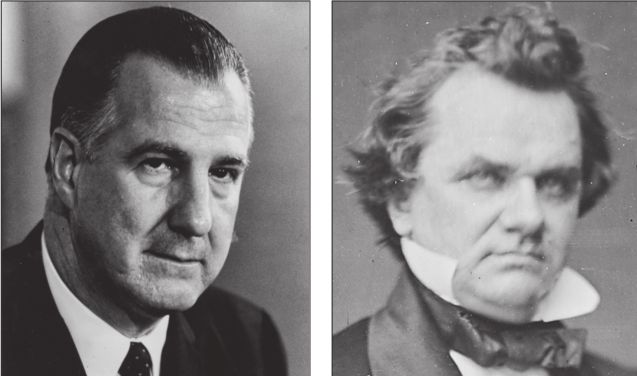
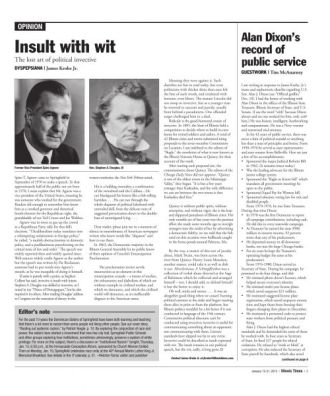
Spiro T. Agnew came to Springfield in September of 1970 to make a speech. To that approximately half of the public not yet born in 1970, I must explain that Mr. Agnew was a vice president of the United States, meaning he was someone who worked for the government. Readers old enough to remember him know him as a crooked governor and rhetorical bomb-thrower for the Republican right, the granddaddy of our Ted Cruzes and Joe Walshes.
Agnew was in town to gee up the crowd at a Republican Party rally for that fall’s elections. “Ultraliberalism today translates into a whimpering isolationism in foreign policy,” he railed, “a mulish obstructionism in domestic policy, and a pusillanimous pussyfooting on the critical issue of law and order.” The speech was widely reported then and widely quoted since. Web sources widely credit Agnew as the author but the speech was written by Pat Buchanan; someone had to put words into Agnew’s mouth, as he was incapable of doing it himself.
If satire is parody with a point, as Stephen Colbert has said, invective is insult with intent. Stephen A. Douglas was skilled in invective, as I noted in my “Prince of Demagogues,” but he also inspired it in others. After reading Douglas’ address to Congress on the extension of slavery in the western territories, the New York Tribune noted, His is a bulldog mentality, a combination of the swineherd and the Caliban....He can blackguard his betters like a fish-selling harridan. . . . He can run through the whole dispason of political falsehood with unrivaled skill, from the delicate note of suggested prevarication down to the doublebass of unmitigated lying. . . .
Dear reader, please join me in a moment of silence in remembrance of American newspaper writers who knew words like “dispason” and how to use them.
In 1863, the Democratic majority in the Illinois General Assembly let its public know of their opinion of Lincoln’s Emancipation Proclamation.
The proclamation invites servile insurrection as an element in this emancipation crusade – a means of warfare, the inhumanity and diabolism of which are without example in civilized warfare, and which we denounce, and which the civilized world will denounce, as an ineffaceable disgrace to the American name.
Meaning they were against
it. Such diatribes are fun to read today, but even politicians with
thicker skins than ours felt the bite of such words, and retaliated with
lawsuits, even blows. The mature Lincoln did not stoop to invective,
but as a younger man he resorted to sarcasm and parody, usually from
behind a pseudonym. One offended target challenged him to a duel.
Ridicule
is the good-humored cousin of invective. In 1885, the State of Illinois
held a competition to decide where to build its new home for retired
soldiers and sailors. A total of 42 Illinois cities and towns submitted
siting proposals to the seven-member Commission on Location. I am
indebted to the editors of “Bugle,” the newsletter of what is now known
as the Illinois Veterans Home at Quincy, for their account of the
result.
After touring each proposed site, the commissioners chose Quincy. The editors of the Chicago Daily News did
not approve. “Quincy is one of the oldest towns in the Mississippi
Valley,” they began. “It is but a few years younger than Kaskaskia, and
the only difference we can see between the two towns is that Kaskaskia
died first.”
Quincy is
without public spirit, without enterprise, and without vigor; she is
the lean and slippered pantaloon of Illinois cities. Her only notable
act of late years was the partisan effort she made some months ago to
inveigle strangers into the midst of her by advertising a democratic
fishfry; we are told that the fish used on this occasion were bullheads
caught in the horse-ponds around Palmyra, Mo.
By
the way, a master of this sort of jocular abuse, Mark Twain, was born
across the river from Quincy. Henry Louis Mencken, another master, could
take it as well as dish it out. Menckeniana: A Schimpfl exikon was
a collection of verbal abuse directed at the Sage of Baltimore which he
collected and arranged himself – not, I should add, to defend himself
it but the better to enjoy it.
Oh
well, sticks and stones. . . . It was an altogether good thing when we
ceased burning political enemies at the stake and began roasting them
alive in print or from the platform, but Illinois politics wouldn’t be a
bit better if it was conducted in language of the 19th century.
Constructive political discourse can’t be conducted using invective;
invective is useful for communicating something about an opponent, not
communicating with them. Literary standards have slipped too far in any
event. Invective could be described as insult expressed with wit. The
insult remains in our political speech, but the wit, sadly, is long
gone.
Contact James Krohe Jr. at [email protected].
Editor’s note
For
the past 10 years the Dominican Sisters of Springfi eld have been both
learning and teaching that there’s a lot more to racism than some people
not liking other people. See our cover story, “Rooting out systemic
racism,” by Patrick Yeagle, p. 10. By exploring the conjunction of race
and power, the sisters have started a movement that now has city hall,
Springfi eld Public Schools and other groups exploring how institutions,
sometimes unknowingly, preserve a system of white privilege. For more
on this subject, there’s a discussion on “Institutional Racism” tonight,
Thursday, Jan. 15, 6:30 p.m., at the Immaculate Conception Atrium,
sponsored by Church Women United. Then on Monday, Jan. 19, Springfi eld
celebrates race unity at the 40 th Annual Martin Luther King Jr.
Memorial Breakfast. See details in the IT calendar, p. 21. –Fletcher
Farrar, editor and publisher