Christmas yeast breads
FOOD | Julianne Glatz
Variations can be found worldwide, although they’re most common in Europe. And it’s a safe bet that the roots of those found in other parts of the planet are from there, too.
Holiday yeast breads. America focuses on cookies, but elsewhere the most traditional holiday sweet treats are yeast-based. Perhaps best known in this country is Germany’s stollen, a dense, dried, candied fruit-andnut confection that originated in Dresden.
Stollen’s fruit and nut components are common threads in many Christmas or other seasonal celebratory yeast breads, dating back to times when such things were luxuries reserved for special occasions.
Other precious and costly ingredients are features of other holiday yeast breads. In Scandinavia, cardamom is common. Complex, with faintly medicinal overtones, it is native to India, Pakistan and Nepal.
Cardamom is reputed to be the world’s second most expensive spice. The undisputed king of costly spices is saffron, the dried stigmas of a variety of crocus that must be harvested by hand. With only three of the precious threads per flower (the female stamens are discarded), it takes an acre of land and hundreds of thousands of flowers to produce a pound of saffron, which retails for well over a thousand dollars, and, depending on its quality, often much more. The good news is that saffron’s flavor and orange-gold color is intense; most recipes call for just a pinch. Both Sweden and the U.K. have traditional Christmas breads and buns made with saffron.
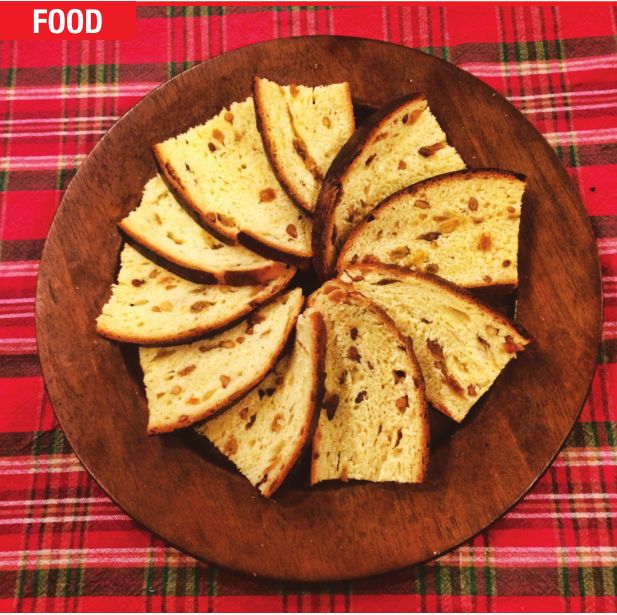
I’ve made several holiday yeast breads and sampled more but my favorite remains Italian panettone which hails from Milan. It’s not because it lacks those costly spices, although the most traditional versions include fairly pricey pine nuts. It’s just slightly sweet and its light texture reminds me of challah, the classic Jewish egg bread.
I’ve been making the panettone recipe below for decades, both to give as gifts and for our family. While it’s delicious fresh from the oven and still slightly warm it has more uses when completely cooled and even slightly stale: sliced thin and toasted to accompany a cheese tray, to make phenomenally delectable French toast or for salad croutons. And, not least, the Christmas morning strata below. Stratas are always a good idea, but particularly for morning celebrations, since almost all the work can be done the day before.
Italian panettone
• 1 T. plus 1 c. sugar, divided
• 1 package active dry yeast, not fast-acting
• 1/4 c. medium hot (105 F – 110 F) tap water
• 2 c. milk, plus 1 T. at room temperature
• 6 c. all-purpose flour, plus additional for kneading
• 3 T. room temperature butter
• 2 T. extra-virgin olive oil, plus additional for oiling the bowl
• 2 large eggs, beaten
• 1 tsp. salt
• 1 c. golden raisins
• 1 c. pine nuts or broken walnuts, lightly toasted
• 1 1/2 tsp. anise seed, lightly crushed with a mallet or flat of a knife OR
• 1 tsp. freshly grated nutmeg
• Up to 2 T. finely grated lemon or orange peel, optional
• Confectioner’s sugar, optional In a small bowl, mix together the
tablespoon of sugar and package of yeast, then stir in the water. Let
stand for 10 minutes or until the yeast has proofed. (Become foamy and
bubbling, “proof” that it’s active.) If it doesn’t proof, discard and
begin again with active yeast, checking to make sure your water is hot
enough to activate the yeast but not hot enough to kill it.
In a large bowl, cream together the butter, olive oil and 1 cup sugar.
Combine a tablespoon of the beaten eggs and tablespoon of the milk in a small bowl and set aside.
Add
the remaining beaten egg, milk, yeast mixture and salt to the mixing
bowl, then add the flour in spoonfuls until everything is combined.
Knead until a smooth dough forms.
Pour
a couple tablespoons of olive oil down the bowl’s side, then, pulling
the dough into a ball, use the dough ball to coat the sides and bottom
of the bowl with the oil, then flip the dough ball oiled-side up.
Cover
the bowl with a barely damp cloth or plastic wrap, place in a warm spot
and let rise until doubled in bulk, about 1–1 1/2 hours.
Mix together the raisins, nuts and anise seeds or nutmeg.
Punch
down the dough, then, on a wellfloured surface, turn the dough out and
flatten with your hands to approximately one-half inch thickness.
Sprinkle
the surface with the raisin/nut mixture, then roll up and knead, adding
more flour as necessary to keep from sticking to your hands or work
surface until everything is well-distributed.
Divide
the dough into halves. At this point it can be put into oiled 9-inch
bread pans or (my preference) shaped into two boules (rounds)
approximately 8-inches in diameter.
If
making boules, place on an oiled baking sheet. Either way, cover with
plastic wrap that’s been lightly oiled or coated with cooking spray and
again let rise until doubled in bulk, 45 minutes to 1 hour.
While the loaves are rising, preheat the oven to 375 F.
Brush
the breads with the reserved egg and milk mixture, then bake for about
45 minutes to an hour or until the loaves are dark golden brown on top
and they sound hollow when tapped.
Cool before slicing. Dust with confectioner’s sugar if desired.
Cherry
almond panettone Substitute dried cherries for the raisins and lightly
toasted slivered almonds for the nuts. Add 1/2 teaspoon almond extract
in place of the anise seed and use only 1/2 teaspoon freshly ground
nutmeg.
Chocolate cherry panettone Not traditional, but definitely delicious.
Substitute
dark chocolate chips for the almonds or use 2/3 cup each chocolate
chips, dried cherries and lightly toasted slivered almonds. Substitute
1/2 teaspoon almond extract for the anise seed and eliminate the nutmeg.
Christmas panettone strata
• 2 T. unsalted butter
• 1 lb. ham or turkey or 1 lb. mushrooms, sliced or cut into bite-sized pieces and sautéed in butter
•
1 1/2 c. Italian fontina cheese, cut into small cubes (this is easiest
to do if chilled) or grated Gruyère-type Swiss cheese, divided
• 3/4 c. chopped parsley, preferably flatleaf, divided
• 6 large eggs
• 2 c. half-and-half
• 1 tsp. freshly ground black pepper, or more or less to taste
• 1 tsp. salt or more or less to taste
• 1 T. finely chopped fresh rosemary or fresh marjoram, optional
• 1/2 cup freshly grated Parmeggiano Reggiano or Parmesan-type cheese
•
4 c. slightly stale panettone, cut into small cubes Butter a
9-by-13-inch or similarly-sized baking dish with the 2 tablespoons of
butter, cover and set aside.
Cut
the ham or turkey into bite-sized pieces. In separate containers,
refrigerate them or the sautéed mushrooms, half of the cubed Fontina and
the parsley.
In a
large bowl, beat the eggs until they are completely combined, then stir
in the halfand-half. Add the pepper, salt, fresh herbs (if using) and
remaining half of the parsley.
Stir in the bread cubes. Combine thoroughly, then cover tightly and refrigerate for at least 4 hours and preferably overnight.
The next morning, remove all the refrigerated components and let stand for about an hour to come to room temperature.
Preheat
the oven to 350 F. Stir the meat or mushrooms, cubed Fontina and half
the parsley into the custard/ bread mixture. Pour into the baking dish
and sprinkle evenly with the Parmesan and remaining fontina cheese.
Bake
for one hour, or until the top is golden brown and a knife inserted
into the strata comes out clean. If the top begins to get too brown,
cover the dish until the strata is done. Let stand for at least 15
minutes for easier serving.
Immediately before serving, sprinkle the reserved parsley evenly over the top.
Serves six to eight.
Contact Julianne Glatz at [email protected].


