Why did the pedestrian not cross the road?
New approaches promise safer streets for walkers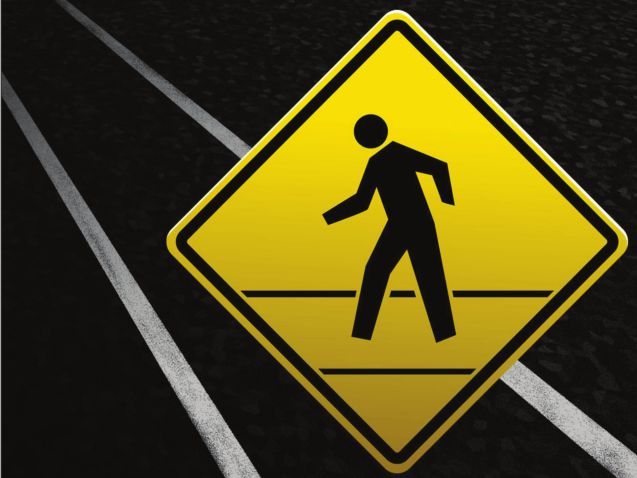
DYSPEPSIANA | James Krohe Jr.
Most unexpected turns to
the right put someone in jeopardy – the Republicans’ insistence on
spending cuts for federal health research is but one example – and that
is as true on the streets as in Congress. Merchants and property owners
in downtown Springfield have been fretting out loud about automobile
drivers – most of whom are speeding through the center of Old
Springfield to get somewhere else – who have become a menace to
pedestrians. This has not been a problem for many years, there being no
one on the streets to hit, but these days rubbernecking tourists and
state workers confused by finding Korean tacos on a lunch menu are not
always going to look twice for cars whose drivers don’t bother to look
even once.
Springfield
is hardly alone in suffering this problem; most pedestrian injuries and
deaths in America occur when the walker is in a crosswalk. Perhaps
you’ve heard that Illinois law now requires that drivers stop whenever a
pedestrian enters a marked crossroad, even in midblock and even if no
sign to that effect is visible. Most Illinoisans don’t, or drive like
they don’t. Some localities have installed signs in the right-of-way
that suggest in the nicest way possible that drivers must stop but they
get hit more often than pedestrians. The Tribune’s John
Hilkevitch recently reported that some 268 of the 344 signs the City of
Chicago installed have had to be replaced. No doubt some fell to
accidents but many, maybe most, were picked off by aggrieved drivers
resentful at having to share their sacred space with pedestrians.
More
signs probably won’t help. As I noted in one of my previous screeds,
the conventionally engineered street forces drivers to pay attention to
the wrong things. Instead of watching and taking account of other road
users (including pedestrians and cyclists) drivers are watching for (and
being distracted by) flashing lights, pavement markings and signs.
Reading a sign warning of children at play, perversely, makes running
into a child more likely.
There are better ways to do things, and several of them were discussed recently over at The Atlantic’s CityLab
website, where Sarah Goodyear interviewed Matts-Åke Belin, traffic
safety strategist with the Swedish Transport Administration. Belin
recounted how Swedish road safety activists had long assumed that making
people safer drivers meant making them better people. Belin advocates a
different approach: Accept that people make mistakes behind the wheel
(like talking on their phones) and create a traffic system for the
fallible drivers instead of trying to adjust the humans to the system.
A good example is the right-on-red law.
It
was adopted to expedite traffic flow, and is universally popular for
having allowed Illinoisans to add whole minutes to their productive day.
But Belin states – without quite saying so in so many words – that any
country that allows the driver to make a turn at the same time a green
light is given to a pedestrian entering the same space is nuts.
Here’s
another example. A traffic system dedicated to making cars move faster
makes it more dangerous. That’s physics talking, not me. If you get hit
by a car going 30 miles per hour, your risk of dying is four chances in
five. If you want a traffic system that leaves fewer people on foot
killed or maimed by cars,
you make drivers go slower – way slower. If you get hit by a car going
19 miles per hour, you have a nine in ten chance of living. That lower
speed, by the way, is the default speed for residential streets and
shopping districts in Sweden, whose pedestrian fatality rate is a little
more than a quarter that in this country.
New
York’s new mayor recently announced that his administration plans to
start treating traffic fatalities as a public health problem and ordered
city government agencies to figure out how to reduce those deaths to
zero. In Chicago, the goal of the city transportation department’s new
“action agenda” is to “eliminate traffic crash fatalities of all kinds
within 10 years using approaches pioneered by the Swedes, among others.
Yeah,
I know – Sweden is Sweden, and the U.S. is the U.S., and it will be a
hot day in Kiruna before Americans start driving like Swedes. A
disbelieving reader from the southwest suburbs responded to the
Hilkevitch report by sneering, “We could very well have a full
generation expecting to just step into one of these areas and traffic
will miraculously come to a halt just for them.” It’s already happened. I
lived 12 years on the West Coast, which is still part of the U.S. until
the Republicans elect a president, and there traffic does miraculously
come to a halt just for pedestrians. The California version of the
crosswalk law was adopted back in 2001, and even Americans learn. The
American Podiatric Medical Association ranked San Francisco as the
safest U.S. city for pedestrians – and would podiatrists ever lie?
Contact James Krohe Jr. at [email protected].
Editor’s note
It
seems downtown Springfi eld has been discovered by billionaires, and
that’s a good thing. Bruce Rauner, who says he’ll fi x up the governor’s
mansion and move in, was spotted relaxing at the Brewhaus Tuesday
afternoon. That’s about the time we broke the news that Dubai
billionaire Khalaf Ahmad Al Habtoor is buying the President Abraham
Lincoln Hotel (see p. 8). Ald. Cory Jobe, who heads the committee
looking for a developer for the YWCA block across the street from the
mansion, wants to make sure the newcomers know downtown offers other
investment opportunities as well. –Fletcher Farrar, editor and publisher
Cover photo by Dan Williams, Treetop Productions, Inc