Panhandlers appeal lawsuit setback
COURT | Patrick Yeagle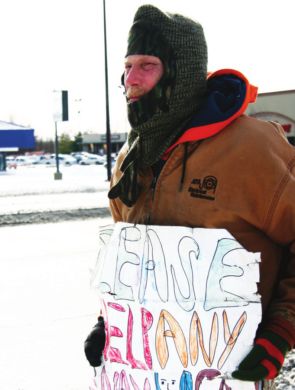
Two well-known panhandlers in Springfield are appealing an initial defeat in their lawsuit against the city. Even if they lose the appeal, however, they’ll likely have another chance to make their case.
The panhandlers seek to have the City of Springfield’s ban on panhandling downtown struck down as a violation of the First Amendment right to free speech. The case hinges on whether the ordinance unfairly targets panhandlers over other groups, and it could affect anti-panhandling laws in other cities nationwide.
Don Norton and Karen Otterson of Springfield filed their lawsuit in September 2013 on behalf of themselves and other panhandlers in the city. They claimed not only that the city’s panhandling ordinance is unconstitutional, but that the city harasses panhandlers even outside of downtown and willfully misinterprets a state law regarding sidewalk usage.
The ordinance prohibits “vocal appeals” for donations within the city’s downtown, though it does not prohibit the use of signs or performances to solicit donations if no vocal appeal is made.
Norton and Otterson asked Judge Richard Mills of the federal Seventh Circuit court in Springfield to approve a preliminary injunction barring the city from enforcing the panhandling ordinance during the legal proceedings of their lawsuit. Mills denied the injunction request in October 2013, reasoning that he didn’t have enough information to tell whether the city meant to specifically target panhandlers.
“Based on the current record, the court is unable to conclude the city adopted the regulation of speech because of disagreement with the message it conveys,” Mills wrote. “The ordinance does not prohibit vocal appeals for immediate donations
throughout most of Springfield, which would appear to cast doubt on the
assertion that it was adopted due to a disagreement with the type of
speech.”
Last week,
Mark Weinberg, a Chicago attorney representing Norton and Otterson,
filed an appeal with the Seventh Circuit Court of Appeals in Chicago,
asking the court to overturn Mills’ ruling and grant a preliminary
injunction or even rule the ordinance unconstitutional outright. He
argued in the appeal that the ordinance targets panhandlers, but even if
that wasn’t the intent, it still has the effect of discriminating
against panhandlers.
If
the appellate court rejects the panhandlers’ arguments, they will
likely still have a chance for a trial in the circuit court, because
Mills’ first opinion only ruled on whether to grant the preliminary
injunction. The next hearing in the case is expected to be sometime in
February in Chicago.
Matthew
Trapp, an attorney for the city, could not be reached for comment.
Former acting corporation counsel John Mehlick resigned in November, and
Springfield mayor Michael Houston has appointed attorney Todd Greenburg
to fill the role, but the city council only approved Greenburg on
Tuesday.
Michael
Stoop, director of community organizing for the Washington, D.C.-based
National Coalition for the Homeless, says his group plans to file a
brief in support of Norton and Otterson. Stoop notes that not all
homeless people are panhandlers, and not all panhandlers are homeless.
Norton and Otterson are currently not homeless, but they have been in
the past. Still, homelessness and panhandling are both common among
people living in poverty or very close to it.
“Anti-panhandling
laws are nothing new,” Stoop said. “Cities have been enacting such
ordinances for years, and their ultimate goal is to rid the downtown of
homeless individuals. It never solves the issue because the problem is
homelessness, not hordes of people panhandling. Communities spend too
much time dealing with the wrong issue.”
The National Law Center on Homelessness and Poverty also filed a brief yesterday arguing in favor of the panhandlers.
Stoop
says Norton and Otterson’s case may affect how other cities nationwide
write ordinances regarding panhandling. He notes that Springfield’s own
ordinance is modeled after ordinances in other cities.
“If
the homeless side wins, it prevents other cities from enacting or
enforcing similar ordinances,” he said. “Likewise, if the homeless
advocates lose and the city wins, it gives other cities the impression
that this is how Springfield solved their panhandling problem, so let’s
do what Springfield did.”
Contact Patrick Yeagle at [email protected].