
Planning a better Springfield
The Springfield-Sangamon County Regional Planning Commission maps the future
PLANNING | Patrick Yeagle
No little girl tells her parents she wants to be a zoning analyst when she grows up. The job is figuring out whether a local government should allow proposed changes to a piece of property, which sounds about as exciting as being a tollbooth operator. But for Molly Berns, a senior planner with the Springfield-Sangamon County Regional Planning Commission, zoning is fun because she’s influencing the future.
“My role is to look out for the best interests of the city and the county, and I take it very seriously,” Berns said.
Originally from Rochester, Berns spends much of her time examining historical records, poring over maps and sifting through legal documents to determine whether a particular zoning request follows the law and fits with the city or county’s long-term plans.
“I like driving by something that went through the zoning process, whether it’s a property owner’s new fence or a property owner whose case was denied, but in doing so cleaned up their property. I like knowing I’m a part of that. I find it very interesting and fascinating, and you never know what’s going to come up.”
Berns is one of about a dozen urban planners at the Springfield-Sangamon County Regional Planning Commission, the multi-jurisdictional agency responsible for drawing the vision of this community’s future. The planning commission turns scattered facts into meaningful research that city and county officials can use in making decisions. The commission is independent and nonpartisan, and its reputation for objectivity gives it influence on important issues in Sangamon County, such as wind energy, transportation, rail consolidation, environmental planning, subdivisions and more.
The Springfield-Sangamon County Regional Planning Commission, which goes by the mouthful of an acronym “SSCRPC,” started as two organizations. As the current name suggests, the predecessor agencies were two separate planning commissions belonging to the city and the county. The two groups began working together and sharing staff in the 1950s, and they officially merged in 1987 through a county ordinance. The commission is headquartered in Room 212 of the Sangamon County Building.
The 12-member staff of the commission is overseen by 23 commission members appointed from various jurisdictions, including the Springfield mayor and Sangamon County Board chair. The commission’s work is divided into four overlapping areas: development, transportation, land use and comprehensive and strategic planning, with one senior planner handling each area. They’re funded by the City of Springfield, Sangamon County, grants from the state and federal transportation departments, and contract work with municipalities like Curran, Sherman and Williamsville.
In addition to serving the City of Springfield and Sangamon County, the commission does work for 116 other jurisdictions within the county, including special taxing bodies like park districts. Despite serving so many entities, the commission is independent and nonpartisan, giving it the ability to offer its “product” – research – without allegiance to any particular body other than the public.
“We look at ourselves as a good consulting organization at prices that participating entities can afford,” said Norm Sims, the commission’s executive director. “We’re able to do for them things that they would have to pay hundreds of thousands of dollars for if they were hiring somebody out of Chicago.”
One example is the economic development plan the commission is currently creating for the Village of Leland Grove. The village presents a challenge because it’s landlocked and consists almost exclusively of residential areas, Sims says. Paying an economic development firm to do such a study would
likely be prohibitively expensive for a small village, but the
commission offers the same services for less.

Sims
was born in Kentucky and moved to Indiana before settling in Illinois,
much like a certain former U.S. president from Springfield.
“Besides
that and wearing a top hat in a parade, I don’t have much in common
with Abe Lincoln,” jokes Sims, a friendly guy with a penchant for
Corvettes and self-depreciating humor. He jokingly says, “I don’t do
anything here,” while giving credit to his staff for the well-regarded
research they produce.
Sims
went to college at Western Kentucky University for psychology and mass
communications, then got his master’s degree at the University of
Kentucky in organizational planning. He has worked in a variety of roles
throughout his life, most notably serving as former Gov. Jim Edgar’s
director of the Illinois Department of Commerce and Community Affairs
and as director of Planning and Economic Development for the City of
Springfield under former mayor Karen Hasara.
Sims
started at the planning commission six years ago and is currently
earning his doctorate at the University of Illinois Springfield. He
recently won the Rail-Splitter Public Service Award from the Central
Illinois Chapter of the American Society for Public Administration,
which honors “public servants whose careers exhibit the highest standard
of excellence, dedication and accomplishment.”
His
approach to planning is modeled after the belief of founding father
Thomas Jefferson that the public is best able to make its own decisions,
rather than the privileged elite, meaning that public input on projects
is crucial. Hearing him describe the commission’s work, it’s easy to
see how his undergraduate degree in psychology can come in handy in the
planning field: plans only work if people follow them.
“Often,
people in the planning world adopt innovations with all the enthusiasm
of a religious revival, but sometimes with the success of the Soviet
economy,” Sims said. “We’ve got to understand how people want to live
and how people use their environment, then build that into our
planning.”
The
“problem” of parking in downtown Springfield is an example of how plans
sometimes conflict with the public’s thought process. There are an
astonishing 29,000 parking spaces downtown in public and private lots,
according to a count by the commission, but downtown parking is a common
gripe among Springfield residents. Linda Wheeland, senior planner for
transportation, says it’s only a matter of perception.
“If
you go to the mall, you can always find a parking spot, because no
matter where you are in the parking lot, you can see the mall,” she
said. “If you’re downtown and can’t find a parking spot within view of
your destination, it feels like there’s no parking.”
“Often, people in the planning world adopt
innovations with all the enthusiasm of a religious revival, but
sometimes with the success of the Soviet economy.”
-Norm Sims, SSCRPC executive director
Sims and his crew
take their reputation and objectivity seriously. For example, Molly
Berns’ zoning work is treated as a quasi-judicial process, with two analysts
writing separate reports on each zoning case. They must merge their
reports and defend the merged version to Sims to ensure that all facets
of a zoning request are covered. Analysts aren’t allowed to talk to
anyone about a particular zoning case to prevent any undue influence
from seeping into the report that gets submitted to the city and county
zoning boards as evidence. If someone wants to talk to an analyst about
their case, Molly Berns says they must do it at the public hearings held
by the zoning boards to ensure transparency.
“We
don’t want someone sharing something that may have the perception of
swaying my opinion,” Berns said. “It’s important for us that anything
that is said in relation to a case is said on the record. It absolutely
has to be on the record at the hearing.”
How does she resist the urge to tell a zoning applicant what they want to hear?
“Years
of practice in self-denial,” Berns says with a laugh. “But seriously,
I’m trained and fully believe that the governmental process has to take
into account a myriad of issues. Our role is to provide an independent
analysis, and it’s up to the elected officials to make a final
determination. Some of the things I say are not going to be popular, and
that’s okay, because I believe that our work here is for the long-term
betterment of the city, the county, and for all parties included.”
Ward
2 Alderwoman Gail Simpson calls the commission’s work “impeccable.” She
points to the commission’s analysis of commercial development potential
in the area bounded by Cook Street and South Grand Avenue between 11 th
and 18 th streets.
“They
put together a plan that was pretty representative of the likelihood of
the success in that area,” Simpson said, confirming that the planners
didn’t just tell the city what it wanted to hear. “They are very
thorough, and I rely very heavily on the research they provide. You may
not like the results, but you can pretty much stand on it being fair and
accurate.”
While Sims
facetiously claims not to do anything at the commission, he spends a
considerable amount of time being the public face of planning in
Springfield. He attends countless meetings of neighborhood associations,
the Citizens Club of Springfield and other groups. He considers it
building what he calls “a constituency for planning” – making
developers, decision makers and the public realize that a successful
community doesn’t just happen.
But it may be what Sims doesn’t do
that makes the commission work well. The staff at the commission says
Sims doesn’t micromanage, instead allowing them to put their expertise
to work.
“Norm has a
lot of faith in what we do,” said Joe Zeibart, a senior planner in the
commission’s development section. “If there’s something that’s very
controversial, I’ll go to him, but he backs me on my decisions, which is
nice, because it gives you the ability to make those decisions and the
confidence to do what you need to do.”
 Much
of Zeibart’s job is evaluating subdivision proposals to make sure they
fit with long-term development plans and abide by state and local laws.
He’s also responsible for projects like the downtown property inventory
and several interactive maps to show data – something the commission is
hoping to do more of in the future. One of his projects is an
interactive map showing proposed subdivision projects around
Springfield.
Much
of Zeibart’s job is evaluating subdivision proposals to make sure they
fit with long-term development plans and abide by state and local laws.
He’s also responsible for projects like the downtown property inventory
and several interactive maps to show data – something the commission is
hoping to do more of in the future. One of his projects is an
interactive map showing proposed subdivision projects around
Springfield.
“I view things better looking at a map,” Zeibart said. “It’s something you can look at and instantly know what’s going on.”
With
a staff of only 12 people, the planning commission is small but
prolific. The staff constantly churns out reports, maps and policy
recommendations for use by the Springfield City Council, Sangamon County
Board, Illinois Department of Transportation and the many small
municipal governments in the county.
Case
in point: three years ago, when it looked like a wind farm would sprout
up around New Berlin and Pleasant Plains, the commission produced a
literature review on the effects of wind farms on property values and
public health, along with a study comparing Sangamon County’s wind farm
regulations with those in other jurisdictions. The wind farm project is
currently still in development, and the planning commission’s studies
helped quell fears that wind turbines would destroy property values and
impede development.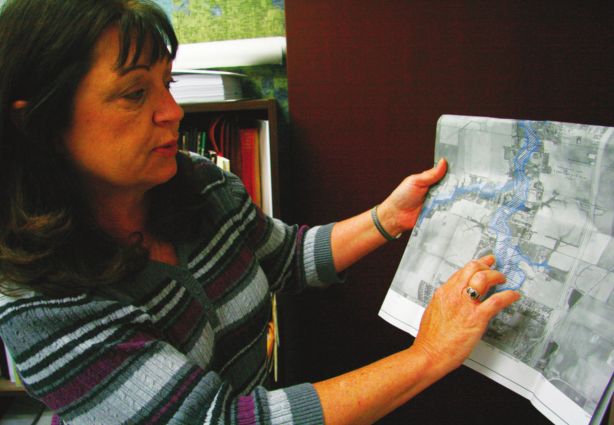
When
the announcement of a high-speed rail line and increased freight trains
through Springfield raised the question of which rail corridor would be
used, the planning commission was part of the study group analyzing the
options. While Springfield engineering firm Hanson Professionals took
the lead and got most of the credit for the study, the planning
commission worked in the background on projects like counting the number
of residences which would be affected by each rail option.
Senior
planner Jeff Fulgenzi, who handles the “big picture” of long-term
strategic planning for the commission, grew up in Springfield. His
family owns Fulgenzi’s Pizza and Pasta, near the Illinois State
Fairgrounds. Before starting at the commission five years ago, he served
eight years on the Sangamon County Board. As a board member, he says,
he tried getting a bike plan in place that would connect the county with
bike paths. Last month the county board and the Springfield City
Council both adopted such a bike plan that was developed by the planning
commission’s Linda Wheeland, senior planner in charge of
transportation.
“Having
something in place is tremendous,” Fulgenzi said. “I don’t think we
could have gotten that done 15 years ago. It takes time, and we’re
making a difference. Our goal was to present information that’s trusted
into their hands.”
Fulgenzi’s
job involves helping local governments make the best use of their
resources and stay ahead of trends. He studies a community’s housing
stock, water capacity, population growth and other factors to devise a
plan for economic stability. He also provides staff support for projects
like the Citizens Efficiency Committee, which looks for ways to
streamline government in Springfield and Sangamon County.
As
a former county board member, lobbyist and bureaucrat, Fulgenzi
understands that planning is a good start, but the follow-through is
often much tougher.
“We
often hear the phrase that there’s no planning,” he says. “I would
disagree. There’s a fair amount of planning, but what we lack is
implementation, and there are reasons for that.”
Besides
the money and political clout that implementing a grand plan usually
requires, Fulgenzi says it also requires “a constituency to really care
and understand those things.”
“I
grew up in this community, so I care about it,” he said. “I’m one who
believes we don’t inherit the world from our ancestors; we gift it to
our grandchildren. What are we going to do and what are we going to
present to our children?”
Contact Patrick Yeagle at [email protected].


