Design experts envision a walkable, bike-friendly urban core
COMMUNITY | Patrick Yeagle
What started as a search for office space has turned into an investment adventure for Springfield architect Larry Quenette. He took a gamble when he decided to turn the threestory Dunn Building at 201 E. Adams St. into high-end loft apartments in Springfield’s downtown, but the gamble appears to be paying off.
Six of the 12 apartments are leased already, Quenette says, and he has received numerous inquiries from potential renters wanting to lease the remaining six apartments once they’re finished.
Quenette’s apparent success with the Dunn Building illustrates what some Springfield business and political leaders hope becomes a new trend: a repurposing of existing vacant buildings that transforms the city’s downtown into a new center of commerce and entertainment.
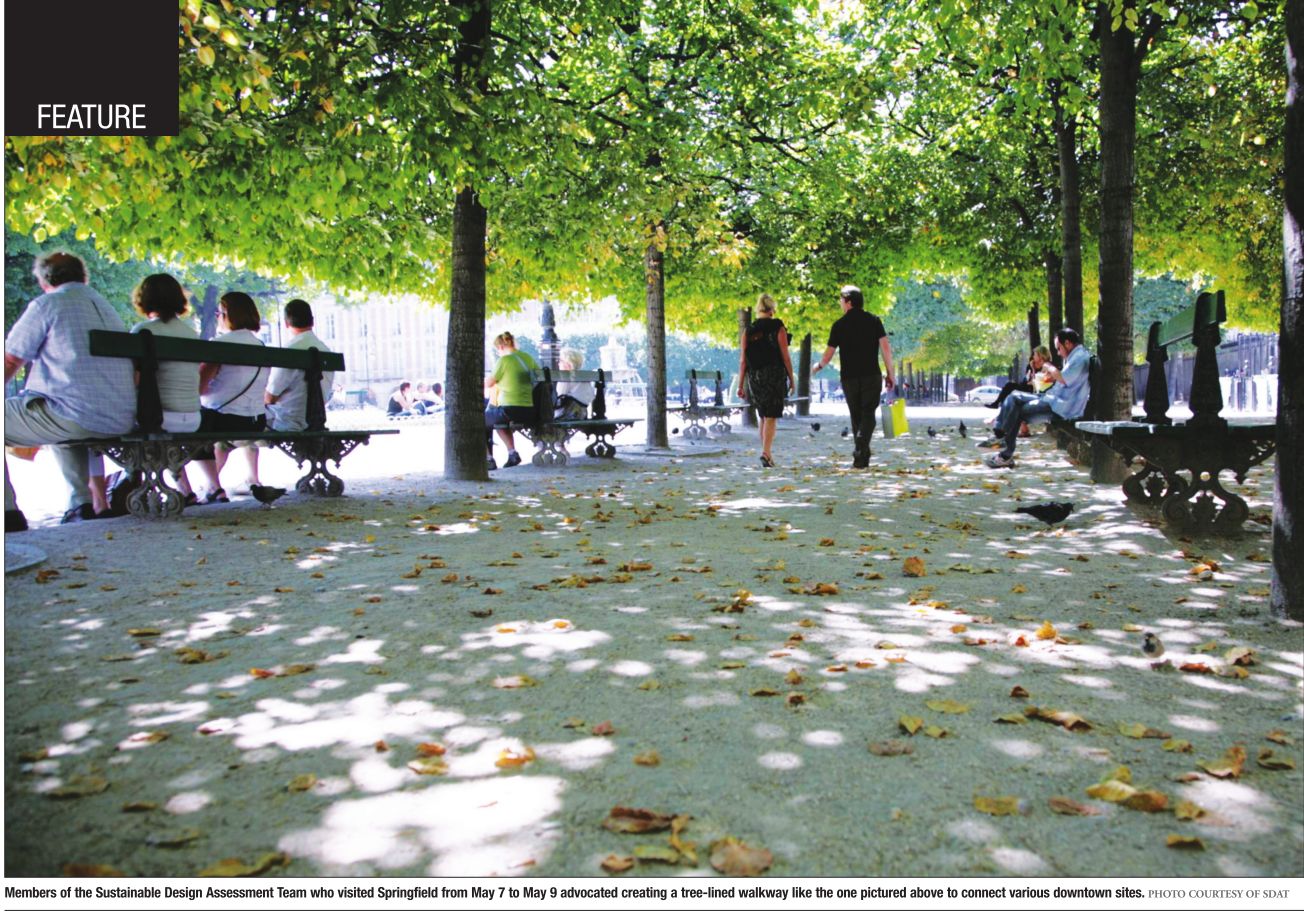
With that purpose in mind, a team of urban planning professionals from around the U.S. visited Springfield from May 7 to May 9, touring the city, listening to its leaders and residents, and applying their expertise to solve problems that hinder development. The sevenmember Sustainable Design Assessment Team (SDAT) came to Springfield to focus on two main issues: the replacement of the Central Area TIF district and the best use of existing infrastructure.
The SDAT project is one of several undertaken each year in cities across the U.S. by the American Institute of Architects. Victoria Ringer, executive director of Downtown Springfield, Inc., says AIA chose Springfield for an SDAT project because the city “responded so aggressively” to the recommendations of AIA’s Regional/Urban Design Assistance Team (R/UDAT), which visited Springfield in 2002 and provided a broad development plan for Springfield and the surrounding area. The SDAT project is more narrowly focused on recommendations to revamp the city’s core.
Support for SDAT came from Downtown Springfield, Inc., City of Springfield, and the Illinois Department of Commerce and Economic Opportunity (DCEO). AIA provided a grant to pay for part of the study, while DSI also raised private donations. No tax dollars were used for the study, Ringer says.
Students from the University of Illinois Springfield, Robert Morris University and Illinois Institute of Technology assisted the team, while a steering committee composed of several Springfield business, nonprofit and community leaders provided guidance and local input for SDAT.
While the group’s final report will be released later, their preliminary recommendations addressed a variety of concerns commonly voiced by Springfield residents: parking issues, a lack of downtown activities, vacant buildings and more. Their recommendations could ultimately affect how Springfield residents and visitors travel, shop, eat and enjoy this city.
Residential and business development
When Larry Quenette bought the Dunn Building in 2010, it had been vacant for two years. It previously housed the Illinois State Police, Quenette said, and it had become “fairly run down” and “musty” after ISP left.
Quenette was looking for office space downtown to house his two companies, Renaissance Architects and Quenette Development, Inc., but he couldn’t find anything that suited his needs, so he decided to purchase a vacant building and use his architectural skills and vision to repurpose it.
But the Dunn Building is 30,000 square feet, and Quenette says he only needed about 3,000 square feet for his office. He asked other downtown property owners and Downtown Springfield, Inc. what he should do with the remaining space, and he says the answer was clear: Springfield needs apartments downtown.
 Residential development downtown is one of the keys to strengthening the city’s core, the SDAT members said at a public forum on May 9. Springfield essentially has a 100 percent occupancy rate for existing apartments, meaning there is likely plenty of demand for further residential development.
Victoria Ringer of DSI says one of the challenges preventing development downtown is that several vacant buildings are owned by people who don’t live in Springfield and so have no immediate stake in the city’s redevelopment efforts. A handful of families own several downtown buildings through trusts that provide income regardless of whether the buildings are productive, she says.
Lisa Stott, deputy director of DCEO’s Office of Marketing & Communications, explains that older buildings also require extra planning to modernize them while still preserving their historic appearance and characteristics. Modern apartment dwellers expect plenty of natural light, but some older buildings have no windows on the sides – especially those that border other buildings. That level of planning can deter developers who see the city’s west side as a cheaper and easier alternative market.
To level the playing field between downtown and the west side, the panel suggested eliminating or reversing incentives that favor west side development. Details will likely be given in the group’s final report.
Without $1.2 million in downtown TIF money to supplement his own investment in the Dunn Building, “there would be no project,” Larry Quenette says. But that TIF district expires in 2016, eliminating a development tool that has helped fund several other projects downtown, including the National Museum of Surveying, the Hoogland Center for the Arts and the construction of the Governor’s Ballroom at the Statehouse Inn.
Tax Increment Finance (TIF) districts work by establishing a base tax level for properties within a blighted area that is targeted for improvement. As property taxes increase, any money raised above the base level is reinvested in the area.
SDAT member Eve Picker, an architect and real estate expert from Pittsburgh, Pa., said the downtown TIF district is “absolutely essential to keep the momentum going,” but urged city leaders not to wait for the current TIF to expire before examining new development tools. A new TIF district covering the same area could be established, Picker said, or the city could grant a 10-year property tax holiday to developers who repurpose vacant downtown buildings. A property tax abatement could yield more than $2 million each year for the city once the abatement ends, Picker estimated, adding that it could save developers up to $3 million in borrowing over the same period.
Establishing a new TIF district may require action by the Illinois General Assembly. State law says the authority of municipal governments to establish new TIF districts expired on Jan. 1, 2012 unless lawmakers pass a new authorization measure.
The city already has a number of other downtown development tools in place. The Downtown Residential Assistance Program encourages development of new downtown apartments through fixed-interest loans of up to $35,000 per project or tax rebates of up to $3,000 per unit. The city’s Architectural Assistance Program offers a $2,000 grant for architectural studies determining the feasibility of residential development within the downtown TIF, while the Downtown Facade Improvements program offers up to $40,000 to downtown building owners who repair and restore the visible exteriors of their buildings.
Transportation
Springfield has an astonishing 29,000 parking spaces downtown, and parking is cheap – a nickel for every six minutes. Even getting a parking ticket in Springfield is cheap compared with other central Illinois cities and especially compared with Chicago.
“We’re practically giving it away,” jokes Norm Sims, executive director of the Springfield-Sangamon County Regional Planning Commission, which produces a report on Springfield’s downtown parking every year.
Yet try to find street parking downtown during dinner or late night, and you’re likely to voice the same frustration uttered by countless others. It’s primarily a problem of perception, says SDAT member Seleta Reynolds, a transportation expert with the San Francisco Municipal Transportation Agency. Much of the parking is available in off-street parking lots and parking garages, which may not be a driver’s first thought when parking downtown, and not all of the parking lots are open to the public. Additionally, drivers who are used to abundant on-site parking at big box stores on the city’s west side may not expect to park two or three blocks away from a downtown destination and walk the remaining distance.
continued on page 14