
Better yet, don’t buy it in the first place
RECYCLING | Neil Schneider
Abby Walden believes that before Springfield residents start to consider recycling their trash, they should first be aware of the goods they are purchasing.
“Products that cannot be reused, you should think twice about buying them,” Walden said. “Instead of buying plastic water bottles, look into getting a reusable water bottle that you can fill up at home and take with you.”
Walden, an environmental studies graduate student at the University of Illinois Springfield and intern at City Water, Light and Power, said she is pleased to see Springfield is moving in a “positive direction” toward more recycling options.
“More and more products are able to be recycled. As we continue to move forward we will be able to offer a larger program for recycling products,” Walden said.
Curbside recycling
What recycling options are available in Springfield? Mark Mahoney, director of public works for the City of Springfield, said homeowners or renters who want curbside recycling should contact their local waste hauler.
Not sure what can be recycled? Mahoney suggests visiting the city of Springfield’s website (www.springfield.il.us/recycle.htm), which features a “Room to Room Guide” offering information and tips about recycling specific items in the typical home. The guide was cre ated in 2008 and is currently being updated.
Mahoney said that his family of six recycles two full bins of recyclable materials a week, including everything from glass to cardboard.
“I generally separate the bottles and cans into one bin and then the paper and cardboard into another bin,” Mahoney said, describing his recycling method. “I then sort them a little bit more and combine them for the Tuesday morning pickup.”
Electronics
Though it’s most known for building affordable housing, Habitat for Humanity of Sangamon County provides an opportunity for people to recycle electronics.
Sarah Mackey, executive director of Habitat for Humanity of Sangamon County, said since the statewide ban on disposing of electronics (batteries, DVD players) in the trash went into effect at the beginning of the year, Habitat for Humanity of Sangamon County Restore has stepped up efforts to accept electronics recyclables.
“Five years ago, a lot of these electronics were ending up in landfills. So after the legislation passed we wanted to increase awareness about recycling electronics,” Mackey said.
The Habitat for Humanity of Sangamon County Restore is at 1514 W. Jefferson St. in Springfield.
Athletic shoes 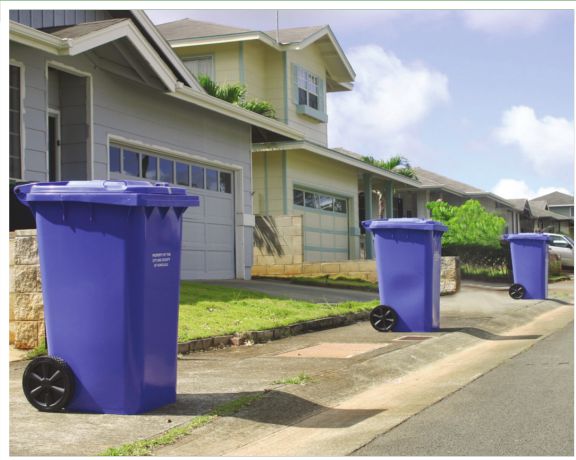
The
Green Center at Lincoln Land Community College also promotes recycling
by encouraging LLCC students and faculty to take an active role. Julie
Bates, manager at the Green Center, said that LLCC has recycling events
throughout the year that allow students and employees to bring in
various recyclables such as paper, plastic, cardboard and cans.
“We
have the basic recycling opportunities, but we also offer special
recycling drives, such as during Earth Week, where students and
employees are able to bring in other materials that they would like to
recycle,” Bates said. Earth Week is April 16-22.
“With
this year’s Earth Week, students and employees can bring in athletic
shoes to recycle and then we will be working to get them to Nike, where
they make them into things like rubber athletic courts.”
Green Business Network
Springfield
has plenty of options for businesses to recycle, as well. The City of
Springfield and the Green Business Network of Springfield (GBNS) are
expanding their efforts to educate and offer a variety of recycling
opportunities to citizens and local businesses.
The
GBNS, which began in 2010, is a nonprofit organization composed of
local businesses that work to encourage environmental sustainability
practices such as recycling, water conservation and energy efficiency.
Bill
Mills, a volunteer for the GBNS and manager of the Energy Services
division of CWLP, said GBNS specifically addresses recycling for
businesses in Springfield through the Recycle Springfield Project.
“Most
small- to medium-sized businesses in Springfield cannot afford the
monthly charge to have a recycling dumpster – particularly if it is only
for cardboard and occasionally paper – that commercial recyclers
provide,” Mills said. “The commercial recyclers do a fine job. We don’t
see that this program (RSP) in any way competes with them. What became
fairly obvious to us is that a lot of materials that could be recycled
were going into trash dumpsters.”
Mills
said the main obstacles for these businesses included the cost of the
recycling dumpster and the cost of the service to have the dumpster
emptied, which could range from $100 to $125 a month and “they typically
only took cardboard, occasionally paper.”
GBNS
addressed this financial issue by partnering with Durr, Tillet and
Kobylarz, Inc., a recycling company in Springfield, to provide free
recycling dumpsters to small- and medium-size businesses and nonprofit
organizations. Businesses qualify for the service by joining the GBNS
and paying a one-time membership fee of $25.
DTK
then set up a central drop-off site located at the corner of 11th and
Madison streets for businesses and citizens to drop off their recyclable
materials. Mills said the recycling dumpsters for RSP come in both a
two cubic yard and a four cubic yard size.
For more information, visit the Green Business Network website at www.gbns.org.
Don’t buy it
Wynne
Coplea, director of college partnerships at Heartland Community College
in Normal and former manager of waste and recycling for the city of
Springfield, echoed Walden’s earlier comments. Ultimately, Coplea says
the consumer is the first line of defense in protecting the environment.
She said products like Styrofoam egg cartons and juice boxes are
difficult to recycle, so consumers should look for products in more
recyclable containers.
“In
some places those products are recyclable, but nowhere in the downstate
area,” Coplea said. “These materials are very tightly compressed.
Paper, plastic and metal all together…..it’s very difficult to get these
materials apart and do any sort of viable recycling with them.”
Contact Neil Schneider at [email protected].


