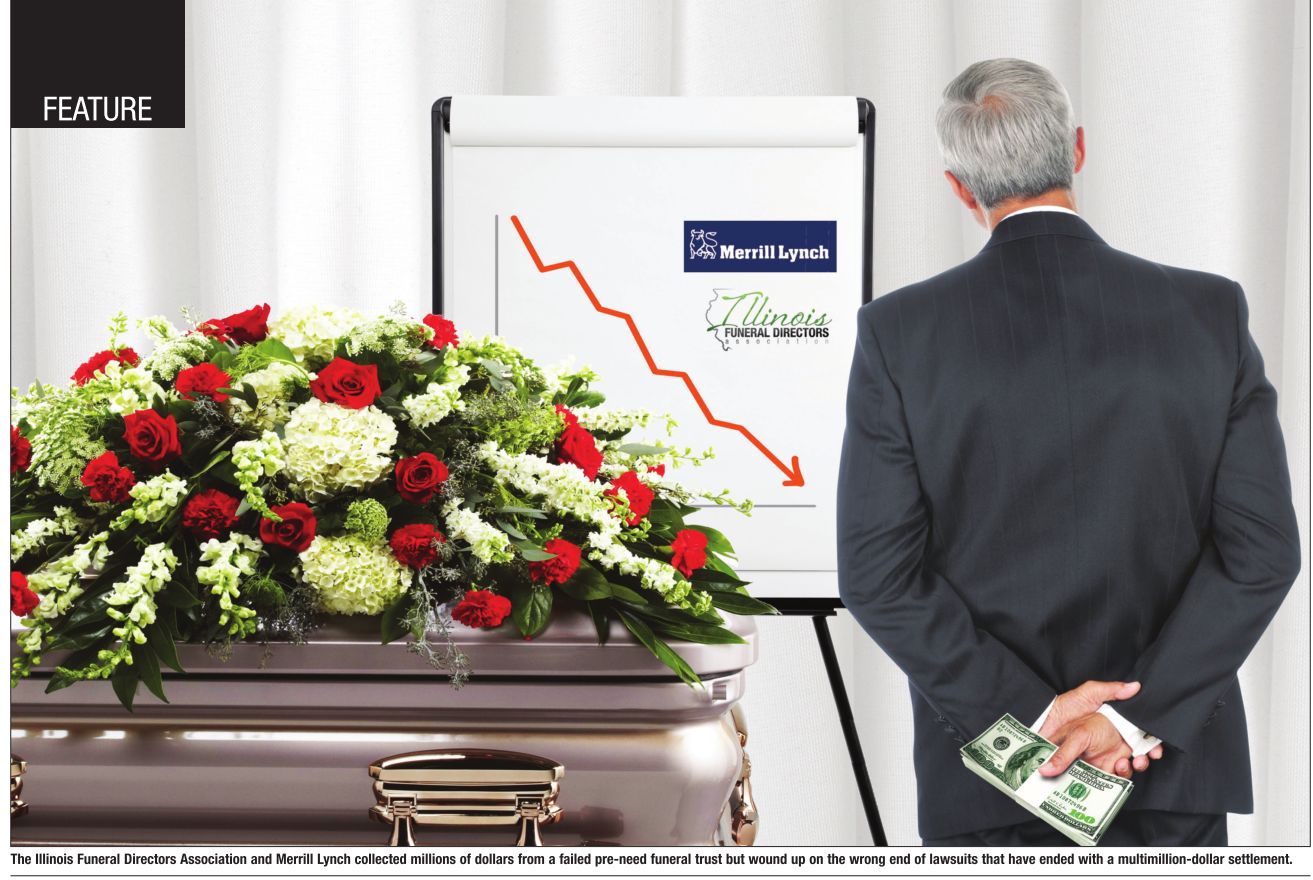
Millions are lost when greed replaces common sense
FINANCE | Bruce Rushton
There is no shortage of blame and stain in the saga of a failed trust fund once administered by the Illinois Funeral Directors Association.
Alleged villains range from Merrill Lynch, which has agreed to pay $55.4 million to funeral directors who lost millions in the scheme, to Springfield corporation counsel Mark Cullen, the IFDA’s former attorney, who has agreed to pay funeral directors $1.75 million to settle a class-action lawsuit finalized last month.
Cullen, a defendant whose name was mentioned 145 times in the first of four lawsuits filed by funeral directors, declined comment on his portion of the settlement package, which also covers claims against Sorling, Northrup, Hanna, Cullen & Cochran, the Springfield law firm where Cullen worked before joining Mayor Michael Houston’s staff. A message left at the firm was not returned. The IFDA will pay $2 million to funeral directors under terms of an agreement to settle lawsuits in which directors alleged fraud and conspiracy.
Merrill Lynch, which agreed to pay $18 million to funeral directors in 2009 to end an inves tigation by the state Department of Insurance, agreed last month to pay an additional $25.9 million to end a probe by the Secretary of State. Funeral directors will also receive $15.25 million to settle lawsuits, with $11.5 million of that amount coming from Merrill Lynch and the balance from the IFDA, Cullen and his former law firm. All told, funeral directors throughout the state will receive $59.15 million.
Beyond big money, the tale of the IFDA includes greed, dysfunctional government watchdogs and a regulatory system that remains sketchy despite scandal, judging by a recent report by the federal General Accountability Office, which includes an appendix devoted to chronicling problems in Illinois’ system of regulating cemeteries and the funeral industry.
The IFDA scheme dating back to the 1980s was relatively simple. Funeral directors sold prepaid funeral plans to customers and the IFDA set up a trust. Edward Schainker, a Merrill Lynch broker based in Springfield, suggested life insurance, but not on the lives of folks who bought funeral plans. Rather, Schainker convinced the IFDA to insure the lives of association officers and funeral directors to underwrite the trust, with big payouts coming when folks died. In the meantime, the IFDA would act as trustee, collecting millions of dollars in administrative fees on a fund that swelled to as much as $300 million.
There were more than a few problems. Funeral directors and association officers who had life insurance plans taken out on them didn’t die on time, but consumers with prepaid funeral plans did. An even more basic issue was insurability. It isn’t kosher under insurance laws to insure the life of just anyone, as if investing in death were the same as buying stocks. Years after the insurance polices were purchased, regulators determined that the IFDA had no “insurable interest” on funeral directors who agreed to let the association buy policies on their lives in exchange for free $25,000 life insurance policies.
Also problematic was a state law that made it illegal to spend money from pre-need purchasers on life insurance without telling purchasers, who remained blissfully unaware that money to pay for their funerals was being spent to insure the lives of strangers. There was also the matter of administrative fees collected by the IFDA. A 1989 state law capped fees at 25 percent of earnings from funeral trusts, but the association, which had been operating under a cap of 5 percent of principle, ignored that limit on a fund worth hundreds of millions of dollars.
The IFDA didn’t have a license to act as a trust from the state Department of Financial and Professional Regulation, which licenses trusts and fiduciaries. The IFDA did, however, have a license from the state comptroller’s office, which renewed the license for years until looming fiscal catastrophe became too big to ignore or hide.
Implosion
Given its purpose, the pre-need funeral fund was supposed to be rock solid. The IFDA, however, saw the fund as a treasure chest, tapping the trust to make loans to funeral directors, including an association board member who used the money to build a funeral home. Collecting as much as $2 million in administrative fees in a single year, the association also opened a funeral museum in Springfield.
Shortly before he retired in 1999, Robert Ninker, the IFDA’s former executive director, told the association board that the trust “is the greatest storehouse of wealth you will ever have,” funeral directors say in a lawsuit against the association.
Instead, the fund proved the association’s biggest albatross.
The first cracks appeared in 2001, when an internal IFDA audit showed a $10 million deficit in the trust – there would not be enough to pay for contracted funerals if everyone died at once. Making matters worse, the policies could not be liquidated without steep tax penalties, and the association was locked in to paying commissions, premiums and management fees to insurance companies and brokers regardless of the performance of securities within policies that dictated the value of the policies.
Despite the deficit, the association continued issuing rosy financial reports to members on the hook for losses. And the comptroller’s office, which licensed the IFDA, remained ignorant.
“Having this regulatory oversight should have provided comfort and actual protection, but clearly the latter was lacking,” funeral directors say in one of their lawsuits against the association, Merrill Lynch, Cullen and his law firm.
By the time the comptroller’s office began an audit in 2005, the deficit had swelled to more than $38.5 million. The shortfall mushroomed as new money was spent covering losses – new customers were paying to bury previous customers, according to funeral directors who sued, likening the trust to a Ponzi scheme.
Any violation of the state Burial Funds Act, the law governing prepaid funeral plans, is a felony, but the comptroller’s office didn’t call police after discovering the mess nearly six years ago, when Dan Hynes was nearing the end of his second term as comptroller and running for re-election. After sending a 2006 letter to the IFDA saying that the situation was “intolerable” and that the association had collected $9.6 million in excessive fees between 2000 and 2005, contrary to the Burial Funds Act, the comptroller called the Department of Financial and Professional Regulation, which licenses banks and other fiduciaries.
Between the comptroller and the department, regulators spent more than a year trying to get the trust into the hands of a properly licensed fiduciary. Despite the escalating deficit, the IFDA wouldn’t give up on life insurance as an investment tool until the Department of Financial and Professional Regulation finally forced the issue with a series of cease-and-desist orders issued in 2008.
‘‘Having regulatory oversight should have provided comfortand actual protection, but clearly the latter was lacking. ”
Cullen, who became the association’s lawyer in 2000, proved an obstacle to getting the association to rid itself of toxic insurance polices and get the money from funeral directors into the hands of a legal fiduciary, according to lawsuits filed by funeral directors who had sold pre-need funeral plans to consumers and were responsible for any losses.
Although regulators found that the policies violated state law because the IFDA had no insurable interest in funeral directors whose lives were insured, funeral directors-turnedplaintiffs and their association, which became a defendant, say that Cullen at some point issued an opinion that approved the enterprise.
As IFDA general counsel, Cullen was a regular at association board meetings and was well acquainted with the trust. Attorneys from Sorling, Northrup, Hanna, Cullen & Cochran, Cullen’s law firm, had been providing legal advice to the association since the 1980s, and the firm had long known that the IFDA’s authority to act as trustee was on shaky legal ground.
In a 1996 letter to the IFDA, Michael Connelly, an attorney with Cullen’s firm, noted that the comptroller issued licenses for sellers of pre-need plans, not trustees charged with safeguarding money from consumers. He suggested that the IFDA resign as trustee to avoid any questions about its legal authority to administer the funeral trust.
“Recall our concern that if the market value of the pre-need trust funds were to fall dramatically, that one or more pre-need customers could bring a class action alleging that the IFDA was acting as a trustee without proper authority and therefore would be liable for the loss in value of the trust funds,” Connelly wrote.
His words proved prophetic.
Meltdown
A decade after Connelly put the IFDA on notice that its license from the comptroller could be meaningless, the association was under scrutiny from regulators. And Cullen got in deeper as the pressure grew.
In February of 2008, Cullen became the association’s managing staff director. He assumed his new role one day before the expiration of a deadline set by the Department of Financial and Professional Regulation for the IFDA to transfer the trust to a licensed fiduciary, funeral directors say in court papers. At the time, Regions Bank, which had a license, was considering taking over the trust, and the state extended the deadline by 90 days, based on assurances from the bank that it would become trustee and a promise from the IFDA that it would agree to transfer authority. But the transfer never happened. After determining that the fund was losing $18,000 a day, Regions insisted on liquidating the life insurance policies. No insured funeral director had died in 2005, and just one had died in 2006, when the IFDA paid $2.8 million in premiums and received less than $650,000 in life insurance payouts. Meanwhile, management fees and commissions were depleting the fund by more than 3 percent annually, the bank determined, and the policies contractually bound the association to make the payments.
“You can’t get enough people to die fast enough to make up this ongoing expense,” a consultant for the bank wrote in a 2008 letter to the IFDA’s accountant.
The consultant also put Cullen on notice, telling the attorney-turned-staff-director in letters that time was critical and that life insurance should never have been used to underwrite a pre-need funeral trust. But Cullen and the IFDA balked, asking Regions to further justify the need to liquidate policies. The bank refused, and when Regions discovered that the IFDA and Cullen had started looking for a different trustee, the bank terminated talk of taking over the trust two months after Cullen joined the association’s staff, saying that further dealings with the IFDA would threaten the bank’s reputation.
“As managing staff director, Cullen was the one responsible for overseeing the transfer of the tax-exempt trust to a bona fide trustee,” attorneys for funeral directors wrote in a lawsuit against the association. “Instead, he actively participated in the selection of a new trustee that would allow the pre-need trust assets to continue to be held in illegal insurance policies.”
Cullen gave poor legal advice, according to funeral directors-turned-plaintiffs who said that the attorney and his law firm had a duty to prevent the association from investing in life insurance policies and, after the fact, a duty to advise the association to end illegal conduct that would increase liability and damages.
“Instead, Cullen was part and parcel of the Life Insurance Enterprise, a conflicted attorney who repeatedly failed to protect his clients’ interests,” lawyers for funeral directors wrote in a lawsuit against Cullen, Merrill Lynch and the IFDA.
Three weeks after Regions walked away in the spring of 2008, the Department of Financial and Professional Regulation issued the first of three cease-and-desist orders to the IFDA that ultimately forced the association to get out of the trustee business. The first order came on May 30, 2008, but Cullen didn’t mention it when he met with funeral directors five days later.
continued on page 14


