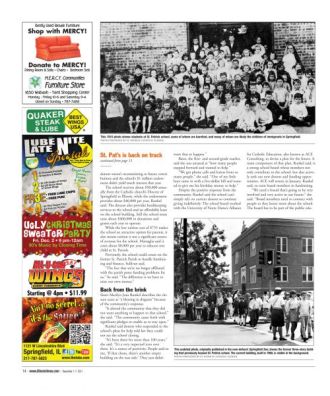
The school receives about $50,000 annually from the Catholic church’s Diocese of Springfield in Illinois, while the endowment provides about $40,000 per year, Runkel said. The diocese also provides bookkeeping services to the school and an affordable lease on the school building. Still the school must raise about $400,000 in donations and grants each year to operate.
While the low tuition cost of $735 makes the school an attractive option for parents, it also means tuition is not a significant source of revenue for the school. Marsaglia said it costs about $8,000 per year to educate one child at St. Patrick.
Previously, the school could count on the former St. Patrick Parish to handle fundraising and finance, Sullivan said.
“The fact that we’re no longer affiliated with the parish poses funding problems for us,” he said. “The difference is we have to raise our own money.”
Back from the brink
Sister Marilyn Jean Runkel describes the closure scare as “a blessing in disguise” because of the community’s response.
“It alerted the community that they did not want anything to happen to that school,” she said. “The community came forth with significant pledges to enable us to stay open.”
Runkel said donors who responded to the school’s pleas for help told her they could not see the school closing.
 “It’s been there for more than 100 years,” she said. “It’s a very respected icon over there. It’s a source of positivity. People said to me, ‘If that closes, there’s another empty building on the east side.’ They just didn’t want that to happen.”
Bates, the first- and second-grade teacher, said she was amazed at “how many people stepped forward and wanted to help.”
“We got phone calls and letters from so many people,” she said. “One of my little boys came in with a five-dollar bill and wanted to give me his birthday money to help.”
Despite the positive response from the community, Runkel said the school can’t simply rely on current donors to continue giving indefinitely. The school board worked with the University of Notre Dame’s Alliance for Catholic Education, also known as ACE Consulting, to devise a plan for the future. A main component of that plan, Runkel said, is a strong school board whose members not only contribute to the school, but also actively seek out new donors and funding opportunities. ACE will return in January, Runkel said, to train board members in fundraising.
“We need a board that’s going to be very involved and very active in our future,” she said. “Board members need to connect with people so they know more about the school. The board has to be part of the public rela- tions arm, thinking creatively – out of the box – about how we can secure our future.”