“It’s pretty much in my blood,” she said, adding that she instantly fell in love with St. Patrick school when she first visited. “There’s something about this place,” Marsaglia said. “Once you’re in, if it’s a perfect fit, you know it right away.”
A school with a mission
Sister Marilyn Jean Runkel, president of the school’s board since 1998, says the school has always had a mission of service. It opened in 1910 to teach the children of Irish immigrants, many of whom moved to Springfield to work in the coal mines. Runkel’s father – the son of Hungarian immigrants who didn’t even speak English – attended the school in the 1920s.
“St. Patrick has always had a mission, even in its opening days, for people with special needs,” Runkel said.
From those working-class roots, the school began to serve families in the surrounding neighborhood, then families from all over Springfield and nearby communities.
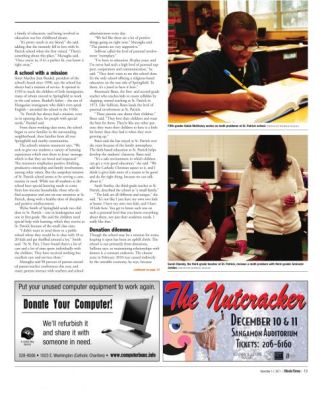
The school’s mission statement says, “We seek to give our students a variety of learning experiences which root them in Jesus’ message, which is that they are loved and respected.” The statement emphasizes positive thinking, productive citizenship and family involvement, among other values. But the unspoken mission of St. Patrick school seems to be serving a community in need. While not all students at the school have special learning needs or come from low-income households, those who do find acceptance and one-on-one attention at St. Patrick, along with a healthy dose of discipline and positive reinforcement.
Wylse Smith of Springfield sends two children to St. Patrick – one in kindergarten and one in first grade. She said the children need special help with learning, which they receive at St. Patrick because of the small class sizes.
“I didn’t want to send them to a public school where they would be in class with 18 to 20 kids and get shuffled around a lot,” Smith said. “At St. Pat’s, I have found there’s a lot of care and a lot of time spent individually with the children. They have received nothing but excellent care and services there.”
Marsaglia said 98 percent of parents attended parent-teacher conferences this year, and many parents interact with teachers and school administrators every day.
“We feel like there are a lot of positive things going on right now,” Marsaglia said. “The parents are very supportive.”
Sullivan called the level of parental involvement “exemplary.”
“I’ve been in education 30-plus years, and I’ve never had such a high level of parental support, cooperation and communication,” he said. “They don’t want to see this school close. It’s the only school offering a religious-based education on the east side of Springfield. To them, it’s a jewel to have it here.”
Rosemarie Bates, the first- and second-grade teacher who teaches kids to count syllables by clapping, started teaching at St. Patrick in 1973. Like Sullivan, Bates lauds the level of parental involvement at St. Patrick.
“These parents care about their children,” Bates said. “They love their children and want the best for them. They’re like any other parents; they want their children to have it a little bit better than they had it when they were growing up.”
Bates said she has stayed at St. Patrick over the years because of the family atmosphere. The faith-based education at St. Patrick helps develop the students’ character, Bates said.
“It’s a safe environment in which children can get a very good education,” she said. “We add the Catholic Christian aspect to it, and I think it gives kids more of a reason to be good and do the right thing, because we can talk about it.”
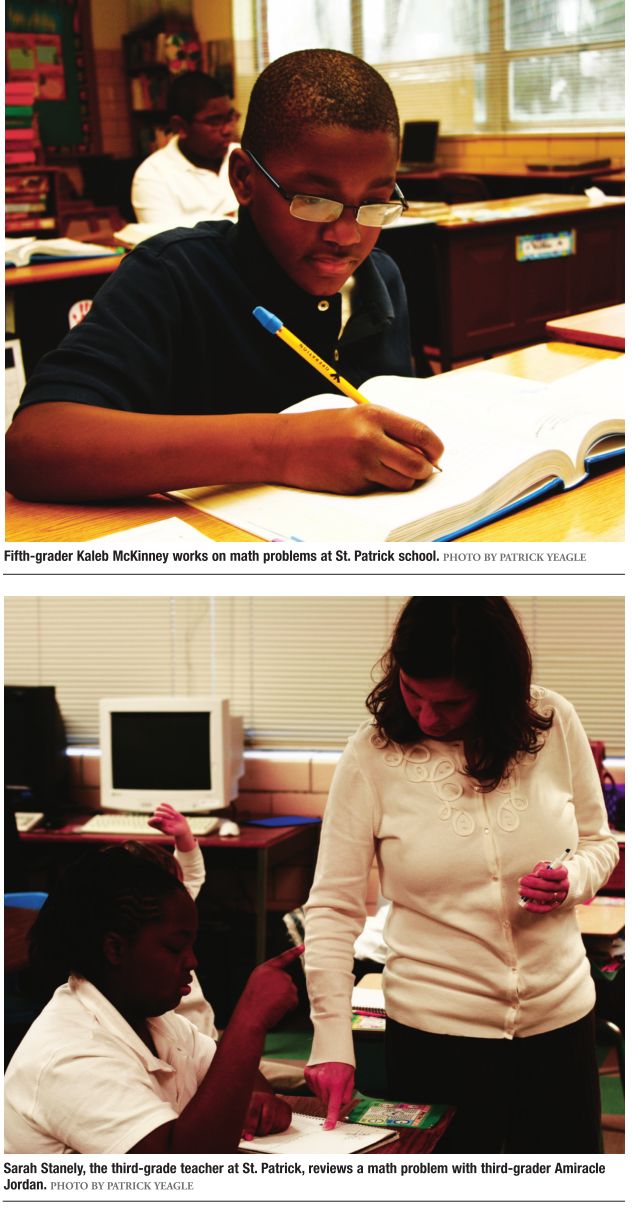
Sarah Stanley, the third-grade teacher at St. Patrick, described the school as “a small family.”
“The kids are all different and unique,” she said. “It’s not like I just have my own two kids at home. I have my own two kids, and I have 10 kids here. You get to know each one on such a personal level that you know everything about them, not just their academic needs. I really like that.”
Donation dilemma
Though the school may be a mission for some, keeping it open has been an uphill climb. The school is run primarily from donations, Sullivan says, so maintaining relationships with donors is a constant endeavor. The closure scare in February 2010 was caused indirectly by the unstable economy, he says, because donors weren’t recommitting to future contributions and the school’s $1 million endowment didn’t yield much interest that year.
continued on page 14