Callahan resisted pressure from above to whitewash his review of the file. He became a believer that Steidl, and his co-defendant, Herb Whitlock, were innocent. When he requested permission to pursue an investigation of other viable suspects who were politically connected, Callahan received a lateral transfer by former Gov. Rod Blagojevich’s new director of state police. He was removed from investigations and transferred to the traffic division. His book, Too Politically Sensitive, provides a detailed account of what happened behind the scenes at ISP.
The following year, in May 2004, a federal judge ordered Randy’s release from prison.
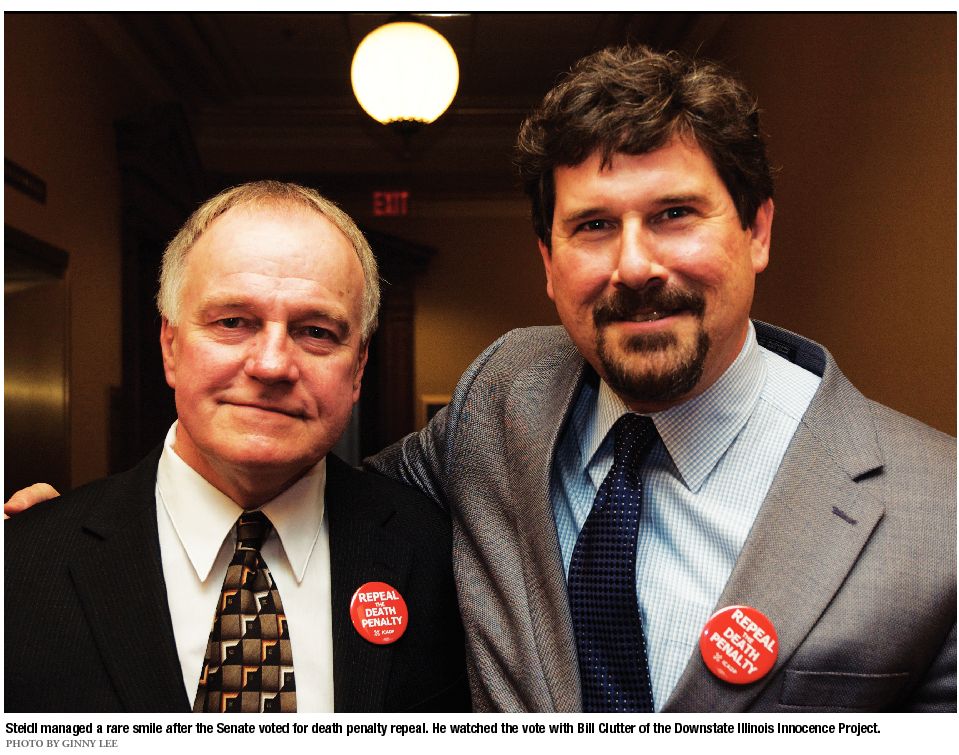
And so when the vote was taken on the House floor, it was Randy Steidl standing in the gallery whom Rep. Karen Yarbrough, the sponsor of the bill, pointed up to in making her argument to lawmakers why the death penalty should be abolished. For the last several months, Randy has been traveling the state telling his story as part of the Illinois Coalition Against the Death Penalty’s campaign to end capital punishment. The vote total shot up to 59, then stopped one vote short of the 60 votes needed. A procedural move was made to place the bill for reconsideration. Two hours later, after intense lobbying by Randy and the Coalition, the bill was brought back to the floor. Rep. Robert Flider of Decatur had a change of heart and switched his vote. The bill passed and was sent to the Senate..
 After two hours of debate in the Senate on Jan. 11, senate sponsor Kwame Raoul asked Randy to stand to give the last word. Senator Raoul reminded the members of what Randy had said during his testimony earlier in the day before the Senate Judiciary Committee: “You can release an innocent man from prison, but you can’t release him from the grave.” The bill passed with 32 votes, with two votes more than was needed.
This historic vote by the General Assembly completed the circle of this story. Now abolition is in the hands of Gov. Quinn. History will look back a hundred years from now, and will compare the abolition of the death penalty to another abolition movement with strong ties to Springfield. It was the right decision then to abolish the practice of a person owning another person of color, though slavery was widely popular in some segments of the population in its day. And so the practice of the state strapping men and women to a gurney and controlling the decision to end life, at the risk of getting it wrong, should also be cast onto the trash heap of history.
Bill Clutter is a licensed private detective and is director of investigations at the Downstate Illinois Innocence Project at the University of Illinois at Springfield.