With copies loaded in the trunk of my car, I headed to Chicago. That evening, I appeared before the board of directors at a meeting of the Illinois Coalition Against the Death Penalty. They were there to discuss plans to organize a candlelight vigil outside the Governor’s Mansion for John Wayne Gacy, whose execution was set for May 10, 1994. It was the face of Gacy, the most notorious serial killer that Illinois had seen in the 20th century, that made support for the death penalty so popular. I stood up, handed everyone in the room a copy of
Illinois Times and pointed to the face of Randy Steidl. His should be the face of the abolition movement. I recounted our recent involvement in the case of Rolando Cruz and Alejandro Hernandez. It is the faces of the wrongly convicted that will persuade public opinion to support abolition of the death penalty.
 Indeed, those were the faces former Gov. George Ryan pointed to when he declared a moratorium on capital punishment 11 years ago.
After the meeting, Rob Warden, now executive director of the Center on Wrongful Convictions at Northwestern University, pulled me aside and invited me to have a drink. On the walk over to the Billy Goat Tavern, made famous by “Saturday Night Live,” Rob revealed he wasn’t enthusiastic about their decision to hold the vigil for a guy like Gacy. His passion as the publisher of the Chicago Lawyer was to shine light on the cases of the innocent who populated death row in Illinois. It was his paper that first told the story of Brian Dugan’s 1985 confession to the murder of Jeanine Nicarico and the fact that prosecutors had convicted two innocent men but were willing to let them be executed as part of their coverup.
On Feb. 7, 1994, law professor Larry Marshall organized his first event at Northwestern to raise public awareness about the plight of his client, Rolando Cruz. We circulated more copies of the Illinois Times article, which Randy’s mother had paid to reprint.
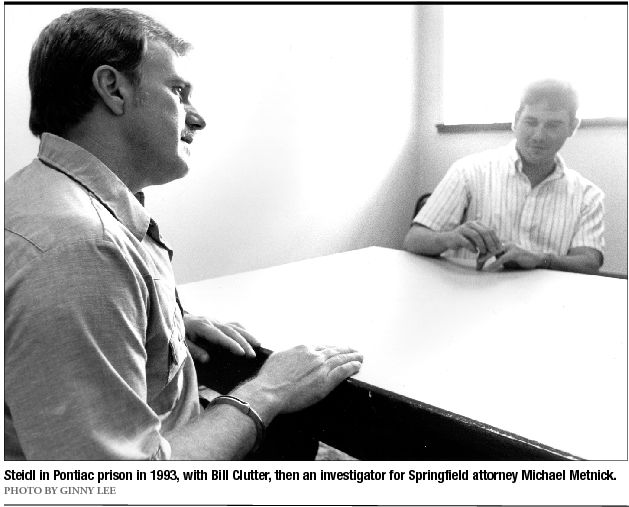
But a few months later, on May 10, the day John Wayne Gacy was executed, our office got a phone call from Pontiac. The warden informed us that Randy Steidl had been attacked in the yard and he was in their medical unit. Armed with a disassembled disposable razor, two men jumped Randy. One pinned his arms back while the other slashed the blade across Randy’s neck. A hit had been ordered on Randy’s life for his refusal to participate in the hunger strike that was organized on the row to protest Gacy’s execution.
One can imagine, given only that bit of news, the gravity of the call. It was the longest imaginable wait to hear word of his condition. Was his fate the same as the other condemned man, Gacy? It would take a few more minutes to learn that the blade had missed Randy’s carotid artery by a razor’s edge.
continued on page 14


