Getting the best bang for the buck
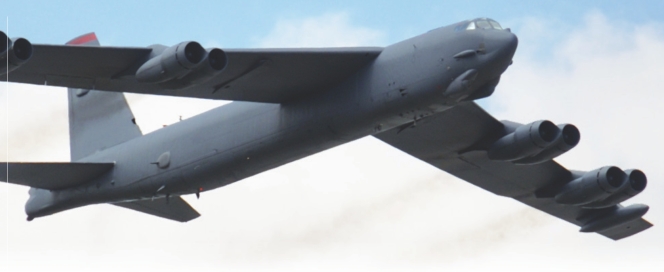
The sound of B-52 aircraft flying over Bossier City is a daily reminder of Barksdale Air Force Base’s importance to our country’s security – and our area’s economy.
A study is under way that, at its conclusion, will go a long way toward determining if we hear that sound for many more years.
The United States Air Force is working to decide if replacing all of the B-52s’ original engines – more than 800 total – would be cost-beneficial. The alternative would be to continue maintaining the current engines.
“The Air Force would like to keep the aircraft around through 2050 and beyond,” said Jim Noetzel, B-52 weapons system team deputy. “If we don’t get new engines, we will have to get a Service Life Engine Program. We have to ask, ‘What is our best bang for our buck? Do we get as much operational benefit versus cost savings?’” The Air Force’s decision-making process is much like what we go through when buying a car.
“The cheapest car does not fit what you need,” Noetzel said. “The mid-priced car does. The more expensive car is more than you need and doesn’t bring you much bang for your buck.”
Noetzel, who is based at Barksdale, has been heavily involved in the study since it began in December 2014.
“This is a big, big, big program,” Noetzel said. “We have to flight-test (the new engines). We have to make sure the weapons come off the wing the same way. This is a very, very large program – in the billons (of dollars).”
Why now? The answer is age – old and new. The current B-52 engines, overhauled through the years, came with the original aircraft built in the early 1960s.
More than 50 years later, the time has come for B-52s to be modernized with items like a new radar system, communication equipment and the ability to carry smart weapons inside the plane’s weapons bay.
“We are running on the ragged edge of our electrical capacity,” Noetzel said. “We need more electrical power. We have to make sure we have enough power to run those things.”
However, the Air Force’s decision whether to replace or maintain the current B-52 engines will not be based solely on mechanics. Economics is a large part of the equation, as Noetzel and his colleagues must find ways in which the Air Force will pay for new engines.
“We’ve been told we can’t afford the production,” Noetzel said. “So, we would borrow the money up front and pay it back over time.”
Noetzel compares the process to obtaining a home loan.
“We have to do the business case analysis to see if the payoff would be right.”
Economics
is also a big reason why the study – and its conclusion – is important
to Shreveport-Bossier. Barksdale, along with Minot (North Dakota) Air
Force Base, is home to the majority of the approximately 75 B-52
aircraft. According to a Barksdale Economic Impact Assessment, Barksdale
is home to more than 6,300 military personnel. Counting civilians and
dependents, that number increases to more than 14,000 people who depend
on the base for their livelihood.
Barksdale says its total economic impact to our area is more than $813 million.
In other words, the B-52s’ longevity is vital to Barksdale, which is vital to our economy.
“To
ensure that (the B-52s continue to fly), we have to do something with
this engine,” Noetzel said. “This program is a commitment to keep this
airplane in the Air Force inventory for a very long time.”
Although
the study has been ongoing for more than two years, a decision is not
imminent. Once a recommendation is reached, it must be approved by the
Department of Defense, which will ask that funding be included in the
president’s budget. Congress must then pass the budget.
Noetzel
said if the engine replacement program is approved, it would not be
before the Air Force’s 2019 Fiscal Year. It would then be approximately
13 years before the engine replacement program is complete.
“Nothing is a done deal, ever, on any program,” Noetzel said. “You never know what’s true until Congress passes a funding bill.”
And until we hear the sound of B-52s – with new engines – flying overhead.
– Tony Taglavore


