The relationship between elections and the stock market
When people think about cycles in the stock market, they tend to look at the obvious drivers of stock prices:
major forces such as the state of the economy, the level
of corporate profits and conditions in global markets. But did you know
that a presidential election itself can be a key pivot point in stock
price trends?
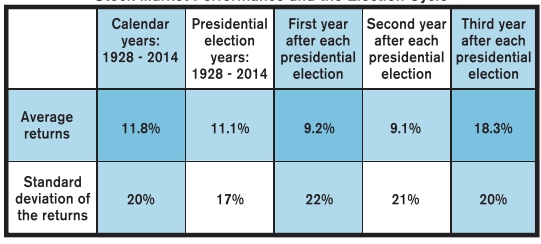
Consider the average yearly performance of the stock market in the table below.
After accounting for random volatility, average presidential election
year performance was slightly below overall average performance.
But
look at the other years in the election cycle. The first two years of
presidential terms have, on average, lagged significantly. But then, in
the third year, the market made up the lost ground and more.
What’s Going On?
Election
years tend to have a degree of uncertainty over the future direction of
the country, and the market may translate that uncertainly into some
reluctance to commit on the part of investors. Then, after the direction
is set, it may take some time for policy changes to assert any
influence, further depressing investment demand. By the third year, clarity could return and investors could embrace the future.
Exceptions May Be More Powerful Than the Generalities
Keep
in mind that the amount of variation in annual returns is substantial,
and is reflected in the high variability, measured by standard
deviation. As a consequence, the chances are good that performance in
any given year could end up being far different from the average for its
category.
That
becomes clear when looking at the extremely good and extremely bad
performing years in the S&P 500 performance data set. The four best
years were 1928 (44%), 1933 (53%), 1935 (60%), and 1954 (52%). The four
worst years were 1931 (-41%), 1937 (-34%), 1974 (-26%), and 2008 (-37%).
No two of the
extreme up years occurred at the same point in an election cycle,
neither did any two of the extreme down years. Three of the extreme
years are associated with Democratic incumbents and five with Republican
incumbents.
Ultimately,
six of the eight extreme performance years were associated with
unpredictable macroeconomic tidal waves – the Great Depression, the oil
price shock (when energy prices quadrupled in a few months), and the
recent financial crisis – events much bigger than any election news.
So
if you are thinking of cashing in on an election year rally – or
selling before an election year rout – think again. As history has
shown, trying to time the market–for whatever reason – is often a
loser’s game. Instead, work with your financial advisor to determine an
appropriate long-term asset allocation that suits your goals and needs.
– Denis Poljak
If you’d
like to learn more, please contact King Poljak Group at Morgan Stanley.
Article provided courtesy of a Morgan Stanley Financial Advisor. The
author(s) are not employees of Morgan Stanley Smith Barney LLC ("Morgan
Stanley"). The opinions expressed by the authors are solely their own
and do not necessarily refl ect those of Morgan Stanley. The information
and data in the article or publication has been obtained from sources
outside of Morgan Stanley and Morgan Stanley makes no representations or
guarantees as to the accuracy or completeness of information or data
from sources outside of Morgan Stanley. Neither the information provided
nor any opinion expressed constitutes a solicitation by Morgan Stanley
with respect to the purchase or sale of any security, investment,
strategy or product that may be mentioned. Morgan Stanley Financial
Advisor(s) engaged The Forum to feature this article. King Poljak Group
may only transact business in states where they are registered or
excluded or exempted from registration MorganStanleyFA.com/Poljak.
Transacting business, follow-up and individualized responses involving
either effecting or attempting to effect transactions in securities, or
the rendering of personalized investment advice for compensation, will
not be made to persons in states where King Poljak Group is not
registered or excluded or exempt from registration. © 2016 Morgan
Stanley Smith Barney LLC. Member SIPC. CRC 1362931 [12/15]


