Couple enjoys downtown gems
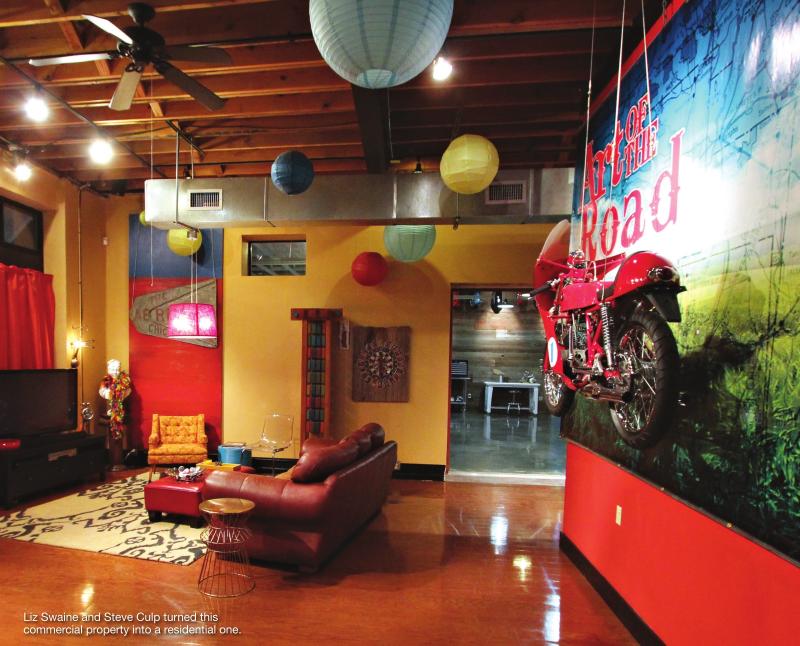
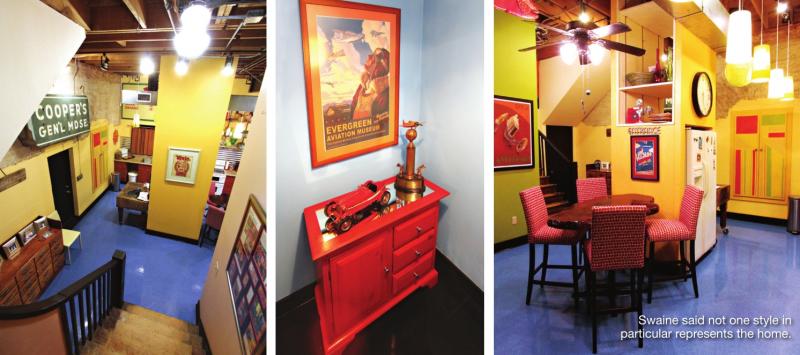
Liz Swaine and her husband, Steve Culp, had been looking for a place in downtown Shreveport for quite awhile when a friend recommended what was being listed as commercial property on Southern Avenue.
The building had most recently housed a florist company but had originally been a grocery store back in the 1920s. “That’s the great thing about this space,” Swaine said. “It can be either residential or commercial – or both.”
Culp
said the space approaches 5,000 square feet and is rock solid in a way
you don’t find in new buildings. “It was built by Sicilians in the
1920s,” he said. “And they built things really well. We had to break
through the exterior wall to add the arch to the new addition, and the
first thing we noticed was that they didn’t use mortar. They used
cement, which is great because the old mortar mix crumbles.” The job
that was estimated to take half a day ended up taking five men and five
days of work.
“The
shell of the building is original, but over the years, it had been
allowed to get into really bad disrepair,” Swaine said. “The roof had
partially caved in, and the floors had rotted away. The prior owners had
done a tremendous amount of work already before we moved in.”
Swaine
and Culp have remodeled and redesigned the living spaces themselves.
“Steve’s the go-to guy on anything that needs to be repaired or
changed,” Swaine said. “I’m the one who usually makes the decisions
about the décor and paint colors. Luckily, the prior owners had already
done the rewiring and installed lots of electrical outlets.”
The
space actually comes off as warmer than most
industrial/commercial-turned living spaces, largely due to the couple’s
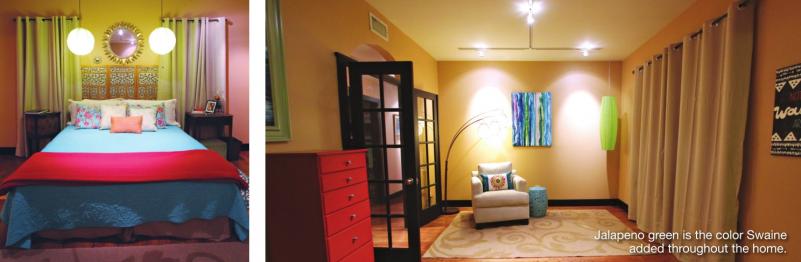
decorating style and the warm bright colors they chose throughout. “It
already felt pretty warm when we moved in here,” Swaine said. “The
finish on the wood floors adds to that feel. We changed some of the
colors on the walls. It’s very eclectic. There is no one particular
style that dominates the space. It’s quite the mix.”
Some
of the mix includes antique furniture from Culp’s parents along with
flea market finds and new items from World Market and IKEA. “We’ve mixed
chairs from online with modern abstract paintings. We find that
everything can really live cohesively and coherently together if you can
figure it all out. Color is a great way to pull things together. We
also look at design websites. There is no shame in borrowing ideas. My
best rooms have been something I’ve seen in a magazine, then taken that
concept and made it our own. Steve and I have been married since 1999,
and during that time, we have lived in four homes, and each of our homes
has been completely different in architectural style, in color, in
feel, in location. Every single space has inspired us in a different
way. The house really does tell you what it needs to be.”
The couple has accumulated some rare finds into their home such as vintage propellers from WWII planes and racing planes.
“This
one collection we have is because of Steve’s wonderful talent with
building airplanes and airshows,” Swaine said. “And because I’m a pilot,
we are drawn to airplane things. We’ve actually got some really cool
and rare things.”
Some
of those flying-hemed pieces include a piece of mail that flew on the
Hindenburg. Other framed pieces of pilots and military figures of note
line the hallway, including photos and memorabilia from Paul Tibbets who
flew the Enola Gay near the end of World War II, and a framed tribute
to young Russian female pilots who flew
against the Germans and were known as Night Witches. They also have
sketching and writings from characters such as German Field Marshal
Erwin Rommel to eclectic characters from aeronautical history.
Swaine
said the building still contains elements from when the space was used
as a grocery store back in the first half of the 20th century. “It was a
neighborhood grocery with Prince Albert in a Can and fruit in the
window,” she said. There is a chopping block placed at the foot of the
original wooden stairs that lead from the kitchen up to the living
spaces. “The reason it survived here is because the wheels were missing,
and it weighs about 400 pounds so there was no one that was going to
take this out of the building,” laughed Swaine. “So we inherited it, and
it is such an incredible piece.” There are photos of the original
Sicilian family members from the 1920s framed and placed around the
kitchen, which has a mid-century modern vibe that mixes well with the
modern industrial elements, bright colors architectural character.
The
kitchen’s quirky but streamlined charm comes from couple’s unexpected
uses of various items in their design. “Our backsplash is just $20 worth
of galvanized steel that we got at Home Depot,” Culp said. “If we had
used subway tile or granite, it would have been much more expensive. We
also kept the florist sink from the previous owners.”
“We have three sinks in the kitchen, and I don’t know how I ever lived without them,” added Swaine.
One
of the dominant colors in the kitchen is “Jalapeno Green” by Benjamin
Moore. “It’s almost a neutral,” Swaine said. “I’m telling you that these
kitchen colors are not the first that I tried. Some greens are almost
institutional.”
The
stripped and unfinished original stairs that lead from the kitchen to
the upstairs living quarters is lined with the original plaster from the
early 20th century. “It has just fallen out in places over the years
and you can see some cracks, but we think it looks kind of like an
archeological dig, and we like it this way,” Swaine said. “Plus, this is
another one of those arts and trades from another time so finding
somebody who could replicate that would be pretty impossible.”
The
living quarters are still intact, but the ceiling has been lowered to
cover the modern ductwork. The original upstairs bathroom still contains
some of its 1930s-era aqua blue ceramic tile, sink and fixtures. There
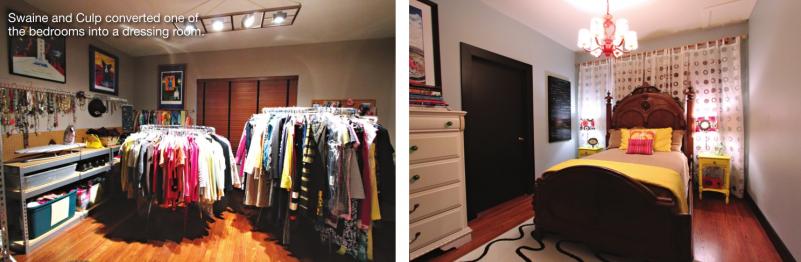
are four bedrooms, but the couple uses one of the smaller ones as a
large dressing area and closet, and another bedroom is being utilized as
an office. The large master bedroom has been modernized with plenty of
outlets and track lighting but still retains the character of the
original structure. Swaine chose chinoiserie colors and used an old
carved screen as a headboard and a few Asian elements in the mix. The
center of the room has an original arch that separates the sleeping area
from a sitting area.
Also
remaining in the upstairs living quarters is a small, wood-trimmed
arched alcove where the original Sicilian family housed a shrine and
altar for their daily prayers.
Swaine
maintained there is no downside to living in these types of spaces.
“It’s easy to live here, easy to clean,” she said. “It doesn’t require
anymore maintenance. You get spoiled spreading out in the space.
Maintenance is minimal because the prior owners did so much to the
space. They redid systems, wall, flooring, windows … mainly what we had
to do was aesthetics.”
That
systems prep and inspection is crucial to getting it all right.
“Whenever we move into a new space. the last few days before we move in
I’m walking around with a razor blade, checking out things because once
you move in, you just live with it,” Culp said.
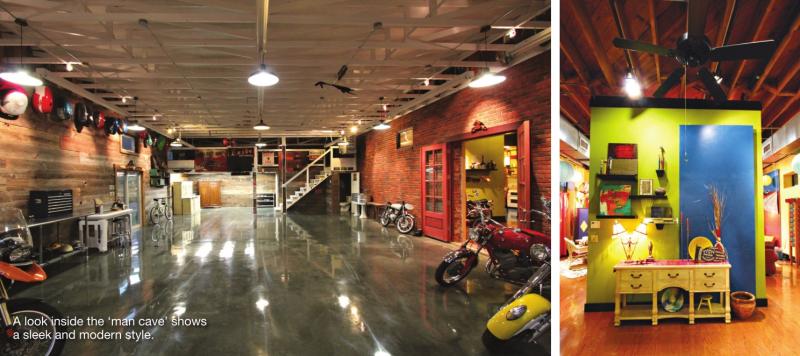
There
is also a new addition that Swaine refers to as “Steve’s man cave,
workshop and gallery space. But we’ve had parties and art exhibits
there, too,” she said. The floors are highly polished concrete with
custom color swirled through it that reads as a dark textural gray. The
walls are covered with hemlock planks that came from a 19th century
northeastern barn. The exterior wooden garage-type doors are from an old
building on Texas Avenue and probably date to around 1900. The doors
still bear 100-year-old bullet holes.
Culp
and Swaine love the space as it is, but they don’t mind putting it on
the market because they are ready to tackle their next project. “We
bought a building downtown, and it’s everything we tell people not to
do. It’s really big and in pretty bad shape, and it’s going to cost an
arm and a leg, but with a good enough price that even if we get into it
and can’t make it work, we can sell it and not lose our shirts,” Swaine
said.
Culp
added, “We’re going from 5,000 square feet to 54,000 square feet with
20,000 square feet of basement. Some of it will be residential, and
we’re just going to do it in phases.”
“The
best thing about eclectic older spaces is that they are so versatile,”
Swaine said. “And it’s really neat to be able to help save history. I
can’t credit the previous owners enough because they did save it. They
formed a relationship with the original owners until they agreed to sell
it to them. There’s no telling how much longer it would have survived.
There are so many properties ripe for this type of rehab. You just have
to think outside of the box.”