
A New Perspective from the Shreveport Skies
Business is looking down for Mike Sledge, which is just how he likes it.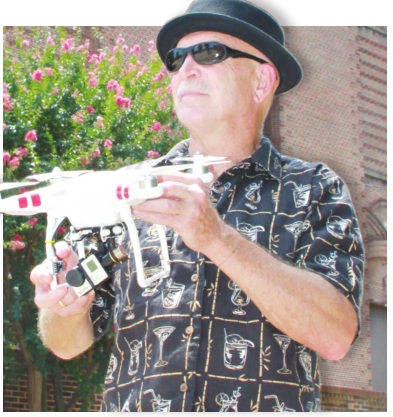
Sledge
owns Bird’s Eye View Photography and Video Production based in
Shreveport. He uses drones, remotecontrolled flying vehicles to
photograph people, places and things from aloft.
He
started the business almost by accident. He was trying to get a
specific shot for an entry in the Louisiana Film Prize competition and
began researching companies that offered aerial photography. Once he
discovered the capability of aerial photography from drones, Sledge was
instantly a fan.
He’s
not alone. It would not be a stretch to say drone equipment has been
flying off the shelves, if sales figures are any indication.
In
a recent report on its website, Fortune Magazine cited a report by the
Association for Unmanned Vehicle Systems International forecasting the
total domestic economic impact will reach more than $82.1 billion
between 2015 and 2025. It forecast the creation of more than 100,000
high-paying jobs in the process. Those figures were based on the Federal
Aviation Administration meeting a 2015 deadline for integrating
unmanned aircraft systems into the national civilian airspace. Those
high-tech jobs would in turn create millions in tax revenue and
additional economic impact as a result.
All
of that is, of course, speculation at this early phase of the drone
story, but a quick Internet search revealed prices ranging from $100 to
several thousand dollars for different models.
As
popular as the niche hobby/industry has become, it is not without its
critics. Issues have arisen concerning the safety of operating the small
aircraft in the vicinity of full-size aircraft and around sensitive
infrastructure and private property. Those concerns have, in turn,
driven discussion of freedom to engage in the hobby/industry on First
Amendment and Commerce Clause bases. It’s also being closely monitored
by the FAA.
In this
month’s issue of AOPA Pilot, Bruce Landsberg, president of the Aircraft
Owners and Pilots Association, wrote that the FAA convened a group to
study the issues in 2007, concerned about the potential growth of the
drone industry. Despite the intervening period, there are not yet
clear-cut regulations in place. That’s a situation Landsberg said
concerns many aviation industry observers.
He
writes that unmanned aerial systems pose a number of problems, but they
also open some great opportunities for general aviation. Landsberg and
Sledge both say safety comes high on the priority list. Sledge put it
atop the three major factors revolving around the UAS debate, safety,
privacy and First Amendment concerns.
Those
concerns deal with whether flying things around the countryside might
be dangerous to people or property if they should crash, how individuals
protect themselves from some peeping tom drone hovering around the
windows, and how the discussion affects drone owners’ rights and what
those rights entail. Landsberg said privacy issues and the like are the
prevue of the state and federal courts and not the job of the FAA to
police or dictate.
In
1981, the FAA issued an Advisory Circular covering model aircraft. The
AC instructs pilots of these aircraft to maintain a safe operating
distance from active airports and populated areas. It discourages
operation around spectators until the craft are proven safe and
prohibits flying the craft above an altitude of 400 feet.
Sledge
said, “Ultimately, it comes down to operator responsibility.” He said
he does a pre-flight check much like the ones done on full-size
aircraft.
 He
also said he tries to use a spotter, someone who can provide an extra
pair of eyes to watch his drones when they are on assignment. He said he
does not fly over people in case of a mechanical failure to minimize
the risk of injury.
He
also said he tries to use a spotter, someone who can provide an extra
pair of eyes to watch his drones when they are on assignment. He said he
does not fly over people in case of a mechanical failure to minimize
the risk of injury.
Apparently,
not every drone flyer is as responsible as Sledge. Landsberg said the
highest-profile incident involving a UAS involved a close call with a
regional jet in Tallahassee, Fla., last March. The smaller craft
reportedly came within 2,300 feet of the commercial carrier, which was
inspected for damage on landing.
Landsberg
wrote, “There have been numerous other mishaps – some amusing, others
not so much – that punctuate the news, but the reality is that UAS hold
tremendous potential for both good and ill. The challenge is to find the
balance.”
“Responsible
ownership is the key,” Sledge said. “Currently, it’s the wild, wild
west out there.” The local entrepreneur said, however, the potential for
good in the UAS field is virtually limitless. He said there are
applications for farming, geography, search-and-rescue operations, real
estate and more. He said the drones could provide a vantage point for
police and firefighters to assess critical incidents and devise
appropriate action based on real-time observation. He explained that all
those potential applications make it imperative that sensible
regulations be adopted by the FAA and other jurisdictions.
Those
possible uses are becoming more apparent to enthusiasts of all stripes,
Sledge said. New ideas about how to make money with drones have been
fueling the explosive growth in the field, he indicated, and, “there’s
no putting the genie back in the bottle now.”
Sledge
likened the coming of drones to the appearance of small, portable video
cameras like the “GoPro.” He predicted that in five to 10 years, the
UAS market will have settled out and be an old, reliable technology
about which no one gives much thought. In the meantime, he said, “Things
are very much in flux. There will be some unpleasant instances,” and
noted the national parks have already banned the use of the unmanned
vehicles on park property. But in the long run he said, “I am optimistic
that balance will be achieved.”
Sledge
believes many of the concerns surrounding the safe usage of the drones
can be controlled by the software that is required to operate the craft.
He believes that limitations can be hard-wired into the programs to
make it highly unlikely that users could accidentally overreach the
crafts’ capabilities or take them where they shouldn’t go. Size and
lifting capability limits, he said, would go a long way toward
controlling the use of the drones.
He’s
somewhat less convinced that legislative intervention would be more
effective. “Laws, ordinances and regulations tend to create more
confusion than correction,” he said.
Each
drone unit consists of a lifting body – a vehicle capable of carrying
loads in three dimensions – a remote controller, the photography gear
and a means of monitoring the flights. He said there are places on the
Internet where the curious or the interested can shop for or compare the
models currently available.
On
his Facebook page, Sledge has compiled some of the work he’s already
done in the area. It includes motion photography of buildings and
landmarks and still photography of extremely high resolution. He has two
different drones in his inventory. Both are capable of shooting still
or motion photography.


