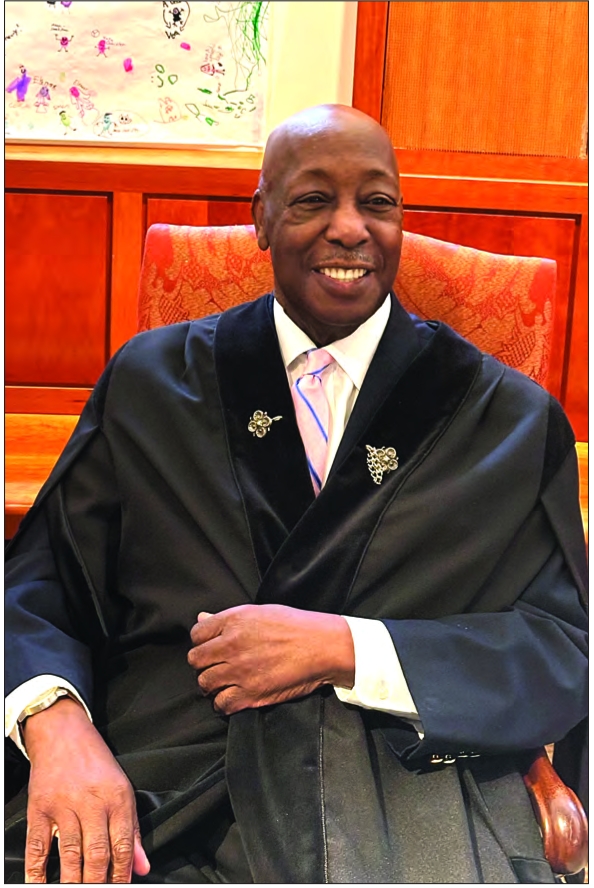
Bob Yearwood, now retired, plans to volunteer at the church as verger emeritus and spend more time with family.When Bob Yearwood hung up his black cassock on Easter Sunday this year, it marked the end of an era. Yearwood, who arrived at Trinity Church in the Back Bay in 1970, is retiring — but his name will live across town, in a building that houses some of Boston’s most vulnerable residents.
Known affectionately as the “Mayor of Copley Square” — a nickname earned over 56 years of welcoming everyone from presidents to local residents with a warm exchange and a ready fist bump — Yearwood served as the church’s verger, the lay minister who leads worship processions and oversees the sanctuary. At the time of his hire, he was stepping into an entirely new position — moving from construction work at a low-cost housing corporation in the South End to becoming a sexton, the church official who manages facilities, maintains the building and acts as the initial point of contact for all who enter. “First day at Trinity was a little on the nervous side because you’re in a whole different environment,” he said. “You never think that you’re going to end up [staying for] 56,” he said.
Yearwood was hired by then-rector Dr. Theodore Parker Ferris, on the recommendations of Rev. Tom Kennedy, then an assistant minister at the church, and his colleague Sam Tyler. The two men had reached out to Rudy Waker, who ran the South End Low-Cost Housing Cooperative — a nonprofit that Trinity Church had helped found — looking for someone to assist the retiring sexton.
“Rudy Waker said, ‘I have the perfect person,’” Kennedy recalled. “We trusted Rudy and that turned out to be one of the great hires in the history of Trinity Church.”
What began as a facilities role evolved into something much harder to define. On any given day, Yearwood might manage building operations, greet visiting dignitaries, sit with someone in need of guidance and press gold coins into the hands of children during Epiphany. In addition to Trinity, he regularly visited Rosie’s Place, a women’s shelter in Boston. Over the years, he became an institutional symbol of the parish. Yearwood understood that his role was about “the people,” and he took that lesson with him throughout his career.
Whatever the requirements of the job, however, one constant was how most people who passed through Trinity’s doors left feeling the warmth of Yearwood’s welcome. Kennedy said colleagues and parishioners recall Yearwood’s “uncanny ability” to remember names and faces — sometimes decades after someone had last set foot in the church.
“We realized this because of his personality. He looked upon the human heart, not to judge it, but to love it,” Kennedy said. “He was probably one of the best pastors the church has ever had.”
Those qualities are something that the Rev. Karen Coleman, who now serves as assistant priest at the church, remembers from when she arrived at Trinity as a divinity student in 2000. Yearwood “just made me feel comfortable,” she said. “He always said words of encouragement.” His presence at the front desk made it a kind of gathering place where everyone, including people experiencing homelessness, would stop and sit down for a conversation, Coleman added.
It’s Yearwood’s more than 30 years of ministering to homeless individuals in Copley Square that also earned him the honor of having his name on a building that serves that population. In 2006, Trinity Church made a significant gift to help the unhoused through its continued work with the Pine Street Inn. In 2006, the shelter purchased a 22-unit, single-room occupancy property for additional housing, a building that opened in 2011 and has since borne Yearwood’s name. “Never in my wildest dreams did I think I would get a house named after me,” Yearwood said.
On May 31 — Trinity Sunday, the high feast day of the Episcopal calendar — the church held a special celebration in Yearwood’s honor, with a single worship service at 10 a.m. The service included remarks by Rector Morgan Allen and a proclamation read by Kenzie Bok, the Boston Housing Authority administrator and a parish member, who spoke on behalf of Mayor Michelle Wu, who officially proclaimed May 31, 2026, as Bob Yearwood Day in the City of Boston. Bok also shared, off-script, her personal connection to Trinity Church and Yearwood: “I had the blessing of being baptized here in this church 36 years ago in that font over in the corner — and Bob’s got 21 years on me.”
While it has been more than a month since Yearwood’s last day, he will remain connected to the church as verger emeritus — a title bestowed to a retired verger, serving as a volunteer. He plans to keep Tuesdays at Trinity’s Clarendon Street desk and lend a hand to his community when he is called to. Now retired, Yearwood will be spending more time with his family and loved ones as well.
“He has meant so much to so many people. And you know, it’s bittersweet,” Coleman said.
As for what he hoped people might take from his example, Yearwood kept the message simple: “It’s all about service. There’s a lot of people out there who need your service. …You gotta make peace with everybody,” he said, adding, “Remember, you’re not [just] a priest, you’re a human being.”