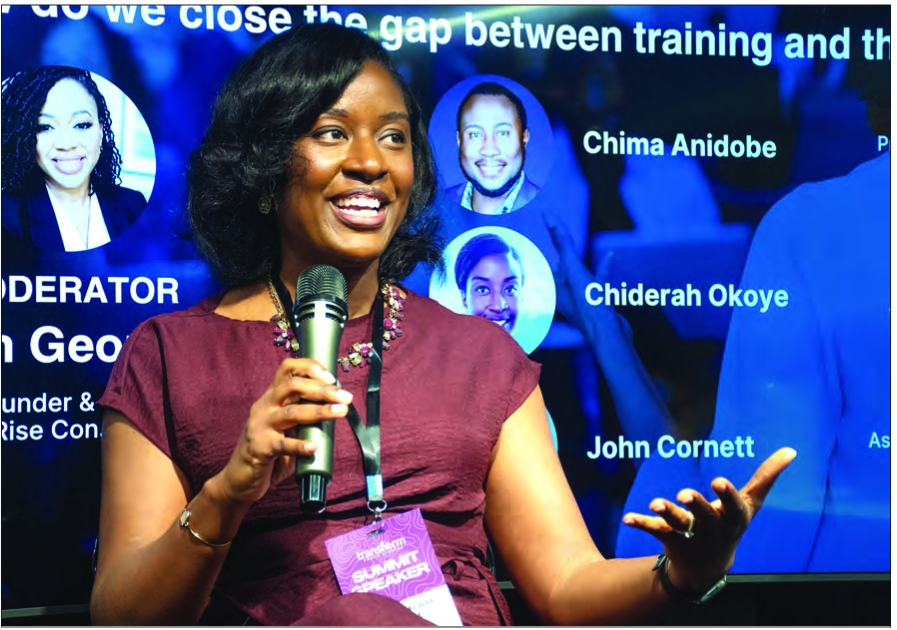
Chiderah
Okoye, managing director at Transform Power Systems, speaks on a panel
about workforce development in the clean energy sector, at TPS’s annual
summit, May 14. The event included a focus on equitable growth in the
sector for businesses, workers and communities of color.
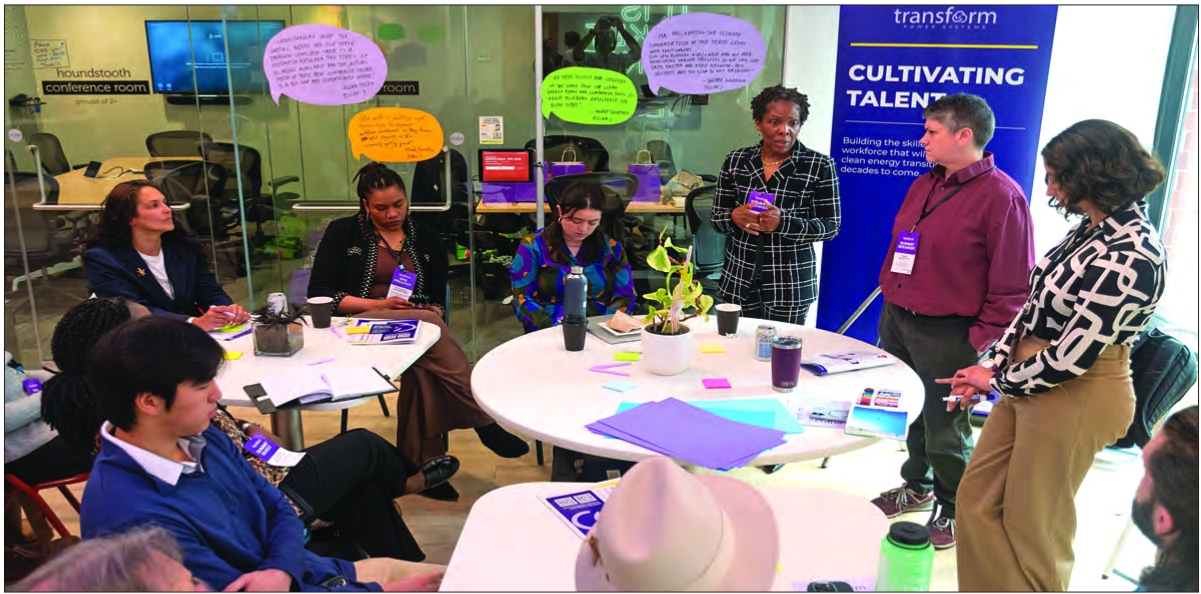
Attendees
brainstorm solutions to a case study at the Transform Power Systems
summit, May 14. The event included a focus on equitable growth in the
sector for businesses, workers and communities of color. Anyone in the clean energy sector knows what an uphill climb they are facing. From struggles to fund clean technologies to getting people to adopt them to bringing politicians on board to pass laws that incentivize making the switch, those in the clean energy space are no strangers to challenges.
A conference, held on May 14 at the Cambridge Innovation Center in Kendall Square, brought many of those challenges to the front and center, with a special focus on continuing to grow clean energy infrastructure in Massachusetts.
“Our intention is that these projects get delivered here … and that we all get brought along,” said Chiderah Okoye, managing director of Transform Power Systems (TPS), the electrical engineering firm that hosted the conference and whose work centers diversity and equity in the clean energy sector.
The conference, which saw over 50 attendees representing clean energy businesses, community groups and local green nonprofits, was not the first run by TPS, but it represented an expanded focus. In its day-to-day work, the organization focuses on three areas: ensuring quality in new clean energy systems, equitably expanding the industry’s workforce (which has largely been the focus of previous conferences), and making sure benefits from new clean energy are fairly distributed across all communities.
A prevailing topic of discussion throughout the day was earning the trust of communities of color. Residents in neighborhoods like Roxbury may be hesitant to put solar panels on their roof without seeing others in the community do it first — part of why James Owens, president of the Edward L. Cooper Community Garden in Roxbury, said he’s looking to put an array on his own home.
It’s
an effort that Lisa Dobbs, a senior program manager at the
Massachusetts Clean Energy Center, the state’s quasi-public clean energy
economic development agency, described as “seeding” the community with
examples of the technology at work.
“When
you see your neighbor has solar, you get more comfortable with it,”
Dobbs said. “Or they can do an open house, or it sort of conditions you
and there’s that sort of social aspect.”
Another
source of mistrust is the people going door-to-door to sign people up
for third-party solar or electric contracts.— This is especially the
case with the electric suppliers, who have faced allegations of
targeting communities of color and those with limited English
proficiency in deals that can mean higher energy costs with limited
benefits.
But that
mistrust can bleed over into other spaces, including thirdparty solar
suppliers — companies that install solar panels on individual homes,
then lease those panels and the energy they generate to the homeowners.
The civil rights organization the Urban League of Eastern Massachusetts,
too, has also faced distrust while running a push to inform residents
about heat pumps.
At
the summit, Christopher Scranton, an Urban League board member, said
that even when staff wear jackets branded with the Urban League logo,
residents have been hesitant to open their doors and chat.
Other challenges that speakers highlighted were around access to capital funding, especially for businesses of color.
Shonte
Davidson, CEO of the electric vehicle infrastructure company Better
Together Brain Trust, said the company is “completely bootstrapped,” as
it tries to balance taking on new projects with the staffing needs those
projects would require.
It’s
a balance that is widespread across the clean energy industry, said
Allan Telio, founder of Balance Rock Consulting, which does work in the
clean energy sector.
“There
is currently a mismatch in terms of the funds that are available and
the types of companies that need to be funded in order for this to grow
here,” he said.
Speakers
said that access is further challenged by the fact that developing
clean energy infrastructure isn’t the kind of dramatic work that easily
attracts investors.
Okoye
said that the kind of work TPS supports isn’t the “cool stuff,” like
experimental new technologies, but rather is the kind of infrastructure
development that will keep things in the region running.
Davidson
agreed. “We’re not sexy — I mean, we’re a goodlooking team, but we’re
not in climate technology,” Davidson joked. “By and far we’re a services
company.”
The
expansion of the sector offers opportunities to foster a diverse
workforce — something on the mind of individuals of color, like
Davidson, who are working in the industry. But fostering that workforce
requires funding.
“The truth is, if we’re capital constrained, you can’t bring people in,” Davidson said.
For
Okoye, it was important that the summit wasn’t just a social event or a
chance to share information, but rather a chance to build connections
and “start to do better” in the clean energy ecosystem. During closing
remarks, Okoye said that industries in Massachusetts tend to move fast
with a desire to solve problems immediately, in a way that can “miss the
mark.”
Having the kind of conversations featured at the summit can help address those gaps, she said. Part of that “miss the mark” concept,
she said, is that developing industries like clean energy are still
identifying the metrics that will help new development be equitable.
“There
are things that we’re very good at measuring that I can say
unequivocally do matter —was the project delivered on time? Was it
without failure and unanticipated delays? Did we keep it within budget?
We can do that all day,” she said. “But projects now often require a
level of community input. And that’s great, but what that looks like is
very different, and we don’t have standard ways that we’re measuring
community outcomes.”
Work
in the clean energy sector has also been impacted by changes in the
federal government in recent years — a fact that was not lost on
speakers at the conference.
Those
changes have required a lot of pivoting, said Elke Trilla, an attorney
with the law firm Wilson Sonsini Goodrich & Rosati, who works with
clean energy companies.
But many speakers said they’re optimistic.
Trilla said that state
leadership, as well as academic institutions fostering innovation, will
help keep things moving. It was a sentiment echoed by Joseph Curtatone,
vice president of government affairs and strategy at indiGO
Technologies, an EV company.
“Massachusetts
— notwithstanding what’s happening in Washington — is one of the
leading states that’s going to make sure … we don’t turn back,”
Curtatone said.
The
potential to develop solutions is particularly pressing as gas and
energy prices rise due national and global factors, Trilla said.
According to the U.S. Energy Information Administration, natural gas
prices in Massachusetts were nearly 75% higher in February this year
than they were five years earlier.
“There’s a real opportunity for us to stand in this moment and find solutions,” Trilla said.