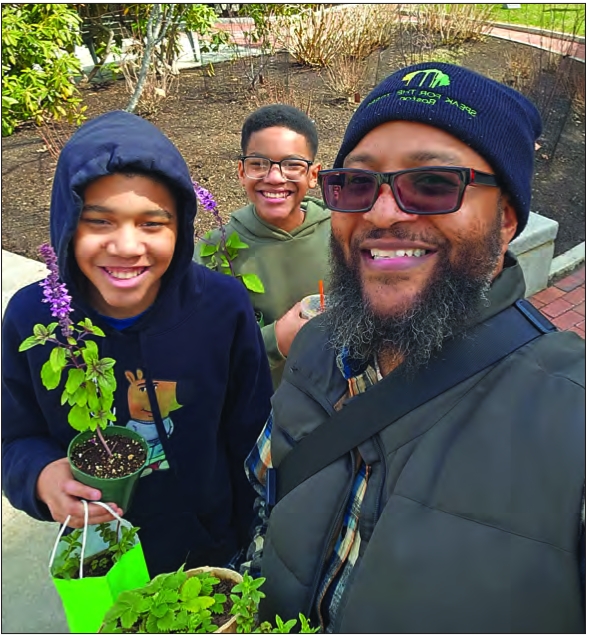
SFTT Director of Community Outreach and Engagement Jarel Ferguson and his children. Throughout his life, Jarel Ferguson remembers always being fascinated with all things nature: the bugs, trees and animals.
Some of his core memories as a youth were when his mother took him to Franklin Park.
“I was always enamored by all of the beautiful trees that were there and the birds I would see. Franklin Park was just like heaven at that time,” he said.
Yet when he could return to his home in Roxbury from these trips, Ferguson recognized that it did not look the same.
As he grew into an adult, he worked in different industries, yet knew that they were not the right fit, as he had a desire to help people and make the world a better place.
Yet, when he began his first nonprofit job at the Food Project in Roxbury and Dorchester learning about the science of how to grow food and vegetables on a farm — that spark he felt for nature as a kid came back to him.
After leaving the Food Project with this realization, the COVID-19 pandemic came and everything was shut down.
All was not lost for him, as he received a call from the executive director of Speak for the Trees who offered him a position with this organization.
Since that phone call, Ferguson has been working in the role of the Director of Community Outreach & Engagement for the organization, whose mission is to “work together with Boston community members to plant, preserve, care, and advocate for trees, [along with] expand[ing] the tree canopy in order to rebuild resilient neighborhoods,
safeguard the health of all residents, [and] repairing historic
injustices that persist today as environmental inequities in urban
communities,” he said.
“I
was able to further continue and develop my passion for the natural
world, for green spaces in our urban environment [and] understand the
science about why trees are important: the benefits that they give us.
Other than oxygen, they give us shade, they give us comfort, they help
us with our mental health…I’m just able to continue [to do] what I love
[and] continue what I do in the community.”
Ferguson
has great joy in being able to serve in the same neighborhoods he grew
up in, as he was born in Mattapan, raised in Roxbury, and currently
lives in Dorchester.
“Speak
for the Trees was founded in 2018. I’ve been with the organization for
nearly five years now, as the Director of Community Outreach Engagement,
and my work [is] a meaningful experience for me. This work is about
much more than just trees. For me, it’s more about the people, our
neighborhoods, our overall health, and making sure our communities have
the resources that we deserve,” he said.
“In urban communities, we
are really trying to improve the quality of life. Trees do help reduce
heat, improve air quality. We know trees give off oxygen, so that’s a
given. Trees also manage storm water, like from the heavy rains that we
get from all the heavy snow. Where’s the water going to go? It goes into
the tree pits. It…also help[s] make our neighborhoods feel more
welcoming. When we have trees, it looks like people care about the
community.”
He also
adds that particularly in Black and brown communities, access to a
healthy tree canopy and green spaces is not always equitable, which is
why the work that Speak for the Trees does is important as it helps to
fill the gaps and brings real benefits to community members who live
there.
Ferguson also
talked about how the organization educates Black and brown communities
about trees. One of their educational programs is called The Tree
Keepers, which is designed to create tree stewards by teaching community
members how to identify trees, take care of trees in their communities.
“We
directly engage with the people we have...we have monthly sessions
where we invite the community in to speak to our trained arborists…[and]
to our education manager to learn about trees and why they’re so
important. These classes that we host are about two to three hours, and
once you finish the class, you’re…a tree keeper,” he said.
He said that this particular program also teaches community members how to advocate for the trees.
If
a tree in their community or any community is under the threat of
destruction - getting the neighborhood around [to] rally together to
save the trees…a lot of that has actually happened more than most people
realize through all the development that’s going around in Boston,” he
said.
“Particularly in
Black and brown communities, these developers are coming in, and
they’re trying to change the landscape… they’re changing the landscape,
primarily starting with putting up new buildings, tearing down old trees
that have been in the community for hundreds of years — they do it
knowingly or even unknowningly.”
Ferguson shared his advice for someone who may enter the environmental space for a career — like he did.
“My
advice would be to start with something that they care about. Start
with what feels real and with that, build something that connects to
your values and to the needs that you see around you…It doesn’t have to
be perfect in the beginning, but it needs purpose. Everything needs
purpose,” he said.
“Whether it’s trees or a business, it’s all about planting a seed.
It
sounds cliche for my business [and] for my work, but we use a lot of
tree puns…You plant a seed, you nurture what matters. You have to be
patient with it, patient with the process, because it takes a long time.
Then over time, it’ll grow into something bigger than what folks even
imagine. I just think that you really just have to keep showing up and
find the passion that you’re passionate about.”
ON THE WEB
Learn more at treeboston.org