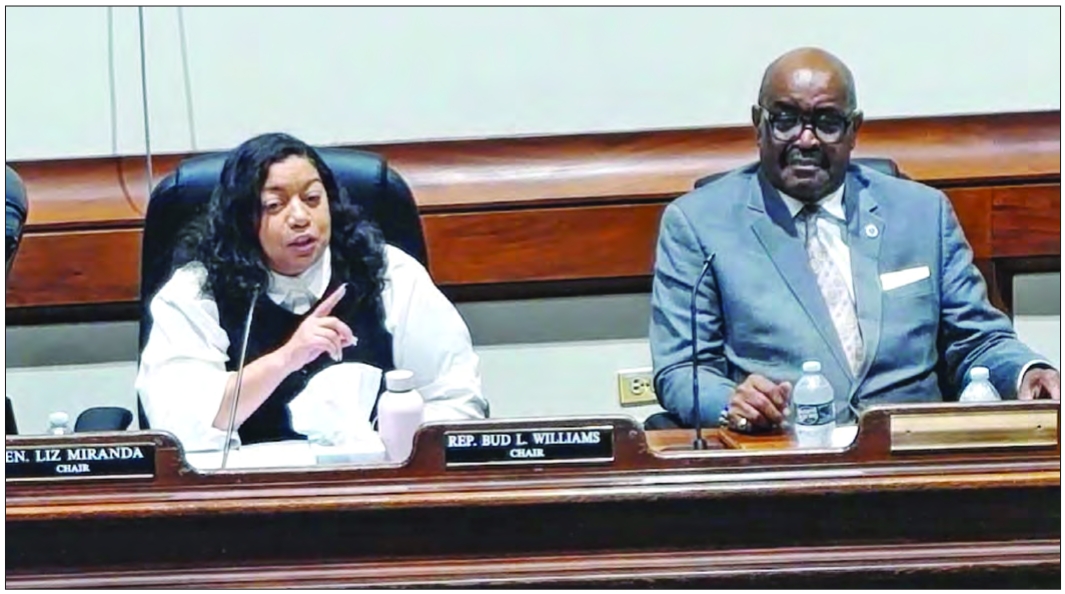
Sen. Liz Miranda and Rep. Bud Williams, co-chairs of the State’s Joint Committee on Racial Equity, Civil Rights and Inclusion, hold forth at the hearing on the impact of federal policy on the racial wealth gap, March 31. 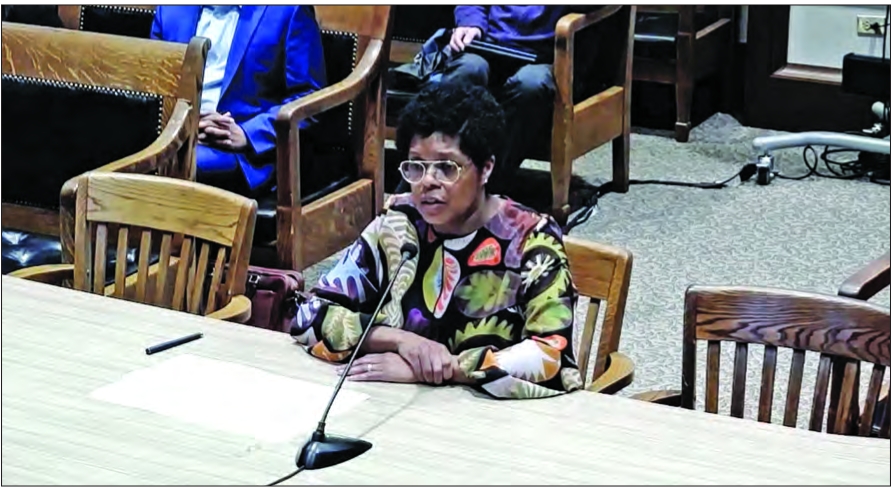
Nicole
Obi, president and CEO of the Black Economic Council of Massachusetts
testifies at the legislative hearing hosted by the State’s Joint
Committee on Racial Equity, Civil Rights and Inclusion, March 31.
Experts at state hearing warn of widening disparities, seek solutions
Changing federal policies could worsen the racial wealth gap, experts at a hearing hosted by the State’s Joint Committee on Racial Equity, Civil Rights and Inclusion said.
“Today’s hearing is about more than naming the problem, it’s about deeply understanding the role federal policy plays in creating the disparities and what Massachusetts can do to fight back,” Sen. Liz Miranda, co-chair of the joint committee, said at the hearing.
At the heart of the hearing was a question about how the Trump administration’s policies — including the passage of the One Big Beautiful Act, newly-imposed tariffs, and the rolling back of diversity, equity and inclusion (DEI) efforts — could impact the wealth gap, the trend that households of color tend to hold less wealth than their white counterparts.
Nationwide, the median white household holds about six to seven times more wealth than the median Black household, and about five times more than the median Latino household. A 2015 report from the Federal Reserve Bank of Boston posited that in the Greater Boston area, white households had a median wealth of $247,500, while Black households had a median wealth of $8.
Kimberly Goulart, a senior research analyst at Boston Indicators, the nonprofit Boston Foundation’s research arm, said in testimony at the hearing that the legislative changes in the One Big Beautiful Act, through changes it made to the tax code, could increase financial instability for lower-income families while generating savings for wealthier households. The act also included cuts to Medicaid and the Supplemental Nutrition Assistance Program (SNAP), which are expected to further cut into low-income households’ ability to create and preserve wealth.
Experts
at the hearing warned that the cuts to Medicaid and SNAP through the
federal law are an intentional choice to generate savings to balance out
tax cuts passed first in 2017 and made permanent in 2025.
“The
federal government’s policies are on purpose,” said Vivian
Abreu-Hernández, president of the Massachusetts Budget and Policy
Center, a think tank focused on state budget and tax policies. “This is
not by mistake. The federal government is cutting close to $1 trillion
in social services because it gave $1 trillion in tax cuts to the
wealthiest and the corporations in the United States.”
According
to estimates by the Congressional Budget Office, those tax cuts mean
families making more than $1 million could see $90,000 in tax relief.
That figure for those making less than $50,000 per year could see about
$300 in tax relief in 2027.
“Because
wealth in the U.S. remains disproportionately concentrated among white
households, the central concern is that, taken as a whole, [law] largely
benefits those who already hold substantial assets already,” said
Goulart, whose testimony at the hearing centered on an October Boston
Indicators report she helped author aimed at forecasting the law’s
potential impacts on the wealth gap.
“This could exacerbate the racial wealth gap.”
That
piece of legislation also established the formation of Trump Accounts, a
baby-bondsstyle system, intended to invest in Americans when they’re
born. But experts at the hearing said the goal of those accounts don’t
seem to be playing out because those accounts weren’t set up in a way to
explicitly help low-income communities.
That’s
because after the government makes an initial deposit, the main
benefits will come from individuals who can invest more in them, said
Jeff Fuhrer, a fellow at the Brookings Institution, a think tank, and
former director of research at the Boston Federal Reserve. In testimony
at the hearing he said that the setup will be poised to help high-income
people who don’t need the additional support.
“We don’t need to help them.
What
we need is some government money to help folks who do not have the
capacity to save right now,” he said. “It’s not that they don’t know how
to save or don’t have the incentive to save. They don’t have the
disposable income to save. Until we fix that, we’re not going to fix
anything.”
Others at
the hearing pointed out that the pilot program also doesn’t
automatically enroll all eligible families — a step Goulart said would
help ensure the families who need access the most are included. The
program also has yet to provide guidance on how balances in the accounts
could impact eligibility for other safety net benefits that depend on
household wealth.
Beyond
the policy changes, experts who testified at the hearing also spoke
about the Trump Administration’s DEI pull-back. Almost as soon as he
took office, President Trump signed an Executive Order overturning
Biden-era DEI efforts in the federal government. Changes at the federal
level have marked a broader shift, as companies, too, have pulled back
on or dropped entirely DEI policies they had adopted in recent years.
That
has created a chilling effect on diversity efforts, even in sectors
where no policy has been implemented or the Trump Administration doesn’t
have the authority to set requirements.
Nicole Obi, president and CEO of the Black Economic Council of Massachusetts (BEMCA), a nonprofit focused on
building Black wealth and entrepreneurship, said that the shift has led
to contracts being delayed, narrowed or denied. For Blackowned
businesses, those contracts are an important way for firms to grow, she
said.
The issue is
compounded by federal funding cuts to the education, health care and
nonprofit sectors, all of which are major purchasers from small
businesses, Obi said.
“As
these institutions pull back, Black-owned firms lose contracts and
revenue at the very moment costs are rising,” Obi said, pointing to one
BEMCA member who has lost over one-third of his revenue from the loss of
contracts with nonprofits, particularly in the education and health
sectors.
Another
prominent focus at the hearing was the importance of maintaining access
to accurate, detailed data to track statistics on labor and business
outcomes.
In some cases, access to that data is hampered by changes in data collection and availability from the Trump Administration.
Experts have said that budget cuts at the federal level have led to reduced or eliminated federal data sets.
“When
data is delayed, reduced or no longer disaggregated, inequalities
become harder to identify and address,” Obi, who called on state leaders
to continue and expand state data collection and distribution, said. “Policymaking without data makes it harder to address long-standing and newfound challenges.”
Already,
Boston and the state are expecting to see new data that will help
inform efforts to close the racial wealth gap. In 2022, the Boston
Federal Reserve announced it would update its 2015 “Color of Wealth”
report, which will look at racial wealth gaps in all of Massachusetts
and not just Boston, drilling down on data specifically from Black,
white and Latinx subpopulations.
An
initial summary of that report is expected to be released by the end of
the year. “Having that data in hand to update what he had from 2015 is
critical,” Fuhrer said. “Start with the data.”
For
some of the persistent challenges behind the racial wealth gap, state
officials at the hearing said they had efforts in place to try to
support residents.
Lauren
Jones, secretary of the Executive Office of Labor and Workforce
Development, pointed to the MassHire network that connects job-seekers
to employment opportunities. She also pointed to her office’s work k
supporting unions and the trades as a path to good employment, wages and
benefits, as well as to English-language learning programs to create
new paths to better employment for non-English speakers.
Juan
Vega, assistant secretary of communities and programs at the Executive
Office of Economic Development, touted state efforts to foster more and
diverse small businesses, including steps like technical assistance, as
one way to try to help close the racial wealth gap.
“The racial wealth gap is also a racial entrepreneurship gap,” he said.
Dr.
Kiame Mahaniah, secretary of the Executive Office of Health and Human
Services, pointed to the state’s Advancing Health Equity in
Massachusetts initiative. Poor health outcomes impact and are impacted
by poverty in the state, he said.
The
state secretaries who testified at the hearing also used the event as a
chance to advocate for funding for their respective offices as the
state moves through its annual budget process, slated to be finalized in
July.
Ultimately,
experts at the hearing said that addressing the wealth gap is not just a
matter of responding to actions from the current administration, but to
take a more historical view, referring to the fact that current gaps in
wealth are a result of the U.S.’s racial history.
“Can
we leverage our work across the legislature and across secretariats so
we can really boost up the quality of life?” Mahaniah posited. “How do
we reverse 400 years of policies? How long will it take you? 400 years
is a long time to be having a bad policy.”