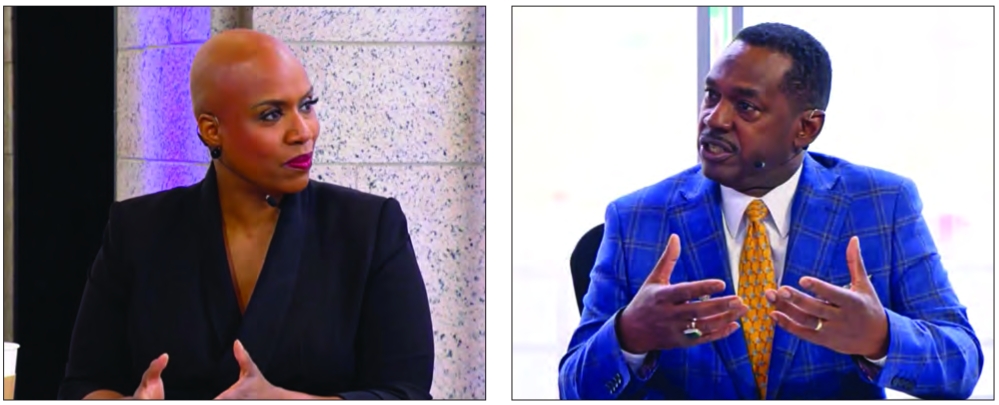
The
Bay State Banner’s Ron Mitchell in conversation with U.S. Rep Ayanna
Pressley during a live taping of “GBH Amplifies” on March 20.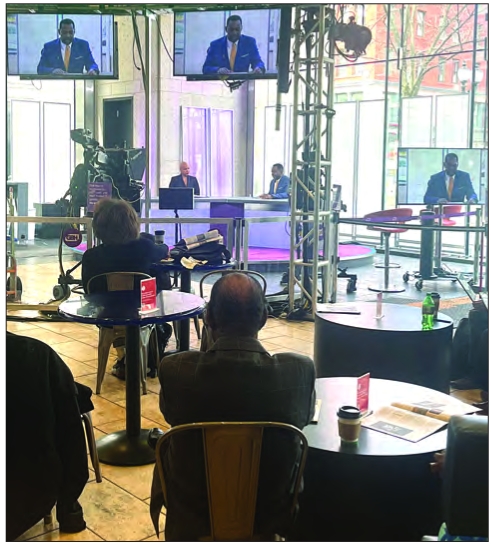
The live taping at GBH Studio at the Boston Public Library.
In conversation with Banner editor and publisher Ron Mitchell on March 20, congresswoman Ayanna Pressley talked about her inspirations and hopes for the future. As part of a live taping of the “GBH Amplifies” series in partnership with The Bay State Banner and in honor of Women’s History Month, the conversation delved into Pressley’s upbringing and experiences that drive the historic work she undertakes today.
Pressley grew up in Chicago, crediting Harold Washington and Jesse Jackson as some of her heaviest influences as to how she works today. She also cherishes her parents, Sandra Pressley and Martin Terrell, as her first teachers.
“My mother raised me alone while my father was battling substance use disorder and was incarcerated during my formative years, and that was an education,” she said.
Watching her father be incarcerated rather than treated opened her eyes to the injustices of the carceral system and how it separates families. Despite the wrongful criminalization of his addiction, with access to Pell grants, he earned two degrees while incarcerated, and his Ph. D. upon being released.
Forced to raise her alone, Pressley’s mother juggled work without being able to afford childcare. Pressley recalled her mother returning home telling her about how her male counterparts that she trained were often promoted over her, and the struggles that came with being a Black woman.
“She
said to me, “to be Black is a beautiful thing and something to be proud
of, but you’ve been born into a struggle and I have an expectation that
you will do your part in that struggle.’”
Growing
up, Pressley quickly found her strength in public speaking. With major
influence from Black media such as the Chicago Defender, she described
how even her coloring books were embedded with pride picturing children
with afros, their fists raised. She credited Chicago as the city that
raised her but said Boston is the city that changed her.
Pressley
came here to attend Boston University, where she studied political
science. She quickly became an influence on her campus, serving as
president in the student government. Working under congressman Joseph P.
Kennedy II in Roxbury gave her firsthand experience of the inner
workings of the congressional office.
She
worked three jobs to sustain herself through the unpaid internship,
where she gained experience to later serve as political director for
Senator John F.
Kerry. At the time, she was content to be “the person behind the person.”
It
wasn’t until she was approached by a group of local leaders advocating
to see a Black woman elected to the City Council that things began to
change. Pressley explained that, initially, she was hesitant to run; at
the time she was her mother’s primary caregiver, and she had just gone
into remission from leukemia.
After
long contemplation, Pressley ran. In 2009 she was elected at-large to
the Boston City Council, the first Black woman elected citywide. While
on the council she created the Committee on Health, Women, Families and
Communities. In 2018 she ran for Congress, stating, “The district had
changed and I
felt the needs of the district had changed. My candidacy was just saying
the district deserves a choice.”
Today,
from pushing the Appraisal Modernization Act to boost Black
homeownership and generational wealth, to her SPARK Act to better
support minority-owned small businesses, Pressley continues to make
monumental strides throughout the community.
Recently,
Pressley led a historic discharge petition to force a vote that would
extend temporary protected status for people from Haiti. Her team led a
bipartisan coalition to “affirm the humanity, the dignity and to fight
for the safety of 350,000 Haitian nationals.”
Over
the past four decades there have only been about 15 successful
discharge petitions. The bar is high, requiring 218 representatives to
sign while on the House floor. As co-chair of the House Haiti Caucus,
Pressley explained the importance of representing the Haitian community
with her district, Massachusetts’ 7th, which houses the third largest
Haitian diaspora in the country.
“I
fight for the people of Haiti because they taught me everything about
the work of resistance and rebellion and deliberation,” said Pressley.
When
asked for a call to action for those who want to help build a better
country, Pressley focused on the importance of looking past the short
term, saying that it’s more than about surviving the Trump
administration, but more so the next 100 years.
“You
all can’t leave that work just to 212 members of a Democratic caucus,
or you can’t just leave that work to elected officials. This is not the
time for just call-ins and call-outs,” she said. “This is the time for
you to bring your gift to the resistance, whatever that is.”