Boston’s
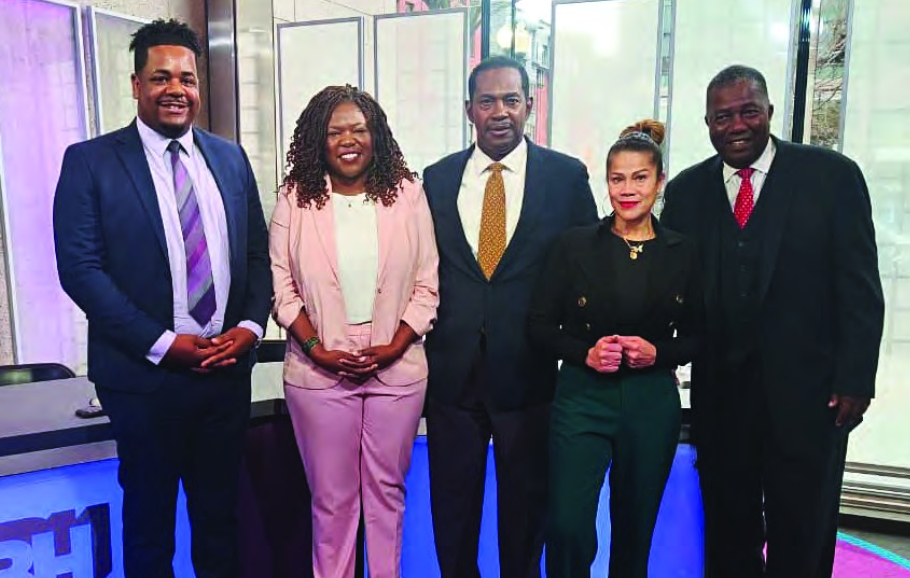
city councilors joined Bay State Banner publisher Ron Mitchel at GBH’s
Newsfeed café. (From left) Incumbent At-large Councilor Henry Santana,
incumbent City Council President Ruthzee Louijeune, Banner publisher Ron
Mitchell, incumbent At-large Councilor Julia Mejia, District 7
Councilor-elect Rev. Miniard Culpepper. 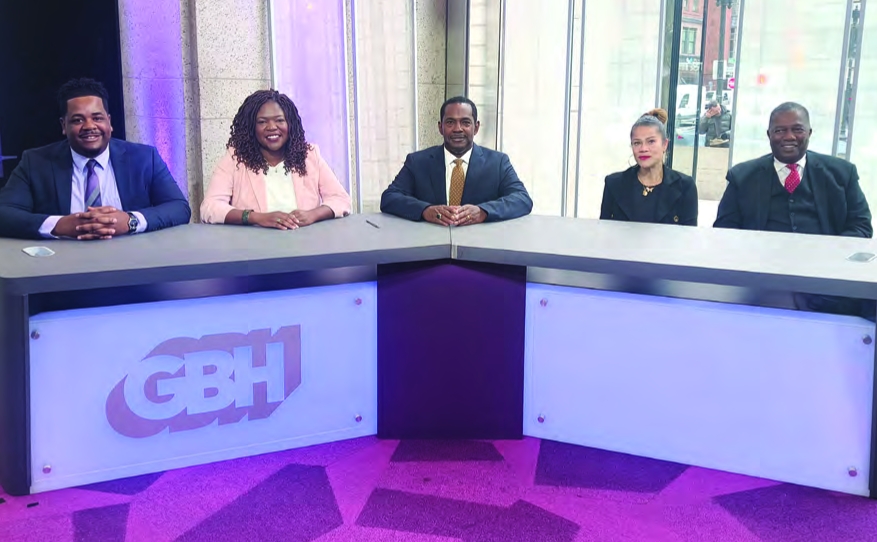
Boston’s
city councilors and moderator Bay State Banner publisher Ron Mitchell
discuss the city’s future at GBH’s Newsfeed café. (From left) Incumbent
At-large Councilor Henry Santana, incumbent City Council President
Ruthzee Louijeune, Banner publisher Ron Mitchell, incumbent At-large
Councilor Julia Mejia, District 7 Councilor-elect Rev. Miniard
Culpepper.
At a Nov 20. live taping of “GBH Amplifies” at the station’s Boston Public Library studio, four Boston city councilors discussed their legislative priorities for the next term, outlining plans to address affordability, education, immigration and the ongoing challenges at Mass. and Cass.
Moderator and Banner publisher Ron Mitchell opened the conversation by reviewing the national context: a 43-day federal government shutdown, rising health care costs, and stepped-up immigration enforcement under the Trump administration. Those pressures, he noted, shape the work ahead for Boston’s new and returning councilors.
City Council President Ruthzee Louijeune said national decisions directly affect Boston residents.
“What’s
happening in Washington is connected to what’s happening here in the
city of Boston,” she said. She pointed to cuts to SNAP benefits and
rising health care premiums as examples of how “the most vulnerable
among us” are harmed by political decisions beyond the city’s control.
Louijeune
said affordability remains the city’s most urgent challenge. “Housing
affordability, affordability in general is a number one issue,” she
said.
She referenced
an ordinance that she passed in October to prioritize affordable housing
in former city-owned buildings, and said she wanted Boston to “explore
what it would look like to create a minimum wage for our city employees”
as a model for employers citywide.
On
the federal shutdown deal, she warned that restored SNAP benefits come
alongside “health care costs skyrocketing for our residents” and risks
to community health centers that depend on federal funding.
District
7 Councilor-elect Rev. Miniard Culpepper, who won one of the closest
races of the year, said constituents supported him because of his record
on neighborhood stabilization. He described his “gentrification
neutralization plan” aimed at protecting tenants and keeping longtime
residents in their homes. Culpepper cited his previous work in
transferring ownership of properties such as Academy Homes, Canfield
Estates and apartments on Seaver Street to resident associations.
Culpepper
said he intends to apply that same urgency to Madison Park Technical
Vocational High School, which he believes requires a complete overhaul.
“We don’t need a renovated Madison Park. We need a new state-of-theart
Madison Park,” he said.
At-large
Councilor Julia Mejia, entering her fourth term, stressed the
importance of political participation. Her historic first win was
decided by a single ballot.
“I
just want to note for the record that it was 22,492 votes… after a
recount,” she said, emphasizing how mobilizing residents of color
contributed to her initial victory and continued support.
Mejia
said her top priority for the next two years is building out a
co-governance model, an approach that gives community coalitions a
direct role in policy design and legislative strategy. “Co-governance…is
an ideology where the real power lies with the constituents, not with
the political power players,” she said.
As
the only councilor who is both a Boston Public Schools graduate and the
parent of BPS students, Mejia said she plans to be “incredibly
aggressive around education issues,” particularly at Madison Park and on
proposals affecting the city’s exam schools.
She
also voiced strong concern about the city’s public-private partnership
to redevelop White Stadium in Franklin Park. Mejia said many residents
fear losing control of public land and facilities.
“People
have said we don’t want a Fenway Park in Franklin Park,” she said. She
added that a coalition of community organizations has outlined an
alternative plan that would allow for a full renovation without turning
over public land to a private operator. “We don’t need a beer garden in
Franklin Park,” she said.
At-large
Councilor Henry Santana, who immigrated from the Dominican Republic as a
child and went through the full citizenship process, said immigrant
families across Boston are living in heightened fear.
“I
really know the fear that our immigrant communities are going through
right now…being too afraid to show up to school, being too afraid to go
to work. And that’s just not the Boston that we are,” he said.
Santana
said he wants the upcoming budget cycle to include more investment in
legal aid for immigrant families and deeper collaboration with community
groups. He also emphasized youth opportunity as a core priority,
including expanding summer jobs and developing more year-round
employment pathways for young people.
On Madison Park, Santana said he supports major
investments to bring the facility up to the level students deserve. He
also backs the White Stadium redevelopment, citing positive impacts on
fields and programming for BPS athletes, but said officials must ensure
commitments to minority-owned and local businesses are fulfilled. “I
will be the first one to stand up if those contracts are not being met,”
he said.
Culpepper,
who lives across from Franklin Park, expressed stronger support for the
White Stadium partnership, pointing to economic benefits. He highlighted
the ownership group’s commitment to direct 50 percent of spending to
local businesses and nonprofits.
“We’re talking about $50 million coming into our community… into our construction companies,” he said.
Culpepper
is forming a District 7 task force to monitor those commitments. “If we
don’t get that 50 percent commitment coming into the community, then
that soccer team is going to have a problem,” he added.
The
discussion ended with each councilor weighing in on Mass. and Cass.
Santana said the city “has done a lot of good things” but still “failed”
in addressing the crisis, and he urged expanding long-term recovery
support.
Louijeune and
Mejia both said Boston needs a recovery campus that offers detox,
stabilization, long-term treatment and job training in one location.
Mejia added that the state must play a larger role, since many
individuals on Mass. and Cass come from outside Boston.
Culpepper
suggested revisiting Long Island as a potential site, with transport by
ferry rather than a new bridge. “I don’t see why we can’t have a boat
that can take folks to Long Island,” he said.