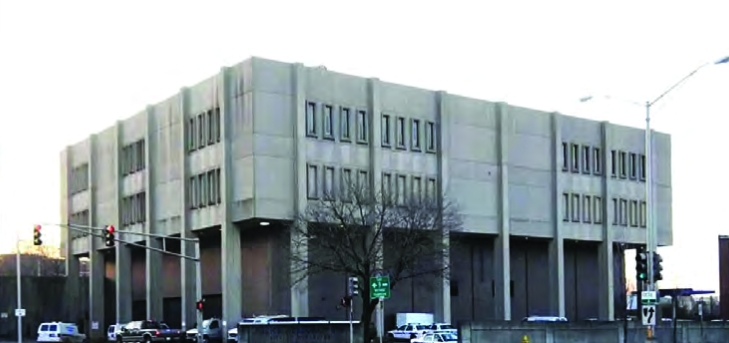
Worcester Police headquarters Two retired Worcester police officers alleged in interviews with the Banner that through various machinations at the city level they have been prevented from accessing their full accidental disability pensions because they are Black.
Charles Brace and William Gardiner said they retired from the Worcester Police Department due to permanent disabilities sustained on the job. They say that complications in the filing and approval processes have left them with a fraction of the pensions they should be receiving.
Under state guidelines, a yearly pension for a public employee who is approved for retirement with an accidental disability is 72% of the rate of compensation they were receiving when they were injured.
The City of Worcester declined to comment, citing personnel matters.
Both officers say their treatment is based on their race. In 2022, the Worcester Police Department faced an investigation by the U.S. Department of Justice that revealed civil rights violations, including sexual misconduct and use of excessive force.
Brace, who worked with the Worcester Police Department for almost 30 years, said he filed for disability retirement due
to issues with blood pressure and chronic kidney disease. His personal
physician recommended he file during a visit to treat a broken finger
that he sustained during an arrest.
He
had previously been pulled off duty a handful of times due to high
blood pressure and deemed unfit to return until his blood pressure went
down. When he joined the police force, his initial physical presented no
issues.
“Any of those
times when I was ill, I could have left that job, but I kept coming
back because I loved what I was doing,” Brace said.
A
state law says that for public safety positions, any disability or
death caused by heart disease or hypertension should be presumed to be
caused by the job, lacking evidence to show it was not job-related.
Brace
filed for disability retirement in early 2015, but clerical errors
delayed the process. Ultimately, he was told he would have a hearing in
front of the Worcester Retirement Board in December.
But
the month that hearing date arrived, Brace says the board met and
decided to keep the application from moving forward, having determined
that it could not succeed as a “matter of law.”
A letter from the retirement board’s attorney to Brace’s attorney suggested
that the medical reason he stopped working was his broken finger, not
his hypertension, and therefore he was ineligible to receive the
benefits he had filed for. The rejection letter also points to the fact
that Brace continued to work following the visit to his doctor, which it
suggests is evidence that hypertension was not the disabling condition.
Brace appealed the decision to the state body that oversees the process in 2018 but hasn’t heard back.
Brace
said that his history with hypertension — including instances that have
prevented him from doing his job — is documented. In his appeal, Brace
and his attorney point to previous cases where individuals received
disability retirement benefits when a separate injury may have triggered
stopping work, but hypertension was the disabling factor, as well as
instances where other employees, for example teachers, finished working
for a period of time despite a permanent disability.
Gardiner
said his experience has been different but has a similar result. When
he retired, a union attorney persuaded him to take a 25% pension on
personal medical retirement, with plans to fight for the higher 72%
disability retirement pension.
Gardiner
spent 10 years with the Worcester Police Department, during which time
he said he regularly faced bullying and ridicule, starting during his
time at the Worcester Police Academy. He said the behavior sometimes
included racial microaggressions.
During
his time with the police department, he began experiencing symptoms of
depression and anxiety and started seeing mental health providers. He
said that he saw a handful of providers but never was connected with one
through the department, despite asking for support.
In
late 2002 he was placed on administrative leave after an argument with a
dispatcher grew heated. His personal and department-issued firearms
were confiscated and according to Gardiner, department leadership deemed
him a danger to himself and others.
He
proceeded to visit a string of psychologists and psychiatrists to
assess whether he could continue performing his job, whether the
disability was reversible and whether it was due to stresses caused by
his police work.
One
forensic psychiatrist determined Gardiner was suffering from
hyperanxiety and post-traumatic stress disorder, believed to be caused
by his work.
Gardiner said the police department then terminated him, disagreeing with the psychiatrist’s assessment.
He
said a three-member medical panel through the Worcester Retirement
Board unanimously agreed that he could no longer perform his role and
that it was not reversible. Two of the three members believed it was
caused by his job.
A
union lawyer with whom Gardiner was working persuaded him to threaten to
take the department to arbitration, which led to the department to
rehire Gardiner with the understanding that he would be on sick time
through his 10-year date with the department, at which time he would
retire on his own.
The attorney said that Gardiner could then fight for the 72% pension under the accidental disability retirement.
But
when he officially retired in 2004, and was no longer a member of the
union, the attorney told him that he would have to pay out-of-pocket for
services.
Unable to pull together the money to pay for those costs on his 25% pension, the decision went unchallenged.
Both retired officers have faced difficulties due to their reduced pensions.
Gardiner
said that he can’t afford to buy new clothes or pay for home repairs,
and he has had to keep his home thermostat at 54 degrees to stretch fuel
assistance throughout the winter. He alleges the city owes him half a
million dollars, given the difference between what he has received and
what he feels he is owed.
“That’s
half a million dollars I haven’t had to put into my house, to eat good
food, to buy good clothes, to go out even,” he said.
Gardiner and Brace said they have heard of white officers in similar health situations who received the full 72% pension.
Albert
Toney, former president of the Minority State Police Officers
Association, said he believes it’s an issue of equity. Retired officers
like Gardiner and Brace “just want to live,” he said.
“All we’re looking for is equal treatment across the board,” he said.