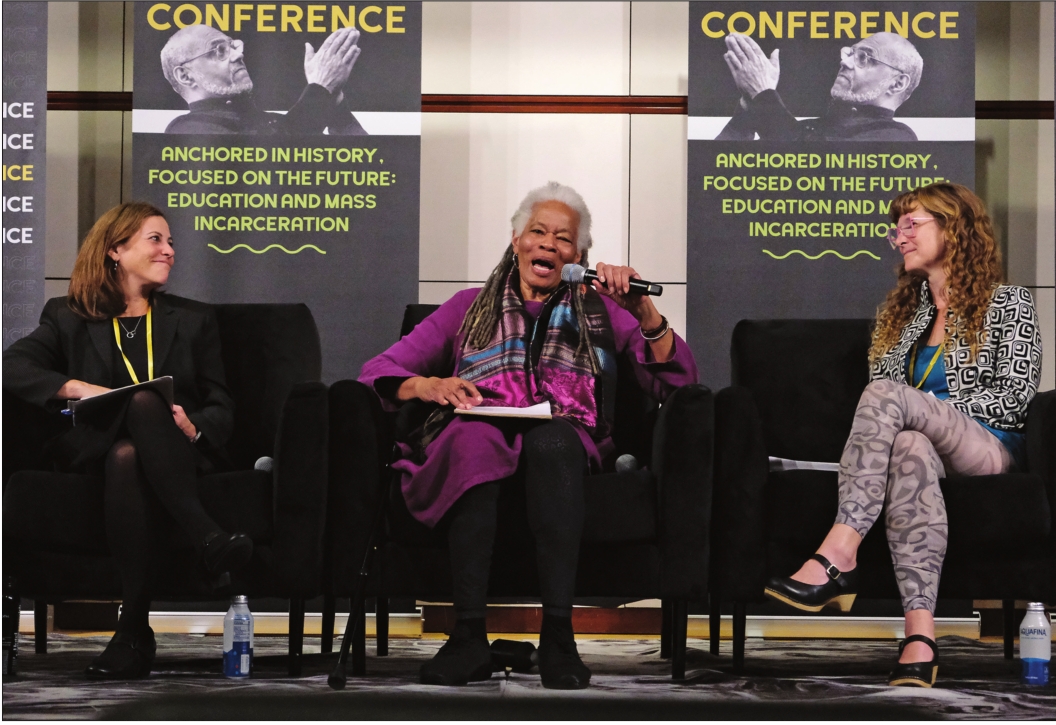
(From left) Rachel Barkow, Janet Jemmot Moses and Tasseli McKay engage in the final panel discussion at the Bob Moses Conference, Oct. 11. 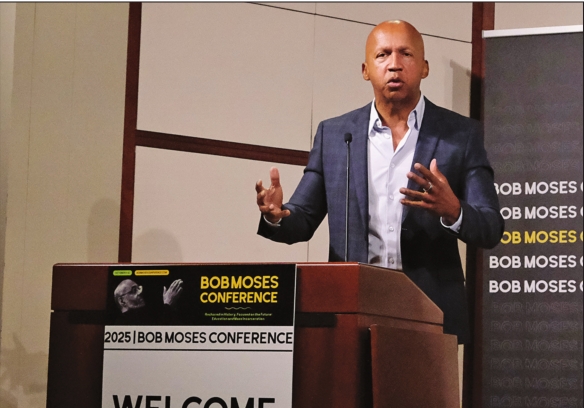
Bryan Stevenson, the keynote speaker, addresses conference attendees.
Anchored in history but focused on the future, the Bob Moses Conference brought together scholars and activists to explore the intersection of education and mass incarceration in the Black community this past weekend.
The event, held at Boston University, honored the legacy of the late civil rights activist Robert P. Moses and featured a number of notable speakers, including economist William A. Darity Jr., sociologist Ruha Benjamin, and the executive director of the Equal Justice Initiative, Bryan Stevenson.
“We cannot accept the narratives that are given to us that are fueling many of the problems that we continue to see. We have to change narratives that feed bigotry and violence and injustice,” said Stevenson, the keynote speaker of the conference.
Established in 2022, the conference was hosted by The Bob Moses Fund and has three primary purposes: to invest in local entities that embody the work of Moses, to nurture a legacy that aligns with his ideals, and to grow a community of changemakers shaped by his teachings.
Moses was best known for his work as a leading organizer of the Student Nonviolent Coordinating Committee (SNCC) in the 1960s, as well as his efforts in voter registration in Mississippi and his advocacy in furthering minority education in math. His lifelong advocacy for civil rights and education reform continues to be an inspiration for newer generations.
With a focus on education, the first day consisted of panels that touched on the systemic inequities that affect the education system, opportunities, and outcomes. These conversations set the stage for the second day, which focused on the negative impacts of mass incarceration on the Black community, its roots in discriminatory, racist practices, and how the system continues to benefit the white community.
Rachel Barkow, a legal scholar and former member of the United States Sentencing Commission, focused on the cruelty and ineffectiveness of giving long sentences, emphasizing that they show how the current system has deviated from constitutional principles. Although unable to attend in person, Darity, the economist and social scientist, virtually discussed the economic impacts of chattel slavery and what he referred to as modern-day government slavery, otherwise known as mass incarceration.
Citing a study by economist Thomas Kramer, Darity noted that the economic loss from chattel slavery was staggering. Using a 3% interest rate and accounting for all seven days of the week, Darity estimated an $18.6 trillion loss for those subjected to the system. At a 6% interest rate, that figure rises to an estimated $6.2 quadrillion.
Drawing a parallel between mass incarceration and what he described as “government slavery,” Darity referenced his work with the California State Reparations Task Force, which analyzed disproportionate arrest and imprisonment rates of Black Californians. Based on the average civil service wage and an estimated 1.48 years of excess imprisonment of Black Americans, the task force calculated the lost wages at $159,272 per person, amounting to a total economic loss of $228 billion for the state.
Renowned lawyer Stevenson, who has spent decades of his career challenging racial injustice, was a key figure behind the U.S. Supreme Court ruling that deemed life without parole for children unconstitutional.
Stevenson spoke on the importance of proximity and said that understanding suffering requires being near those who experience it. He explained how fearmongering cultivates an environment where people accept the unacceptable treatment of others – for example, labeling children “superpredators” or criminalizing addiction as opposed to treating it as the health issue that it is.
“We cannot accept the narratives that are given to us that are fueling many of the problems that we continue to see. We have to change narratives that feed bigotry and violence and injustice,” he said, a line that drew audible agreement from audience members, many who murmured “yes” or clapped along to many powerful points Stevenson made during his speech.
The conference consisted of small-group discussions, where attendees gathered to reflect on where they see these issues in today’s society and identify the “cracks” that allow them to exist. The room quickly filled with conversations as participants shared their own personal experiences, voicing concerns about the disparities they see in their own communities.
Kevin Smith, a Foxborough resident, recalled briefly meeting Bob Moses more than a decade ago — first at a STEM conference at Simmons College and later at Moses’ 80th birthday fundraiser at MIT.
Reflecting on the topic of education in Massachusetts, Smith noted that while the state is often celebrated as number one in the nation for education, that ranking doesn’t reflect the experience of all students. He pointed to the “Number One for Some” report by the Massachusetts Education Equity Partnership (MEEP), which highlights inequities across school districts.
“But we knew that before the state came out with that report,” said Smith, adding that he hasn’t seen much progress since its release in 2018. Drawing on the concept of “sharecropper education” – a system where people are taught just enough to remain in low-wage or labor-intensive work – Smith compared those inequities to the educational disparities that persist today.
“So if you can’t do the math and all of those other STEM types of things and other skills that we need to survive, where’s the quality in education? So we’re paying a lot for education, but we’re not getting the outcomes,” Smith said.
The conference closed with a panel conversation featuring speakers from early sessions, including Janet Jemmott Moses, the wife of the late Bob Moses. They reflected not only on the legacy of Bob, but the importance of truth-telling, and community support in order to advance educational justice and address the issue of mass incarceration.