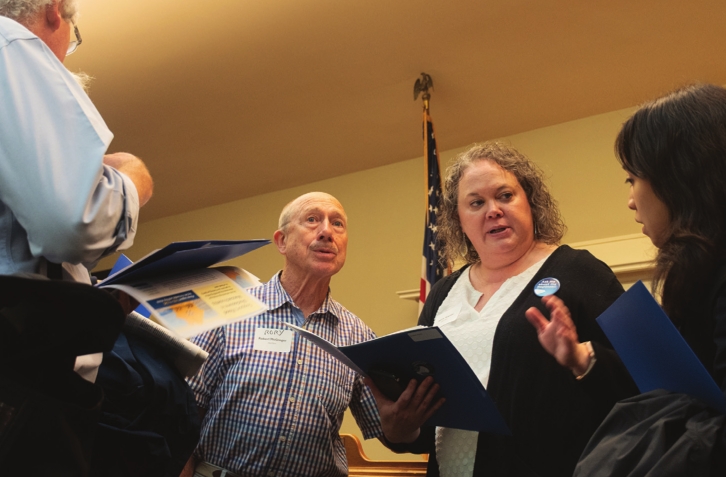
Kerry Snyder (second from right) preps with other supporters of the Neponset River at a State House advocacy day, Oct. 8. At the event, Lobby for the Rivers Day, advocates asked legislators to support three bills focused on the environment and conservation.
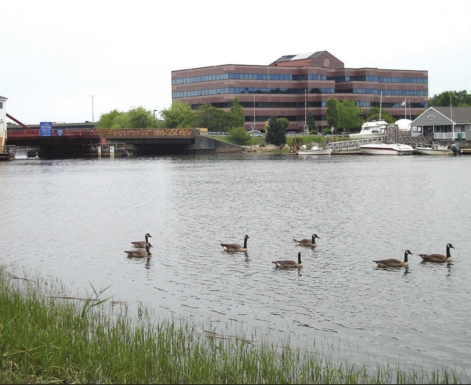
The Neponset River
As rain pelted the State House, advocates for the Bay State’s many rivers and watersheds gathered Oct. 8 in a fourth-floor hearing room to prepare their call for the support of waterways across Massachusetts.
The Lobby for the Rivers Day, organized by the Massachusetts Rivers Alliance, brought together representatives for the state’s various rivers in support of three climate and conservation bills currently in front of state legislators.
When sponsoring legislators gave remarks to welcome the slightly damp advocates, they identified themselves as much by their local river as by their district or municipalities.
For rivers statewide, the three bills, which tackle efforts like improving the state’s ability to respond to droughts or creating new ways to set aside land for conservation, offer a chance to take steps to protect and improve their health and access.
Kerry Snyder, managing director for community resilience at the Neponset River Watershed Association, said that for an urban river like the Neponset, which runs along Boston’s southern edge and hosts a watershed that includes 14 cities and towns, the bills slot in neatly with the watershed association’s goals.
“The pieces of legislation go a long way toward supporting our mission of making sure the Neponset and its surrounding lands remain an accessible resource for everyone in the region,” Snyder said.
The bills would expand and codify the state’s ability to take action to protect natural spaces and resources. Supporters said they’re an important step for the state to take as climate change brings more severe storms, droughts and other impacts.
“I think it’s critically important for Massachusetts to continue the good and clear work for managing the impacts of climate and preparing for the resilience that we need,” said Heather Clish, policy director of the Massachusetts Rivers Alliance.
Advocacy around the legislation comes as the federal government pulls back on funding and protections for the environment and environmental projects.
The Trump administration has cut billions of dollars in funding for green energy projects since January. It is also in the process of seeking to repeal the Environmental Protection Agency’s “endangerment finding,” an action that would take away the federal government’s authority to regulate greenhouse gas emissions. Over the summer, the administration took steps to shutter the EPA’s scientific research arm.
In that context, legislators and advocates said these bills are of particular importance.
“What we’re doing at the state level is more important than ever now the feds are taking a big step back from the responsibility to protect our environment,” said Julia Blatt, executive director at the Massachusetts Rivers Alliance, in remarks ahead of the lobbying day. “The work we do with our legislators and with the administration here has taken on critical importance.”
Advocates acknowledged that state efforts will tend to struggle to match the scale of federal ones, but called them an important start.
“While it is a huge challenge for us to fill those gaps at the federal level, I’m really proud that we have those like you for standing up, but also many people in the legislature who understand the importance of our environment, of clean air, clean water, as one of our most important resources,” said Rep. Christine Barber, who co-chairs the state’s Joint Committee on Environment and Natural Resources.
Advocates at the event had their focus on three pieces of legislation currently in front of the legislature, all focused on conservation and water resources.
One bill is aimed at expanding the state’s ability to implement more uniform water system conservation measures. Currently, in the case of droughts, cities and towns implement what advocates called a “patchwork” of steps to limit water use. The law would give the Executive Office of Energy and Environmental Affairs the authority to require efforts to limit non-essential water uses in regions depending on the level of drought, and as recommended under the state’s 2023 Drought Management Plan.
Currently, the state can only require water conservation measures after the governor has declared a drought emergency.
The irony of the weather was not lost on attendees. Torrential rain while advocating for legislation to address droughts was, in fact, something of a joke at the gathering. During the last lobbying day, Clish said, they faced similar weather while calling for the same bill.
But, also not lost on attendees was that the pattern of weather — weeks of little to no rain followed by a condensed downpour — tends to do little to alleviate droughts. It’s a pattern that is growing more common with a changing climate.
“We can’t wait,” Snyder said. “The rain patterns have already changed; we’re already seeing more flooding; we’re already seeing more drought.”
When more rain falls than can be absorbed by the ground, it runs off, which can carry pollution into waterways or lead to stormwater flooding.
The second bill would create a new pot of money, called the Nature for All Fund, which would use tax revenue from an existing tax on sporting goods to pay for land acquisition, restoration of natural spaces to create parks and trails, and the protection of natural resources like waterways and forests.
It wouldn’t increase or create a new sales tax, but instead would direct dollars that currently go into the state’s general fund into the new, specific Nature for All bucket.
Clish said that the fund would help the state reach conservation goals set by the state in 2022 to permanently protect at least 30% of the state’s land and waters by 2030 and at least 40% by 2050.
“It would accelerate, significantly, the available pool of funding to do that,” she said.
Currently, the state has protected 28% of land and water resources across Massachusetts.
The third proposed bill codifies the state’s Division of Ecological Restoration, which is housed in the Department of Fish and Game.
That division is responsible for protecting and restoring rivers, wetlands and watersheds across the state.
For example, on Oct. 9, the state announced over $700,000 in grant funding through the Division of Ecological Restoration to remove dams, restore wetlands and revitalize waterways.
The division, which is a non-regulatory, science-based agency, was created in 2009 to catalyze river and wetland restoration efforts. Since then, the division has completed more than 150 projects across Massachusetts, according to a press release celebrating 15 years of work in September 2024.
Along rivers like the Neponset, which has included efforts like removing dams. Snyder said that one 2022 DER-funded project in Norwood removed a dam on Traphole Brook, a tributary of the river. That effort reduced flooding risks and revegetated the ecosystem.
That project was made possible through state support.
“These cities and towns simply don’t have the resources to do all these things by themselves,” Snyder said.
She called the technical assistance and grant funding the state provides through the Division of Ecological Resources, “really beneficial.”
Because the division was created outside of a legislative process, its existence could be theoretically tenuous.
“The issue there is that they do not have statutory standing,” Blatt said. “They could be swept away with a new administration.”
The law, if passed, would add a layer of protection, requiring legislative action to get rid of the division.
Clish said there isn’t a current concern that the group will be disbanded, but given its track record of work in the state, it’s worth safeguarding.
“It’s so successful, it is so integral to meeting the state’s biodiversity goals, that it’s time to shore it up and make it a permanent part of The Commonwealth of Massachusetts,” she said.
All three bills are currently waiting to be reported out of the Joint Committee on Environment and Natural Resources.
Also on the radar of advocates was the Mass Ready Act, a nearly $3 million bond bill that would focus on infrastructure improvements and environmental protections. That legislation was filed by Gov. Maura Healey in June.
Barber, from the Joint Committee on Environment and Natural Resources, said the potential funding that could come from that bond bill may be an important resource amid federal funding cuts to climate and environmental projects.
“That’s a huge opportunity for this commonwealth, especially in light of federal cuts, because that is money we can borrow and bond that we can use over the next five years,” Barber said. “As we’re continuing, likely, to face challenges, we’ll have money we can put into needed infrastructure improvements.”
And the Mass Ready Act offers another path toward passage for the legislation. Instead of being passed individually, the three pieces of priority legislation for the advocates could, instead, be included as part of the bond bill.
Clish said that the Massachusetts Rivers Alliance views all three of the bills as a match for the bond bill’s priorities.
“All three of these bills fit with this,” Clish said. “In the case of the Division of Ecological Restoration, it fits into our natural systems.