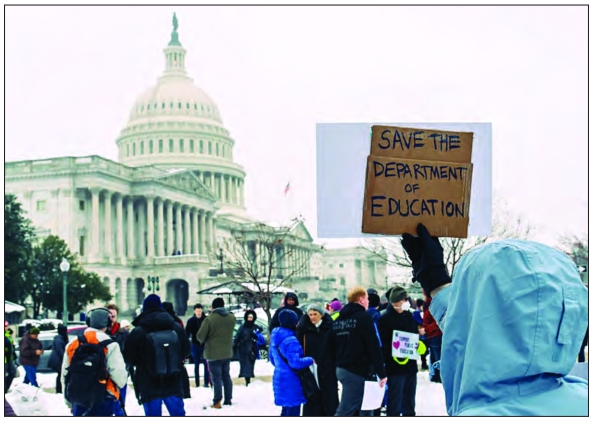
A demonstrator holds a sign supporting the Department of Education during a Capitol protest.Last spring, the Department of Education ordered all discrimination of protected characteristics, like race, sex, national origin or religion, to end. Diversity, equity and inclusion programs were implicated for advantaging some. The NAACP, states and labor unions sued.
The US Attorney General opened new fronts for conflict during the summer with a legal memo. Now, Massachusetts Gov. Maura Healey and Attorney General Andrea Campbell have circulated their own, advising districts to continue DEI work.
Days ago, the Trump administration cut millions in magnet school grants to Chicago, New York City and Fairfax, Virginia, for targeting minorities with aid.
While initial court skirmishes remain unresolved, the battle may be won or lost based on whether schools stand their ground.
“We are not going to let them bully us into abandoning our values. Not today, not ever,” said state Secretary of Education Patrick Tutwiler in a statement.
State and federal governments at odds
On Sept. 23, Healey and Campbell issued guidance to schools “in response to evolving court precedent and continuing attacks by the federal government on diversity, equity, inclusion, and accessibility.”
“Educational institutions should continue to foster diversity, equity, inclusion, and accessibility among their student bodies,” it reads.
Nothing in federal communications can change the
“laws” and “legal principles,” which, “encourage — and even require —
schools to promote educational opportunity for students of all
backgrounds.”
That contradicts federal guidance.
“In
recent years, the federal government has turned a blind eye toward, or
even encouraged, various discriminatory practices, seemingly because of
their purportedly benign labels, objectives, or intentions. No longer,”
declared the office of U. S. Attorney General Pam Bondi on July 29.
She
warned against preferential treatment or segregation by protected
characteristics as well as using proxies, calling them “ostensibly
neutral criteria that substitute.”
Noting
that “policies or practices based on protected characteristics are
subject to rigorous judicial scrutiny,” the July memo gives “examples of
unlawful practices.”
The
federal memo called out “geographic targeting” where program
recruitment targets places or organizations primarily because of their
racial or ethnic background rather than “legitimate factors.”
In
contrast, state guidance allows colleges to take a “holistic review in
admissions,” including income levels, being first generation, and any
neighborhood or community circumstances.
For
justification, they cite “binding precedent” of Boston’s ZIP Code-based
exam school admission policies. The First Circuit Court of Appeals
rejected a challenge to the BPS policy in 2021.
The
Boston-based court cited a Supreme Court ruling that “the motive of
increasing minority participation is not suspect.” The panel wrote,
“Justice Kennedy not only ruled this motive permissible, but fortified
its use by race-neutral proxies for accomplishing its end.”
Backed by three other
circuit court precedents, the judges found that “considering racial data
is not a racial classification and does not trigger strict scrutiny.”
The Supreme Court declined to take up the BPS issue last December. Still, BPS may amend its policy again soon.
To
the federal government, “sex-based selection for contracts” are
“unlawful.” Policies prioritizing women-owned or minority-owned
businesses “over equally or more qualified businesses without preferred
group status,” were described.
Massachusetts’s Supplier Diversity Program does just that.
The Supplier Diversity Office establishes “annual spending benchmarks” for Healey’s executive agencies.
Further,
state law still requires every school district to appoint a DEI
officer. Thus, the Trump administration has set a course that runs
through Beacon Hill.
‘Evolving’ High Court precedent
State
guidance for educational institutions explains two recent Supreme Court
rulings. In 2023, SCOTUS ruled against the use of race in admissions at
Harvard and the University of North Carolina. The Students for Fair
Admissions [SFFA] decision has been interpreted broadly by the Trump
administration to apply throughout grades K-12.
Largely
based on the decision, the U.S. Department of Education sent letters to
state education agencies earlier this year targeting DEI.
In
Massachusetts, the SFFA ruling is interpreted narrowly. “The case has
no direct application to programs outside of higher education admissions
or to admissions policies that do not use race as a factor for
admissions in the same way,” the state wrote.
And
while the Healey-Campbell memo says “schools can and should assume that
SFFA’s reasoning may extend” to benefits for particular students based
on race, it nonetheless maintains “it is not unlawful for a school
generally to take race into account” operationally.
Another SCOTUS ruling, Mahmoud v. Taylor, concerns LGBTQ+ storybooks introduced in Maryland’s Montgomery County school district.
Initially
allowing parents to opt out of instruction when the books were read,
the school board reversed course the following school year. The volume
of opt-outs was infeasible. Parents sued.
Since
public school is mandatory and alternatives are costly, the top court
found that the curriculum “imposes the kind of burden on religious
exercise” it had previously deemed “unacceptable.”
For
the majority of justices, stories of same-sex marriage challenged the
religious freedom of those who believe in only opposite-sex marriages.
The books, read as early as kindergarten, are “unmistakably normative,”
Justice Samuel Alito wrote for the majority.
“These
books impose upon children a set of values and beliefs that are
‘hostile’ to their parents’ religious beliefs,” six justices agreed.
They feared the books “exert a psychological ‘pressure to conform.’”
Announcing
guidance last week, Healey and Campbell advised that “K-12 schools
should continue to use an inclusive, age-appropriate curriculum, which
can include topics like race, gender, sexual orientation, gender
identity, disability, and religion.” They wrote, “public schools should
not interpret the Mahmoud decision as requiring or permitting them to
erase particular groups from the curriculum.”
Education
Commissioner Pedro Martinez said each district should “consider its
unique circumstances and consult legal counsel” whether any opt-out
policy is required.