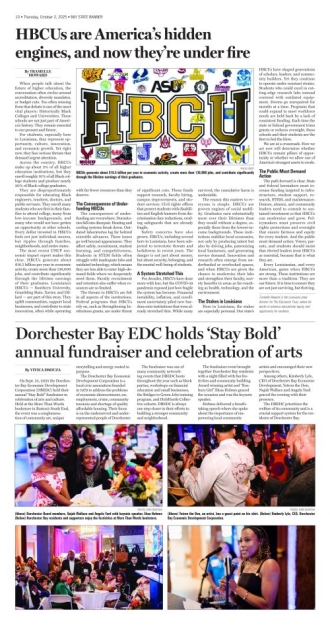
HBCUs
generate about $16.5 billion per year in economic activity, create more
than 136,000 jobs, and contribute significantly through the lifetime
earnings of their graduates. When people talk about the future of higher education, the conversation often circles around accreditation, diversity mandates, or budget cuts. Too often missing from that debate is one of the most vital players: Historically Black Colleges and Universities. These schools are not just part of America’s history. They remain essential to our present and future.
For students, especially here in Louisiana, they represent opportunity, culture, innovation, and economic growth. Yet right now, they face serious threats that demand urgent attention.
Across the country, HBCUs make up about 3% of all higher education institutions, but they enroll roughly 10% of all Black college students and produce nearly 20% of Black college graduates.
They are disproportionately responsible for educating Black engineers, teachers, doctors, and public servants. They enroll many students who are first in their families to attend college, many from low-income backgrounds, and many who would not have gotten an opportunity at other schools. Every dollar invested in HBCUs fuels not just individual success, but ripples through families, neighborhoods, and entire states.
The most recent UNCF economic impact report makes this clear. HBCUs generate about $16.5 billion per year in economic activity, create more than 136,000 jobs, and contribute significantly through the lifetime earnings of their graduates. Louisiana’s HBCUs — Southern University, Grambling State, Xavier, and Dillard — are part of this story. They uplift communities, support local businesses, and contribute to state innovation, often while operating with far fewer resources than they deserve.
The Consequences of Underfunding HBCUs
The
consequences of underfunding are everywhere. Dormitories fall into
disrepair. Heating and cooling systems break down. Outdated laboratories
lag far behind scientific advances. These issues go well beyond
appearances. They affect safety, recruitment, student learning, and
competitiveness. Students in STEM fields often struggle with inadequate
labs and outdated technology, which means they are less able to enter
high-demand fields where we desperately need them. Faculty recruitment
and retention also suffer when resources are so limited.
The
threats to HBCUs are felt in all aspects of the institutions. Federal
programs that HBCUs rely on, such as Strengthening Institutions grants,
are under threat of significant cuts. These funds support research,
faculty hiring, campus improvements, and student services. Civil rights
offices that protect students with disabilities and English learners
from discrimination face reductions, eroding safeguards that are already
fragile.
Safety
concerns have also grown. HBCUs, including several here in Louisiana,
have been subjected to terroristic threats and lockdowns in recent
years. The danger is not just about money, but about security,
belonging, and the mental well-being of students.
A System Stretched Thin
For
decades, HBCUs have done more with less, but the COVID-19 pandemic
exposed just how fragile the system has become. Financial instability,
inflation, and enrollment uncertainty piled new burdens onto
institutions that were already stretched thin. While many survived, the
cumulative harm is undeniable.
The
reason this matters to everyone is simple. HBCUs are proven engines of
social mobility. Graduates earn substantially more over their lifetimes
than they would without a degree, especially those from the
lowest-income backgrounds. These institutions stabilize local economies,
not only by producing talent but also by driving jobs, patronizing
local businesses, and generating service demand. Innovation and research
often emerge from underfunded or overlooked spaces, and when HBCUs are
given the chance to modernize their labs and strengthen their faculty,
society benefits in areas as far-reaching as health, technology, and the
environment.
The Stakes in Louisiana
Here in Louisiana, the stakes are especially personal. Our state’s HBCUs have shaped
generations of scholars, leaders, and community builders. Yet they
continue to operate under constant strains. Students who could excel in
cutting-edge research labs instead contend with outdated equipment.
Dorms go unrepaired for months at a time. Programs that could expand to
meet workforce needs are held back by a lack of consistent funding. Each
time the state or federal government trims grants or reduces oversight,
these schools and their students are the first to feel the blow.
We
are at a crossroads. How we act now will determine whether HBCUs remain
pillars of opportunity or whether we allow one of America’s strongest
assets to erode.
The Public Must Demand Action
The
path forward is clear. State and federal lawmakers must increase
funding targeted to infrastructure, student support, research, STEM, and
maintenance.
Donors,
alumni, and community leaders need to commit to sustained investment so
that HBCUs can modernize and grow. Policymakers must preserve civil
rights protections and oversight that ensure fairness and equity for
every student. And the public must demand action. Voters, parents, and
students should insist that elected leaders treat HBCUs as essential,
because that is what they are.
Every
Louisianian, and every American, gains when HBCUs are strong. These
institutions are more than a tradition. They are our future. It is time
to ensure they are not just surviving, but thriving.
Tramelle
Howard is the Louisiana state director for The Education Trust, where
he works to advance educational equity and opportunity for students.