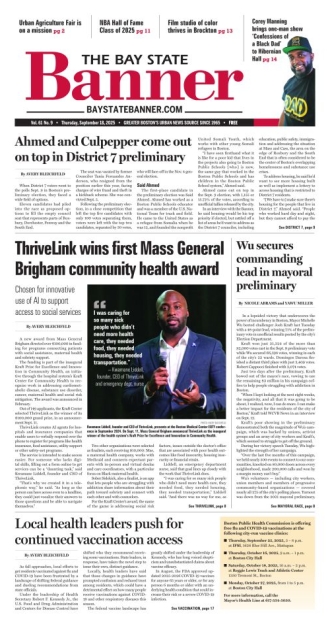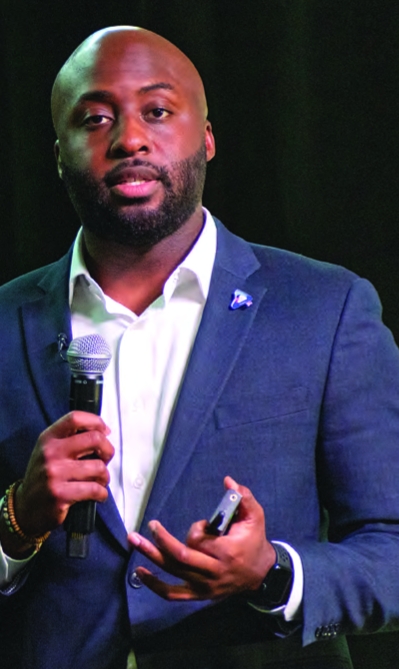
Kwamane Liddell, founder and CEO of ThriveLink, presents at the Boston Medical Center EQTY conference in September 2024. On Sept. 11, Mass General Brigham announced ThriveLink as the inaugural winner of the health system’s Kraft Prize for Excellence and Innovation in Community Health. Chosen for innovative use of AI to support access to social services
A new award from Mass General Brigham directed over $100,000 in funding for programs connecting patients with social assistance, maternal health and sobriety support.
The funding is part of the inaugural Kraft Prize for Excellence and Innovation in Community Health, an initiative through the hospital system’s Kraft Center for Community Health to recognize work in addressing cardiometabolic disease, substance use disorder, cancer, maternal health and social risk mitigation. The award was announced in February.
Out of 149 applicants, the Kraft Center selected ThriveLink as the winner of its $100,000 grand prize, in an announcement Sept. 11.
ThriveLink creates AI agents for hospitals and insurance companies that enable users to verbally respond over the phone to register for programs like health insurance, food assistance, utility support or other safety-net programs.
The service is intended to make access easier. For someone who lacks digital skills, filling out a form online to get services can be a “daunting task,” said Kwamane Liddell, founder and CEO of ThriveLink.
“That’s why we created it in a telephonic way,” he said. “As long as the person can have access even to a landline, they could just vocalize their answers to those questions and be able to navigate themselves.”
Two other organizations were selected as finalists, each receiving $10,000: Mae, a maternal health company, works with Medicaid and connects expectant parents with in-person and virtual doulas and care coordinators, with a particular focus on Black maternal health.
Sober Sidekick, also a finalist, is an app that lets people who are struggling with addiction share information about their path toward sobriety and connect with each other and with counselors.
For the Kraft Center’s award, the name of the game is addressing social risk factors, issues outside the doctor’s office that are associated with poor health outcomes like food insecurity, housing insecurity or financial strain.
Liddell, an emergency department nurse, said that goal lines up closely with the work that ThriveLink does.
“I was caring for so many sick people who didn’t need more health care, they needed food, they needed housing, they needed transportation,” Liddell said. “And there was no way for me, as a clinical person, to be able to just sit down and help these families do the paperwork that they really needed.”
When health systems fail to address those social risk factors, it means not bringing appropriate care to patients, said Dr. Elsie Taveras, executive director of the Kraft Center.
“We can provide the best clinical care, the best medication for a person’s diabetes, or an inhaler for a person’s asthma, but if we failed to connect that person — if they’re also hungry — to food resources, or if we failed to screen and mitigate their social risk factors, we failed that patient,” Taveras said.
She said the award aims to bring funds to “scalable” solutions, taking promising smaller pilot or test programs and connecting them to a broader population.
Those programs often show they can work, but they’re never expanded to a level of improving population or community outcomes, Taveras said, pointing to a frequently cited statistic that it can take an average of 17 years for research evidence to reach clinical practice.
“There are a lot of demonstration programs, there are a lot of pilots, there are a lot of research studies and small-scale programs and proof of concepts that sometimes just stay on the shelf,” she said.
Central to the Kraft Center award, as well, is the idea of capitalizing on the new opportunities that a changing technological landscape can offer. That kind of innovation, Taveras said, was what drew their attention to Thrive-Link, as well as finalists Mae and Sober Sidekick.
“We are living in the time of AI, of technology, of these incredible digital health platforms and services,” Taveras said. “If we fail to have this incredible time of innovation meet the needs of community members — in particular, underserved communities and communities that have disproportionately higher burden of disease and chronic diseases — then we’re really not appreciating or taking advantage of the moment.”
For Liddell, the processes that ThriveLink can support residents through “is what AI should be doing.”
“We’ve always needed more social workers to be available to help people navigate these things — we’ve needed that for years — but this is the first time where technology actually can meaningfully take up some of that work,” he said.
His vision through ThriveLink is to make it so the social workers that are available can spend time doing the more complex work they were trained to do — like helping with medications or mental health needs — instead of administrative work.
The selection of the award’s inaugural winner came before recent federal shifts introduced new threats to access to many of the programs with which Thrive-Link aims to connect community members, including health insurance programs like Medicaid and food assistance programs like the Supplemental Nutrition Assistance Program, but Taveras said those federal changes make the organization and the services they provide all the more significant.
“Tying someone back to food security resources, tying them back to insurance services, utility services has been a challenge that so many of us have tried to take on,” Taveras said. “ThriveLink provides a solution for doing that really well and will be even more important as we look to bridge some of the gaps that we know are going to happen.”
Under the Trump administration’s budget reconciliation bill, passed in July and known through much of its legislative process as the “One Big Beautiful Bill,” experts predict millions of people across the country could lose access to benefits through Medicaid and SNAP.
Much of that is expected to come through added administrative burdens. The law requires that Medicaid recipients now reverify their eligibility for benefits every six months — a change from the previous one-year timeline.
And both Medicaid and SNAP will be subject to new work requirements, which means additional reporting that is expected to lead to disenrollment solely for procedural reasons.
Recent reports from Boston-area organizations placed the local impacts of those cuts in the range of tens to hundreds of thousands of recipients.
Data released Sept. 2 by Boston Indicators, the research arm of the Boston Foundation, estimated that more than 40,000 adults may be at risk of losing access to SNAP benefits when the law takes effect.
And a report from the Blue Cross Blue Shield Foundation of Massachusetts, published Sept. 3, projected between 141,000 and 203,000 people statewide could lose MassHealth coverage as a result of the six-month redetermination timeline and work requirements.
Liddell said he wants to use this moment to have ThriveLink work toward connecting people not only to services like Medicaid, but to employment programs as well — something the Kraft Center funding will allow the organization to focus more on.
The award will also allow ThriveLink to expand its focus to include more connections to maternal health services, he said.
ThriveLink, too, will continue its other operations, which he said is especially important at a time when families are facing rising costs and may have greater need for social support programs.
“It’s just a really important time in society, particularly when you think about price increases and inflation,” Liddell said. “How many people really need this kind of support?”