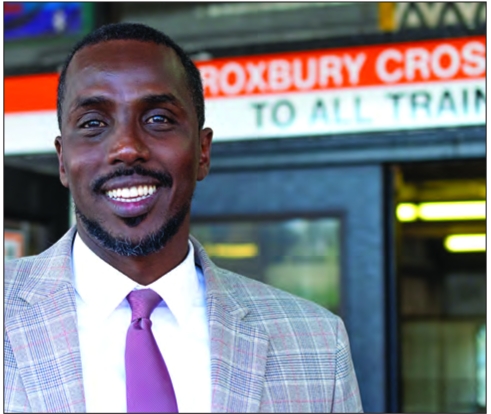
District 7 City Council candidate Said Ahmed poses for a photo at Roxbury Crossing, Sept. 16. Ahmed came in first of 11 candidates in the Sept. 9 preliminary election.
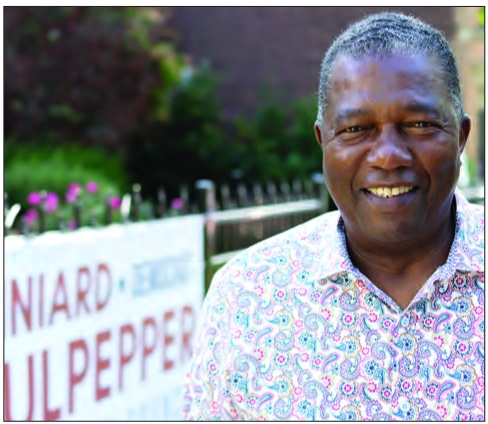
District 7 City Council candidate Miniard Culpepper poses for a photo outside of his Dorchester home, Sept. 16. Culpepper came in second of 11 candidates in the Sept. 9 preliminary election
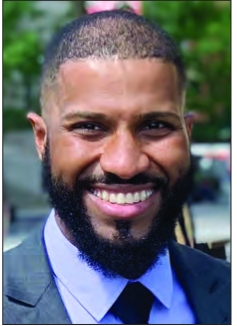
District 7 City Council candidate Mavrick Afonso
When District 7 voters went to the polls Sept. 9 in Boston’s preliminary election, they faced a wide field of options.
Eleven candidates had piled into the race as proposed options to fill the empty council seat that represents parts of Roxbury, Dorchester, Fenway and the South End.
The seat was vacated by former Councilor Tania Fernandes Anderson, who resigned from the position earlier this year, facing charges of wire fraud and theft in a kickback scheme. She was convicted Sept. 5.
Following the preliminary election, in a close competition that left the top five candidates with only 100 votes separating them, voters were left with the top two candidates, separated by 50 votes, who will face-off in the Nov. 4 general election.
Said Ahmed
The first-place candidate in the preliminary election was Said Ahmed. Ahmed has worked as a Boston Public Schools educator and was a member of the U.S. National Team for track and field.
He came to the United States as a refugee from Somalia when he was 12, and founded the nonprofit United Somali Youth, which works with other young Somali refugees in Boston.
“I have seen firsthand what it is like for a poor kid that lives in the projects also going to Boston Public Schools [who] is now, the same guy that worked in the Boston Public Schools and has children in the Boston Public School system,” Ahmed said.
Ahmed came out on top in the Sept. 9 election, with 1,155 or 15.72% of the votes, according to unofficial tallies released by the city.
In an interview with the Banner, he said housing would be his top priority if elected, but rattled off a list of areas he’d want to address as the District 7 councilor, including education, public safety, immigration and addressing the situation at Mass and Cass, the area on the edge of Roxbury and the South End that is often considered to be the center of Boston’s overlapping homelessness and substance use crises.
To address housing, he said he’d want to see more housing built as well as implement a lottery to access housing that is restricted to District 7 residents.
“[We have to] make sure there’s housing for the people that live in District 7,” Ahmed said. “People who worked hard day and night, but they cannot afford to pay the rent.”
He said that, as a BPS educator, he saw students leave classes as their families moved away from the city, pushed out by housing prices.
Ahmed also said he’d like to see more pathways to homeownership for residents, including efforts like a tenant’s opportunity to purchase, which would give tenants in a building right of first refusal if their landlord looks to sell the property.
When it comes to addressing educational needs, he pointed to his own multitude of experiences with the Boston Public School system, from when he was a student when he arrived in Boston to his time working in the district, both in and out of the classroom. He is now a BPS parent.
Ahmed said he worries that resources are not distributed equally across BPS schools, something he’d like to see change if elected.
“Our schools have and have not,” he said. “I want to make sure our schools, our students, have equal opportunity and equal resources — it doesn’t matter if you go to Boston Latin School, Latin Academy, Madison Park or English High School.”
At the heart of his bid for the council seat, he said he wants to see greater accountability and responsiveness from the office.
“It’s time for District 7 to have a city councilor that they can trust, who listens and delivers,” Ahmed said. “That’s what District 7 needs, and I think that’s me.”
Miniard Culpepper
The second candidate advancing to the November election is Miniard Culpepper, an attorney with nearly three decades of experience at the federal Department of Housing and Urban Development. Culpepper now serves as pastor of Roxbury’s Pleasant Hill Missionary Baptist Church, which was founded by his grandfather.
In an interview with the Banner, Culpepper touted that experience with HUD — he described himself as “the housing candidate” — as well as legislative experience he has from working as chief of staff for former Michigan Rep. Barbara Rose Collins, in his pitch for why he should serve as the district’s next city councilor.
He came through the preliminary election about 50 votes behind Ahmed, with 1,102 or 15.00% of the votes, according to the city’s tally.
Like Ahmed, he called housing District 7’s top issue, pulling from his experience with HUD to pitch policy changes that he said he thinks would start to address the lack.
He said he’d like to reduce gentrification in District 7 by helping more residents become homeowners through steps like supporting Boston Housing Authority’s First Home Program, which can support eligible first-time homebuyers to put Section 8 rental vouchers toward the purchase of a home.
Culpepper also said he’d support public housing tenants having an ownership interest in their housing. And he proposed that as the city gets single family homes in District 7 from HUD — which can occur after a homeowner defaults on some federally insured home loans — those properties should enter a housing lottery that is available specifically to District 7 residents. Similar lottery restrictions could exist in other districts, he said.
“Residents in those districts have an opportunity at a lottery for homes in their district,” Culpepper said. “That begins to stabilize neighborhoods.”
Culpepper also offered ideas on managing Mass and Cass, suggesting the creation of a “care campus.” He pointed to efforts in Los Angeles, where a comparable campus offers mental health and addiction treatment services, as well as amenities like showers and laundry. He also proposed the formation of a Boston Homeless Housing Services Authority, which would work to serve people at Mass and Cass as well as across the city, with focused services to address homelessness.
To address rising costs of housing and living for younger individuals and seniors, he proposed pulling from the city’s Inclusionary Development Policy Fund, which developers can pay into in lieu of meeting the quotas of affordable housing required under the city’s Inclusionary Development Policy.
He suggested using money from that fund to support seniors and help younger residents become homeowners in a bid to help stabilize neighborhoods. Currently the city says the fund should be used to fund the creation of income-restricted housing across Boston.
Culpepper also pointed to a legacy of community involvement and fighting for local issues, in recent years including advocating the uptake of COVID-19 vaccines during the pandemic, welcoming unhoused migrants to stay at the Melnea Cass Recreation Center or trying to prevent the closure of the Walgreens on Warren Street, which shuttered in early 2024.
“I’ve lived in District 7 all of my life; I’ve been fighting in District 7 all of my life,” Culpepper said. “I know the issues in District 7 because I’ve lived them.”
Mavrick Afonso
Mavrick Afonso, who came in third place by just 17 votes out of the total 8,047 votes cast in the D7 primary, according to the City of Boston unofficial election results, has requested an official recount of the ballots.
Afonso, who’s not a stranger to City Hall or the State House, said “Every member of our community deserves our unwavering commitment to ensuring their voices are heard and their needs are met. Together, we’ll create a movement that puts our neighbors first, tackles real issues head-on, and brings lasting change that matters. It’s time for a new chapter, and I am here to lead our district.”
Afonso galvanized the help of fellow candidates Said Abdikarim, WaWa Bell and Samuel Hurtado and other community leader to help his campaign gather signatures. Together they where able to receive enough signatures by the Monday deadline to request a recount of four out of the six wards.
“With 6,402 votes in play, we’re not just challenging four wards, we’re challenging the status quo. This isn’t about numbers; it’s about community. I’m ready to lead, to listen, and to fight for every voice, because together, we’ll make real change,” said Afonso, who’s campaign future hangs in the balance.