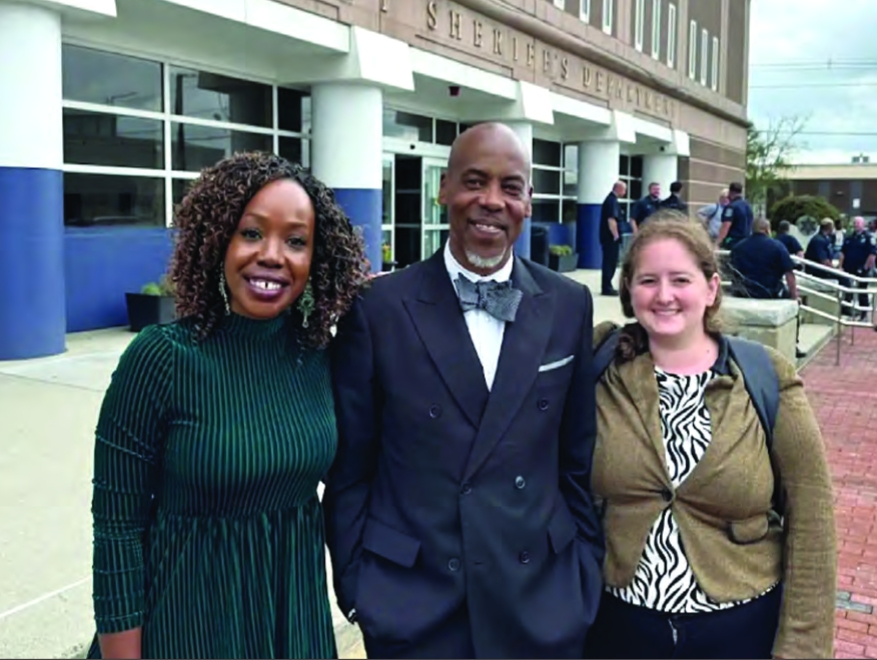
Professor
DeAnza Cook, left, and Pastor Franklin Hobbs of Healing Our Land,
center, with organizer Elly Kalfus, right, pose for a photo in front of
the Suffolk County Sheriff’s Department. They all met with inmates to
help them cast ballots and advocate for voting rights on Friday, Sept.
5, 2025. Incarcerated felons don’t have the right to vote in Massachusetts — but they still have the right to try to change that.
Advocates attempting to restore those voting rights kicked off a statewide petition drive on Sept. 5 by collecting signatures inside Suffolk County jails. An organization called Healing Our Land, which supports incarcerated and formerly incarcerated people, convened political leaders, advocates and several dozen inmates inside the Suffolk County House of Correction.
They brought with them the petitions that were approved by the state’s attorney general last week in support of a ballot initiative to restore voting rights, and several inmates signed.
DeAnza Cook, a professor at Ohio State University and a board member of Healing Our Land, told GBH News that it sends an important signal that incarcerated people “will be the very first ones to have their names on that petition.”
In Massachusetts, people serving time for felonies haven’t been allowed to vote in any elections since 2000, when voters approved a constitutional amendment suspending their rights. If it’s successful, the new initiative would reverse that.
The ballot initiative is likely to take years; for starters, organizers must collect tens of thousands of signatures from around the state. At least 25% of state lawmakers will have to approve the measure in the next two legislative sessions, then the issue could be put on the 2028 ballot.
Men incarcerated in the state prison in Norfolk
participated in drafting the initiative as part of a project called
Empowering Descendant Communities to Unlock Democracy.
There
are more than 7,000 people in Massachusetts who cannot vote because of
their felony convictions, said Franklin Hobbs, a pastor and the founder
of Healing Our Land.
But people incarcerated on misdemeanors or awaiting trial still have the right to vote.
As they collected signatures for the ballot initiative, Healing Our Land and other advocates were also going “from unit
to unit” inside the Suffolk County jails, connecting with prisoners and
making sure those eligible can vote. Some people incarcerated at the
Suffolk County House of Correction were eligible to vote in Tuesday’s
preliminary election in Boston.
“We’re
tracking their process,” Hobbs said. “Filling out a registration form
or an absentee ballot application. ‘Did you get your ballot?’ We’re
receiving their ballots. We’re saying, ‘Did your ballot get cast?’ We’re
following that whole process.”
Elly Kalfus, a volunteer coordinator for the voting
rights project, said it’s impossible to know how many potential voters
are behind bars in county jails because the secretary of state has not
released that data.
But
between Nashua Street Jail and Suffolk County House of Correction, she
said, “Right now we’ve registered 100 voters for this election. Last
year we had more like 300 voters because of the presidential election.”
But
Hobbs said it should be the government’s responsibility to make it easy
for prisoners to vote. “We’re trying to institutionalize this,” he
said. “This should not be this difficult. Ultimately the secretary of
state — it’s his responsibility to make sure that everybody [behind
bars] has the same rights that everybody on the outside has.”
State
Rep. Russell Holmes, a Democrat who represents Boston neighborhoods
including Mattapan, Dorchester and Roslindale, joined Hobbs and the
other advocates at the House of Correction last Friday.
“As
a state, we had for hundreds of years allowed people who were
incarcerated to vote — and then we took that away as pretty much a
punishment,” he told GBH News, referring to the move in 2000 to suspend
rights of people incarcerated for felonies.
Holmes
hopes to see the initiative passed. He said he told those serving time
that they have to vote if they want politicians to take their issues
seriously.
“The most
important thing you can do is vote, because we’re going to pay attention
to it if you do.” he said. “If you don’t vote, we’re not going to
really pay attention.”
Paul Singer is the senior editor, equity & justice at GBH News.


