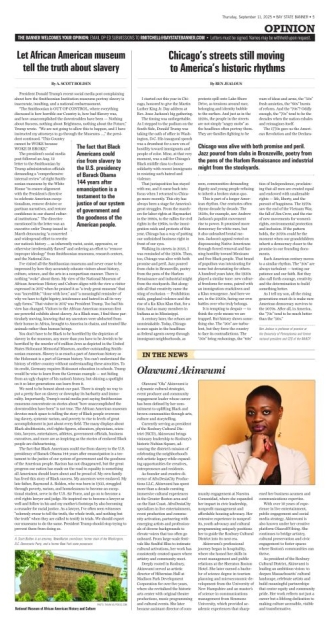
I started out this year in Chicago, honored to give the Martin Luther King Jr. Day address at Rev. Jesse Jackson’s big gathering.
The timing was unforgettable.
As I stepped to the podium on the South Side, Donald Trump was taking the oath of office in Washington, D.C. His inaugural speech was a drumbeat for a new era of hostility toward immigrants and people of color. Mine, at that very moment, was a call for Chicago’s Black middle class to choose solidarity with recent immigrants in resisting such hatred and violence.
That juxtaposition has stayed with me, and it came back into focus when I returned to Chicago more recently. This city has always been a stage for America’s great struggles. From the marchers for labor rights at Haymarket in the 1880s, to the rallies for civil rights in the 1960s, to the immigration raids and protests of this year, Chicago has a way of putting our unfinished business right in front of our eyes.
Walking its streets in 2025, I was reminded of the 1920s. Then, too, Chicago was alive with both promise and peril. Jazz poured from clubs in Bronzeville, poetry from the pens of the Harlem Renaissance and industrial might from the stockyards. But alongside all that creativity came the sting of exclusion — Prohibition raids, gangland violence and the rise of a Ku Klux Klan that, for a time, had as many members in Indiana as in Mississippi.
A century later, the echoes are unmistakable. Today, Chicago is once again in the headlines as federal agents sweep through immigrant neighborhoods, as protests spill onto Lake
Shore Drive, as tensions around race, belonging and identity bubble to
the surface. And just as in the 1920s, the people in the streets are not
simply “angry mobs” as the headlines often portray them. They are
families fighting to be seen, communities demanding dignity and young
people refusing to inherit a broken status quo.
This
is part of a longer American rhythm. Our centuries often rhyme decade
by decade. The 1820s, for example, saw Andrew Jackson’s populist
movement rise to power. It promised more democracy for white men, but it
also unleashed brutal racism. Jackson’s appeal rested on dispossessing
Native Americans through forced removal and fanning hostility toward
Mexicans and free Black people. That brand of populism was intoxicating
for some but devastating for others. A hundred years later, the 1920s
played a similar tune: new cultural freedoms for some, paired with an
immigration crackdown and a Klan resurgence. And here we are, in the
2020s, facing our own battles over who truly belongs.
It
is tempting to despair — to think the cycle means we are trapped. But
history shows something else. The “20s” are turbulent, but they force
the country to face its contradictions. The “30s” bring reckonings, the
“40s” wars of ideas and arms,
the “50s” fresh anxieties, the “60s” bursts of reform. And the “70s”?
Oddly enough, the “70s” tend to be the decades when the nation exhales
and reimagines itself.
The
1770s gave us the American Revolution and the Declaration of
Independence, proclaiming that all men are created equal and endowed
with unalienable rights — life, liberty, and the pursuit of happiness.
The 1970s saw the end of the Vietnam War, the fall of Jim Crow, and the
rise of new movements for women’s rights, environmental protection and
inclusion. If the pattern holds, the 2070s could be the moment when our
grandchildren inherit a democracy closer to the promise in our founding
documents.
Each
American century moves to a similar rhythm. The “20s” are always
turbulent — testing our patience and our faith. But they also call forth
courage, creativity and the determination to build something better.
As
I tell my son, all the rising generations must do is make sure American
democracy survives to the 2070s. After all, in America, the “70s” tend
to be much better than the “20s.”
Ben Jealous is professor of practice at the University of Pennsylvania and former national president and CEO of the NAACP.