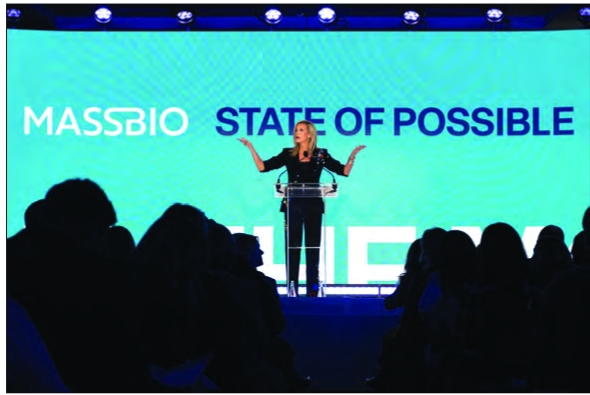
President
and CEO Kendalle Burlin O’Connell addresses attendees at group’s annual
conference in April 2024. In August, the life-sciences trade group
released a report on the state of Massachusetts’ biotechnology industry,
which saw reduced hiring in the past year.A new report from the Massachusetts Biotechnology Council, or MassBio, identified an ongoing slump in the state’s life sciences industry.
The new industry snapshot, released at the end of last month, showed lower public and private funding, as well as a slight decline in hiring for biotech jobs.
Research and development jobs declined by 1.7% in 2024 and biomanufacturing jobs dropped by 1.5%; overall employment in the sector rose, but only by 0.1%.
The sector has seen increased vacancies in lab space — the new snapshot identified a vacancy rate of 22.9% in Cambridge and 38.3% in Boston — and funding has dropped.
In Massachusetts, one major source of money for the life sciences industry has been through the federal National Institutes of Health — in 2024, it had the highest NIH funding per capita — but that source has seen significant cuts. In an interview MassBio released with the snapshot, Mass- Bio’s CEO and president Kendalle Burlin O’Connell said the state is on pace to see almost half a billion dollars of NIH cuts.
In August, the Supreme Court gave the Trump administration permission to continue with cutting almost $2 billion in research grants issued by the NIH.
In 2024, private funding for the life sciences dropped too, according to the MassBio snapshot, likely in response to federal policy changes that have spurred uncertainty. Venture capital funding in the first half of 2025 was 17% lower than it was the year before.
But, while the report showed a slowdown in hiring, there isn’t a dramatic loss of jobs in the sector. The industry has seen some layoffs, while other companies have continued to grow.
In June, MassBioEd, a workforce development nonprofit, released its own workforce trends report that found a similar pattern of job numbers staying relatively steady or declining slightly.
At a national level, the life sciences industry is also experiencing lower hiring volumes. A June report from the Life Science Workforce Collaborative, a nationwide coalition of industry associations focused on workforce development, found hiring in the industry slowed down across the country in 2023, and declined slightly in 2024.
Sunny Schwartz, MassBioEd’s CEO, said that, while this moment may not be “business as usual,” the slump isn’t the norm, or at least the desired situation for an industry that saw years of rapid growth.
It certainly isn’t like “the world on fire.”
The drop in hiring comes following a spate of workforce development programs that have sprung up in recent years to fill roles in the life sciences sector, promising career paths for more Boston-area residents — especially those without a four-year college degree.
In 2021, MassBioEd launched a life sciences apprenticeship program aimed at connecting candidates from underrepresented groups to careers in the sector.
More programs were opened in the following years, many, like Bioversity which was an offshoot from MassBio, following a short program aimed to quickly get their students ready for the jobs in certain pockets of the industry.
In early 2024, the city of Boston allocated $4.7 million to community colleges and local programs aimed at developing a local biotech workforce.
With the expansion of programs, efforts like
MassBioEd’s career hub, which it launched in 2023, and the Roxbury Worx
initiative from The American City Coalition, have attempted to connect
more residents with the programs that best fit them.
For some of those programs working on the ground, the new MassBio numbers didn’t come as a surprise.
Zach
Stanley, executive director at Bioversity, said that the companies his
program has worked with have shown reduced demand for the program’s
graduates in the past six to eight months.
“It’s definitely been harder in 2025 to place our graduates than it was in 2024,” Stanley said.
That
shift in demand has led some workforce development programs to
reconsider some of the details around how they handle the work.
Bioversity has reduced class sizes from 12 to 15 participants in each session to cohorts of eight to 12 students.
Stanley
said the program has also shifted some of its curriculum to spend as
much time as possible focused on things like résumé development and
interview skills so that when jobs become available, students will be
prepared to access them.
“Not
only are there fewer job postings in total; the hiring environment is
much more competitive,” he said. “There’s many more people applying for
each open role.”
Behind the leveling out of hiring is a shift from seeking out new hires to focusing on existing staff, Schwartz said.
“You’re
seeing it’s easier for companies to find people, and there’s a huge
emphasis on your current workforce and reskilling your current
workforce, even more than we’ve seen in the past,” Schwartz said.
She
said that has been reflected in hiring through MassBioEd’s
apprenticeship program, which provides technical training and hands-on
experience while offering students a stipend. Through that program,
partner companies commit to hiring participants before someone starts
training.
In the past year, the number of those apprenticeships hasn’t disappeared, but has dropped, Schwartz said.
“Before
it was like, ‘Yeah, we need a million of these people, … we can’t get
them fast enough,’” Schwartz said. “Now it’s a little more cautious
about that.”
For other programs, operations have continued largely uninterrupted, despite the slump.
Cambridge-based
LabCentral runs a program called Biotech Ready, for students who have
an undergraduate degree and need to score specific skills or
microcredentials to fit the jobs they’re seeking.
Uzo
Erlingsson, associate director of educational programming at
LabCentral, said the Biotech Ready program hasn’t had major shifts in
how it recruits or trains. Rather, the contraction in the biotech
industry, she said, has confirmed the model they’re working with.
“Our
model has always been about creating value talent,” Erlingsson said.
“What that means is that the talent — the employee — wants to do that
job, and the employer is looking for that talent.”
However,
despite any shifts in hiring trends, workforce development programs say
the long-term goals of the workforce development efforts remain the
same: connecting more employers and employees to bolster the industry in the state.
“All
along, this has been part of the long-term vision in terms of training.
What we’re doing is we’re serving the need of our ecosystem, we’re not
just serving boom need,” Erlingsson said, referring to the surge in
interest and investment in biotech with the COVID-19 pandemic.
And
while the hiring market is more competitive, Stanley said he believes
that programs like Bioversity are still valuable and in a good position
to connect residents — especially those from outside of the sector and
often outside of higher ed — with entry level jobs that can last longer
and become careers.
“It’s
not about that first job,” Stanley said. “It’s really about the
opportunity to start something new for somebody for the long term.”
In
its industry snapshot, Mass- Bio projected that, with a life science
workforce totaling over 117,000 jobs, Massachusetts remains primed to
rebound if and when investor confidence returns.
“We’ve
still got all of the stakeholders here, we’ve got all of the
ingredients,” Burlin O’Connell said in the TV Biotech interview. “What
we need to see is a recommitment to boldly invest, smart policy and
long-term thinking.”
That sense of optimism was widespread across the workforce development programs.
Schwartz
pointed to other statistics in the MassBio report that she said point
to a “place of strength” in the industry. Despite the 1.7% decrease in
biopharmaceutical research and development employment, the state still
has nearly a quarter of the country’s workforce in that space.
Overall,
the state had over 143,000 jobs in the life sciences industry in 2024
according to the June employment report released by MassBioEd.
“We
have to keep in mind that there are companies in Massachusetts that
have drugs that have been approved already; they’re going to continue to
manufacture those drugs, and they need workers to do that,” Schwartz
said.
“There is investment in research and development and you’re going to continue to need scientists to do that.”
Erlingsson
said that the state “shouldn’t give up yet,” and that at LabCentral
they are “doubling down” because they believe the need will always be
there.
“Whether
there’s a boom or there’s a contraction, the industry will always need
early-career scientists who can see a pathway to growth,” she said.
Stanley
said the continued operations of programs like Bioversity despite the
slump should position the state to be in a place where there isn’t a
talent shortage if there is a bounce-back.
“We
want to continue to be here, as Bioversity, to make sure that as the
industry comes back and hiring picks up, that the talent is there —
especially trained talent, which is what employers have been saying from
the get-go is the hardest to find,” Stanley said.