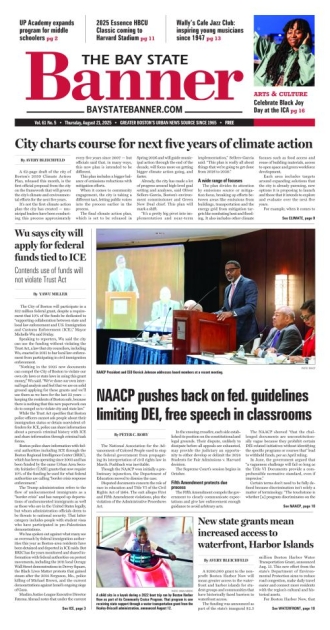
NAACP President and CEO Derrick Johnson addresses board members at a recent meeting.The National Association for the Advancement of Colored People sued to stop the federal government from propagating its interpretation of civil rights law in March. Pushback was inevitable.
Though the NAACP won initially a preliminary injunction, the Department of Education moved to dismiss the case.
Disputed documents concern the role of race in education and Title VI of the Civil Rights Act of 1964. The suit alleges First and Fifth Amendment violations, plus the violation of the Administrative Procedures Act.
In the ensuing crossfire, each side established its position on the constitutional and legal grounds. Their dispute, unlikely to dissipate before all appeals are exhausted, may provide the judiciary an opportunity to either develop or delimit the 2024 Students for Fair Admissions v. Harvard decision.
The Supreme Court’s session begins in October.
Fifth Amendment protects due process
The Fifth Amendment compels the government to clearly communicate expectations and give law enforcement enough guidance to avoid arbitrary acts.
The NAACP showed “that the challenged documents are unconstitutionally vague because they prohibit certain DEI-related initiatives without identifying the specific programs or courses that” lead to withheld funds, per an April ruling.
In June, the government argued that “a vagueness challenge will fail so long as the Title VI Documents provide a comprehensible normative standard, even if imprecise.”
Certain terms don’t need to be fully defined because discrimination isn’t solely a matter of terminology. “The touchstone is whether [a] program discriminates on the basis of race,” department lawyers wrote.
Only a “hostile racial environment” calls for recourse.
Since 1994, that requires “severe, pervasive or persistent” racial harassment.
One
document offers a “sliding scale” with two poles: “an elementary school
that sponsors programming that acts to shame” certain students would be
unlawful, while an “exploration of similar themes in a class discussion
at a university” would be less problematic.
Silent on secondary grades, the government admits “there might be some edge cases.”
It
knocks “the overreaction” of some school districts that cut back before
judicial intervention. “Their unreasonable interpretation of the Title
VI Documents fails to show that those independent actors” reacted
predictably, they contended.
In Decatur, Ga., NAACP members feared the loss of an African American history course before the rulings.
The
school board initially rescinded its “Equity Policy and its School
Board Governing Policy.” After judicial injunctions, it reinstated the
policies.
Decatur’s
action “was not unreasonable,” the NAACP claimed, since “the policies
seemed likely to be covered by the documents.” The Peach State
particulars are vital, since the association needs at least one member
whose injuries can be traced to the challenged documents.
Due process secures equal protection
The NAACP also made an equal protection claim under the Fifth Amendment.
Though the Fourteenth Amendment affirms equal
protection from state actions, the Supreme Court has allowed federal
equal protection claims under the Fifth since 1954. On the same day as
the Brown v. Board of Education decision, SCOTUS ruled “the concepts of
equal protection and due process are not mutually exclusive.”
Unless
the government expressly classified people based on race, an equal
protection claim requires showing a disparate impact and discriminatory
intent. The government denied both.
It
claimed that “the Title VI Documents are race-neutral on their face”
and that the “NAACP’s equal protection claim principally relies on a
distorted and mistaken view.”
Since
the documents prohibit discrimination and lack language that reveals
discriminatory intent, the government doubts it violated the
Constitution.
It notes that “a plaintiff ’s burden of proving intentional discrimination is notoriously difficult.”
“The
documents assert that instruction on race is unlawful under Title VI if
it acts to shame or guilt students or accuses them of being oppressors
in a racial hierarchy,” the NAACP replied.
That
sends a “clear message” that the Department of Education is
“exclusively concerned about the shame or guilt” that “could be
experienced by white students.”
Further, the civil rights group contended that the “historical background … supports an inference of discriminatory purpose.”
“In
response to the racial justice protests in 2020, some school districts
and universities established policies to equalize access to selective
programs, adopted curriculum addressing race and systemic racism, and
expanded programming to ensure Black students’ equal access to a
supportive and inclusive learning environment,” the NAACP wrote.
Such programs and policies, once encouraged, are now disfavored.
The
NAACP said the department “knowingly injures Black children” since it
forces school districts to discontinue activities “proven to improve
educational outcomes for Black children.”
Proof
relies on a study by Robert Sellers, Ph.aD. His research connects Black
adolescents’ ideas of and experiences with race to their psychology.
Research
shows that private regard, or a positive attitude toward one’s own
race, is associated with less depressive symptoms and lower stress in
Black youth.
Sellers measured that through agreement with statements like “I’m happy that I’m Black.”
“Positive
feelings toward their racial group,” the research reads, “may help
prevent the internalization of inferiority beliefs.”
Youth
who view their race in low public regard experienced racial hassles
more frequently. They appear to “buffer” their psychological functioning
from such negative interactions. Sellers suggests they may have better
“coping strategies.”
In
reply, the government sees only “educational institutions exercising
independent discretion in responding to the Title VI Documents” where
school district cutbacks resulted.
Additionally, the NAACP argued, “the government conceded” its certification was novel.
SCOTUS
ruled in 1976 that “departures from the normal procedural sequence also
might afford evidence that improper purposes are playing a role.”
“Although evidence of procedural irregularities could support an inference of racial discrimination,” the government countered, “here, NAACP fails to draw any connection between the purported short timelines and the alleged discriminatory motive.”
That
is, perhaps, because the district court judge already counted the
timeline against the government. In April, the judge wrote, the short
timeframe “exacerbates vagueness concerns.”
“Recipients
were originally given only ten days to return the completed
Certification — hardly enough time for schools to consult with the
Department or determine which specific policies constitute prohibited
DEI.”
“As a result,”
the judge ruled, “students have lost access to programming, curricular
offerings, and other initiatives, some of which undoubtedly constitute
protected speech.”
Free speech in classrooms may matter
The
April injunction did not rely on a First Amendment violation. That
injury “stems from the independent decisions of school boards and
administrators to end certain programs implicating DEI,” the ruling
noted.
Then, an
injunction wouldn’t necessarily provide relief since the court had “no
declarations from any schools or administrators stating that they would
return programming.”
Now, however, districts like Decatur, Georgia have done so.
For
Michaela Turnage Young, senior counsel of the Equal Protection
Initiative at the Legal Defense Fund, the government is “infringing upon
our clients’ First Amendment rights to both freely assemble and also to
receive information.”
One
document has “language that essentially prohibits instruction
concerning systemic racism,” she said. “That is viewpoint
discrimination.”
“While
there is clearly a First Amendment right to receive information, I am
not aware of a right to not feel guilty or to feel shame,” argued
Turnage Young, a former trial attorney for the Civil Rights Division of
the Department of Justice.
“Certain
parts of our history just are distressing,” she said. “That doesn’t
mean that we should be denying students an opportunity to learn about
them.”
In July, the
NAACP wrote, “The promise of significant funding cuts and legal action
can only be understood as a means of coercion to facilitate the
suppression of speech disfavored” officially.
With
months to go before any resolution, the NAACP has wind in its sails. In
August, a separate suit to protect funding for Equity Assistance
Centers won an early victory. EACs date to the passage of the Civil
Rights Act.