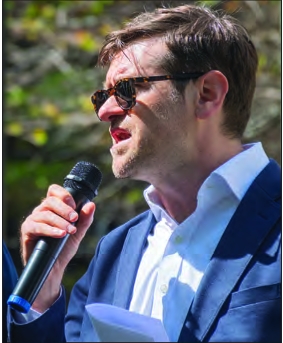
Oliver
Sellers-Garci, city of Boston environment commissioner, speaks at a
press conference May 7 about climate-focused retrofit projects. In early
August, Sellers-Garcia and the city of Boston released a draft of its
2030 climate action plan, a five-year plan aimed at implementing climate
mitigation and emissions reduction plans across Boston. A 62-page draft of the city of Boston’s 2030 Climate Action Plan, released this month, is the first official proposal from the city on the framework that will govern the city’s climate and environmental efforts for the next five years.
It’s not the first climate action plan the city has created — municipal leaders have been conducting this process approximately every five years since 2007 — but officials said that, in many ways, this new plan is intended to be different.
This plan includes a bigger balance of emissions reductions with mitigation efforts.
When it comes to community engagement, the city is taking a different tact, letting public voices into the process earlier in the process.
The final climate action plan, which is set to be released in Spring 2026 and will guide municipal action through the end of the decade, will focus more on getting bigger climate action going, and faster.
Already, the city has made a lot of progress around high-level goal setting and analyses, said Oliver Sellers-Garcia, Boston’s environment commissioner and Green New Deal chief. This plan will mark a shift.
“It’s a pretty big pivot into implementation and near-term implementation,” Sellers-Garcia said. “This plan is really all about things that we’re going to get done from 2026 to 2030.”
A wide range of focuses
The plan divides its attention by emissions source or mitigation focus, breaking up efforts between areas like emissions from buildings, transportation and the energy grid from mitigation targets like combating heat and flooding. It also includes other climate focuses such as food access and reuse of building materials, access to open space and green workforce development.
Each area includes targets around expanding solutions that the city is already pursuing, new options it is proposing to launch and those that it intends to explore and evaluate over the next five years.
For example, when it comes to reducing
emissions from buildings across the city, the draft includes efforts to
grow and scale the city’s implementation of BERDO, the Building
Emissions Reduction and Disclosure Ordinance, which requires larger
buildings in the city to report and reduce emissions until they
ultimately reach netzero. The ordinance was passed in 2021, but this
year marked the first that building owners actually have emissions
standards to meet.
For
smaller buildings the city proposes building on existing pilot programs
to encourage steps like replacing gas stoves with electric or induction
ones. New efforts include convening a restaurant decarbonization task
force to address a sector that offers particular challenges around
replacing appliances and retrofitting.
In
the city’s plans around energy use and emissions, the city proposes
continuing and expanding its community choice electricity program, while
launching new efforts like a joint procurement plan to bring more
renewable energy to large buildings, or exploring the role of battery
storage systems, which are included in the city’s energy plan to support
the electrical grid.
When
it comes to resilience efforts, such as for addressing urban heat, the
city outlines continued plans like expanding its cooling resources and
infrastructure, while also developing heat protection interventions for
workers and exploring new solutions for public cooling in a wider
variety of places that are not well served by current proposals like
tree planting and green-roof bus shelters.
Among
the resilience efforts meant to prepare the city to face the impacts of
climate change, the draft proposes addressing them through a
combination of targeted capital investments, improved data systems,
updated design standards and expanded partnerships.
Through the work outlined in the plan, the city’s approach to those priorities will be rooted in a “climate justice
framework,” which includes priorities like improving health and quality
of life for residents across the city, sharing benefits and burdens
equitably and partaking in climate action in partnership with
communities.
Christina
Schlegel, executive director of the Global Center for Climate Justice,
said she’s excited to see the city be so forthright with a climate
justice framework.
It’s
a model that officials said builds on existing concepts of
environmental justice communities — officially designated by how much of
the area has a low household income, is comprised of minority
populations, or has residents with more limited English usage — while
climate justice looks more forward toward future impacts from climate
change.
“I think one
of the key distinctions with climate justice is about recognizing that
the harms of climate — the forward-looking, projected harms of climate —
are really going to be borne unevenly,” Sellers-Garcia said. “That
really, in a way that is more complex than environmental justice, brings
together a lot of different factors that have to do with social and
economic interactions with the environment.”
But he said it also means making sure that the potential benefits of climate solutions are also distributed equally.
That effort, Schlegel said, requires intentionality, something she said this draft plan starts to work toward.
“That has to be planned, you know, that has to be invested in if we’re talking about the positive impacts,” Schlegel said.
Through
it all, it means bringing the communities that have long borne the
brunt of environmental injustices — and that are likely primed to
experience the worst impacts from climate change — into the solutions.
Part
of that work is showing residents that climate actions can also be
beneficial generally, said Hessann Farooqi, executive director of the
Boston Climate Action Network. He called it “the most important thing we
can do to build a broad coalition of
residents to actually make these programs a reality in the next several
years and in the next several decades.”
“Not
everyone is thinking about climate change every day — most people
aren’t,” Farooqi said. “If you’re struggling to pay your energy bills,
you’re not thinking about where that energy comes from.”
For
example, he pointed to city efforts around fare-free buses. The city
has run 23, 28, or 29 without charging riders since 2021, which has
increased ridership and decreased emissions from personal vehicles,
while bringing other benefits like potentially saving money for riders
and increasing the speed of buses.
The
draft plan describes the city’s intention to find new funding sources
to keep the program going and to expand it to other routes across the
city.
Meeting the moment
The
timing of the plan is significant, coming as climate change continues
to worsen, federal support wanes and the city stares down pending
deadlines in its mitigation goals, like a 2030 benchmark to reduce
citywide emissions by 50% and municipal emissions by 60%.
“We’re
in a moment that’s very different from where we were in 2019, the last
time we had a Climate Action Plan — for better and for worse,” Farooqi
said.
When it comes to
a landscape of shifting federal priorities with an abrupt pull-back on
climate supports from the Trump administration, the timing of the plan
means considering where funding for the city’s many efforts will come
from, if not the federal government.
The
city has not been a stranger to seeking or receiving federal funds for
its projects in the past. For example, the fare-free bus pilot operated
by the city has been run using $4.2 million annually in funding through
the pandemic-era American Rescue Plan Act. Or, in 2023, the city
received a $11.4 million grant from the U.S. Forest Service to support
its urban tree canopy efforts.
In
the draft, the city acknowledges the landscape of “uncertain federal
support” and proposes alternatives it plans to pursue, including to
continue to explore public-private partnerships, to explore climate
accelerators and long-term funding options and to create a city climate
budget to better manage climate-related spending and investments.
Seeking community engagement
The plan has an extended review process; the document is a preliminary draft that precedes a full draft later this fall.
Throughout
the new draft, survey questions prompt readers to think about and share
how they expect parts of the plan will impact them and their
communities. And throughout the rest of the summer, the city plans to
host meetings and engagements out across Boston’s neighborhoods.
Sellers-Garcia
said that in previous climate action planning processes, the city has
waited until the official public comment process to release a draft
plan. This process is a shift from that, he said.
“We’re adding an additional step into the process that is, ‘Hey, take a look at what we have. Let’s all figure out how we would
do it,’ and based off of how we will do it, we then decide what ends up
going into the final plan,” he said. “So many of these plans have
really shot for the moon before everyone gets a chance to look at it
together.”
It’s
intentional that this draft is not the complete plan, instead outlining
the broader agenda, while leaving specific steps for further development
based on input.
Over
the next several months, as the city puts together its official draft,
Sellers-Garcia said that they plan to try to engage with community
members in a host of ways, through local meetings but also through
surveys.
“We’re really trying to do it in a way that fits into everybody’s time,” he said.
The
current plan is relatively limited, with the broad strokes of the
city’s approach for the next five years. Elizabeth Jameson, Boston’s
director of climate policy and planning, said the official full draft
that will be released this fall should include more metrics and
accountability defined. The final version, to be released next year,
will include more specific road maps that outline how the city plans to
reach its implementation goals.
That
timeline gives an opportunity to bring more individuals and — too
Farooqi, perhaps more importantly — organizations and institutions to
support the work.
“When
we take this time, we can also make sure that’s done in a way that’s
transparent and equitable, so that big institutions and small
community-based organizations can all be at a level playing field to
make sure that we can get a wide array of partners to help implement
this,” he said.
Bringing
a wide collection of stakeholders into the work is a priority for the
city, said Katherine Diaz, director of climate action innovation and
analytics. The city, she said, is looking to serve as a leader in
climate work, but to get buy-in from community organizations and larger
partners.
“It’s very much an all of government, all of city, approach to our different strategies in the Climate Action Plan,” she said.