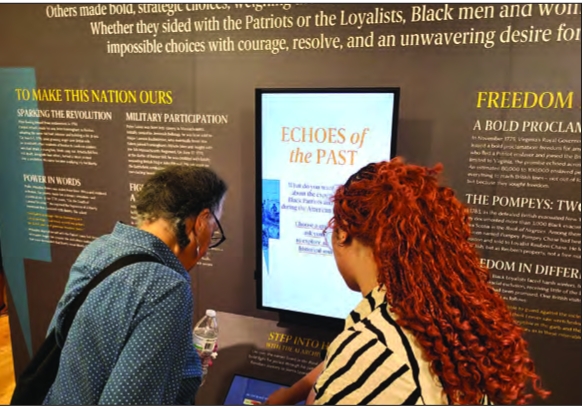
Angela Tate, chief curator and director of collection at MAAH, shows visitors how to use the exhibit’s interactive digital technology. 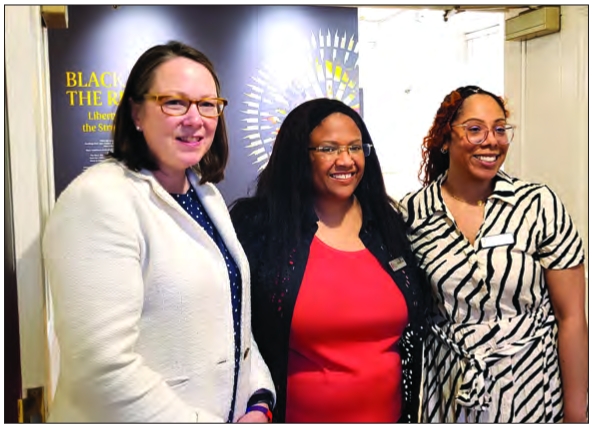
From
left: Kate Fox, executive director of the Massachusetts Office of
Travel & Tourism; Dr. Noelle Trent, president of MAAH; and chief
curator Angela Tate unveil the new exhibit together.
New MAAH exhibition centers Black history of Revolutionary War
Visitors gathered at the Museum of African American History (MAAH) in Boston last Monday to see the unveiling of their newest exhibit titled “Black Voices of the Revolution.” It reexamines the diverse stories of African Americans during the Revolutionary War era to challenge traditional narratives by highlighting the individuals who have often been left out of mainstream historical accounts.
Black Voices of the Revolution explores the American Revolutionary period by centering Black and female perspectives. The exhibit is organized into six sections, including “Freedom for Whom?” and “Mapping Black Revolutionary Boston,” while featuring notable historical figures like Crispus Attucks, Phillis Wheatley Peters and Prince Hall, among others. Created through a partnership with TimeLooper, it incorporates interactive digital technology powered
with AI that uses the museum’s collection of primary sources to
generate answers to visitors’ questions about the people and history.
The exhibit also displays some archeological artifacts found from their
Nantucket location, accompanied with 3D printed model replicas that
guests can physically interact with.
Dr.
Noelle Trent, president and CEO of MAAH, explained how this exhibit is a
new style for the museum to show people a different perspective on the
history of the American Revolution and the ideas people traditionally
don’t know about.
“It
allows us to show people what the Black community was thinking because
we’re not a monolith and we’ve never been a monolith,” she said. “There
are so many different powerful stories, especially the stories of women.
Black women’s voices have historically been minimized in the public
narrative, so we have worked really hard to present some new ideas.”
By
shifting the focus of the American Revolution through the Black lens,
the exhibition adds a crucial narrative that redefines the understanding
of key moments from the period, putting a spotlight on stories from
individuals often overlooked that shaped the country’s founding.
The
creation of Black Voices of the Revolution was more challenging than
some of the museum’s previous exhibits. Angela Tate, chief curator and
director of collection for MAAH, described how the Black community
during the period didn’t leave an extensive amount of personal written
records. Much of their presence is mainly seen in historical archives
from petitions documenting their fight for freedom, confessions and
newspapers.
“Using
these digitally immersive technologies, we get to bring these documents
to life that visitors can engage with on their own terms and think
about, what it means for us to have to do this excavation of the
archives to tell these stories,” said Tate.
Visitors
described the exhibit as a powerful way to connect with history by
sharing and engaging with the diverse experiences that the Black
community faced at the time as well as similar experiences faced today.
“I
think people aren’t able to accept what they can’t understand, and art
helps bridge that gap by making things accessible and easier to
understand,” said Nyla Cross, a Harvard Du Bois intern curating an
exhibit at the Museum of Fine Arts. “Exhibits like this and art take
really traditional, intense, and complex topics and simplify them,
putting them in an avenue that’s easier for people to understand, easier
for them to empathize with and more engaging.”
Trevon
Henderson, also a Harvard Du Bois intern, described that it is an
immersive space for people to engage and participate in. “Having a space
like this to be able to teach is definitely important because it
doesn’t allow anyone to be stagnant. You get to walk around, and you get
to interact, that’s significant for anybody seeking to learn. Neil
deGrasse Tyson always says, ‘You want your work to be meaningful, you
want the space for the viewer to be meaningful, and you want them to
pose questions and ask questions about things.’”
As
Tom O’Reilly, a member of the museum, explained, the importance of art
was a way to help people understand different voices. “In many ways we
have a shared history, the same dates, the same times, but different
experiences. A big part for me is, I think the solution is in the other
person’s space. Whatever the problem
is, the solution’s in the other person’s place. The more you understand
where the other person’s coming from, the more we’re able to figure out
what the solution is to the problems we face together.”
The
exhibit was funded by a grant from MA250 administered by the
Massachusetts Office of Travel & Tourism. This funding was crucial
for MAAH to be able to create this exhibit. “We’re very grateful to the
state of Massachusetts for offering this funding opportunity because,
without it, we wouldn’t have this exhibition at all,” said Tate.
Especially
after the museum lost its IMLS grant funding due to federal cuts, it
has been increasingly more difficult for them to not only create new
exhibits, but have educational events to go along with it as well.
“Not
having that [grant] meant that we had to rethink how we were going to
do the educational program, particularly around this exhibition,” said
Trent. “The programming is now delayed, and with the injunction, we’re
able to rethink some things. But we’re hoping that people see this and
they want to support this effort, and that we can encourage school
groups to visit and engage with the digital technology as well.”
Places
like the Museum of African American History are essential for educating
people about the experiences and contributions of African Americans
during the founding of the United States. “I think the work around is
leaning on community partners, donors to the museum, and other
institutions with similar missions who want to partner with us. At this
point in time, I’m really leaning on the community,” Tate said.
Without sustained funding, continuing to uncover the history and importance of these stories becomes harder to preserve.
Federal
funding cuts to museums are catastrophic, particularly for ones like
MAAH that aim to teach and expand the understanding of America’s full
history.
“For federal
funding to be cut for spaces like these, it means that there is
definitely a revolt on learning and teaching. Thankfully we’re able to
still have spaces like these and people who won’t just stand for
injustice,” said Henderson.
With
the Trump administration’s increasing pushback on cultural
institutions, it creates a dangerous standard on how history can be
portrayed and discussed in the country.
“It’s
tragic that we have a governmental moment where the ambition is to
reduce us, to make everything smaller and one voice, that cannot be the
story of a great nation. A great nation has never been only one voice or
one story, and it cannot be. What makes the greatness of America is the
elaborate, composite make up of it,” said Edmund Barry Gaither,
director and curator of the Museum of the National Center of
Afro-American Artists.
“All
of the people who have brought pieces of themselves, their legacies and
heritages from every spot in the globe, have woven them into a
magnificent tapestry. And now we have someone in charge of the tapestry
who wants to cut it up and rip out all of the threads that are not his
own.”
Like the pieces
that African Americans contributed to the founding of the United States
during the American Revolution, the diverse stories and backgrounds
different people bring are essential to understanding the shared history
all of us have.
“Every
institution like this one has its purpose of making people larger and
more fully engaged with what it means to be human. What it means to be
human, is to be open to a larger world,” Gaither said.
For
MAAH, they continue to strive to protect the history which shaped the
United States, a country that was built upon by those who were denied
freedom but shaped the very foundation of this nation.
“I
hope people realize that African Americans have been here in this
country, that they’ve made significant contributions. We hope to round
out some stories that people think they know,” said Trent.


