
Geothermal system in the works: A rendering shows an under-construction habitat for African penguins at the Franklin Park Zoo, slated to be opened in spring 2026. The habitat will be heated and cooled using a geothermal system to increase energy efficiency.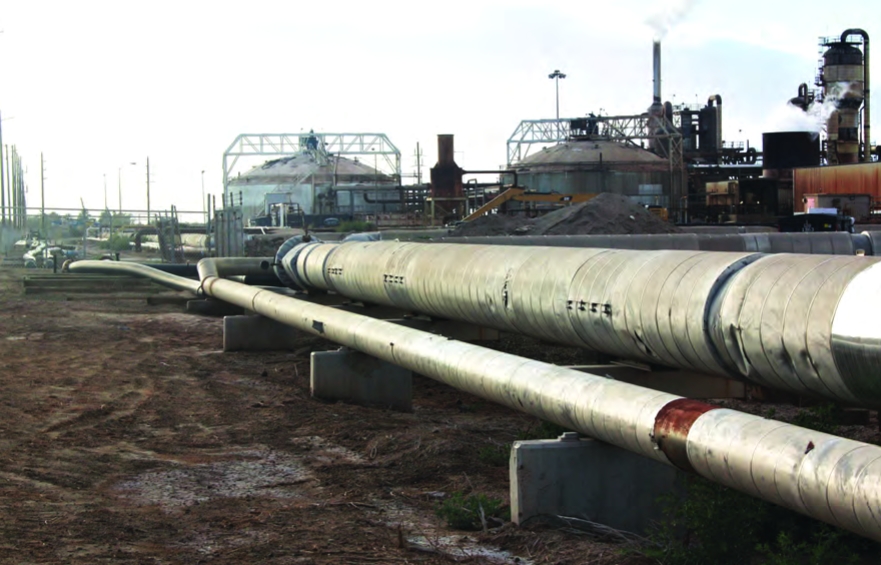
A
geothermal energy plant near the Salton Sea, California. Water pipes
are shown in the foreground and steam exhaust in the background.
The Bay State Banner wants to hear your questions about the climate and environment. This article was produced as part of a new project called Encyclopedia Climatica, in response to a readersubmitted question. Do you have a question about climate or environment? Submit it to us at tinyurl.com/banner-climate-questions or email to [email protected].
A READER ASKS: “Can you explain how geothermal energy works and how it can be applied to housing? Is it ‘clean’ energy?”
A rookery of new residents will be moving into Franklin Park Zoo next year. When that colony of African penguins arrives next spring, the exhibit that will house the temperate birds will be heated and cooled by the heat of the earth.
The system will use 20 boreholes — vertical pipes, installed 600 feet into the ground — to pump a heat-transferring liquid through a geothermal system to regulate the temperature of the water and the air inside the new building.
It doesn’t come cheap — the system costs an estimated $800,000 to $1 million more than a traditional setup, said John Linehan, president and CEO of Zoo New England.
But it will operate more efficiently, meaning a reduction in carbon emissions, a priority for Zoo New England, which runs Franklin Park Zoo.
“Being a conservation organization means setting good examples and using technology where we can, to reduce our carbon footprint,” Linehan said.
Geothermal
systems aren’t just for the birds. Increasingly, across the region,
geothermal is being used to heat and cool homes, a solution that
advocates, officials and researchers celebrate as an important step
toward decarbonizing Massachusetts.
“It’s
a sustainable, reliable resource that we have, and we have it beneath
our feet,” said Melissa Lavinson, executive director of the state’s
Office of Energy Transformation.
Broadly,
with geothermal, there are different ways the earth’s heat can be used,
including for heating and cooling and for generating electricity.
Geothermal for heating and cooling
In
New England, the most prominent — and currently only — use of
geothermal is for heating and cooling buildings, like the pending
penguin enclosure.
The
systems rely on the constant temperatures found at shallow underground
depths. There, temperatures tend to hover at a consistent level, locally
about 55 degrees, which allows geothermal heat pumps to pull heat up
into buildings in cold weather or tuck heat underground when it gets hot
out.
In hot weather,
those systems pump a “geothermal fluid” — generally a refrigerant like
in an air conditioner — to pick up heat from a hot room. The fluid is
then carried underground to let the heat dissipate. In cold weather, the
reverse occurs. In both cases the physics of compressing and expanding
gases is used to amplify the transfer.
“All
you’re doing is using that constant temperature underground to act as
either a heat source or a heat sink, meaning it’ll either take the heat
out of a cooling fluid or add heat to that fluid,” said Emily Ryan, a
professor of mechanical engineering at Boston University and an
associate director at the school’s Institute for Global Sustainability.
Unlike geothermal for power generation, heat pumps are an appliance, not a source of energy.
“If
people start to hear the publicity around this networked geothermal,
and they’re like, ‘Great, we’re going to get geothermal energy,’ but
you’re not,” Ryan said. “You still need electricity from our grid to
power these systems.”
For
supporters, the benefits of a geothermal system are plentiful. The
systems tend to be more efficient than traditional HVAC systems.
“From
a decarbonization perspective, it can actually help reduce peak
electric demand,” Lavinson said. Geothermal heating and cooling systems
are up to 65% more efficient than traditional HVAC systems, according to
the U.S. Department of Energy
And
in a region like New England, with old housing stock built for cooler
temperatures, it can add a cooling system to buildings that didn’t
previously have air conditioning.
Supporters
also see a lot of potential in the ability to make the transition. Much
of the labor needed for laying out the pipes needed to transmit heat
underground is carry-over from gas systems.
“Digging,
putting in pipe, connecting pipe to homes and businesses, that’s stuff
that we do every day,” said Liam Needham, Eversource’s director of
customer thermal solutions.
Already,
there’s been proof-ofconcept of that transition at an Eversource
geothermal project in Framingham, said Zeyneb Magavi, executive director
at the Home Energy Efficiency Team, or HEET, a Boston-based nonprofit
focused on the thermal energy transition.
“The
gas pipe installer workforce, they literally went from installing gas
pipe one week to installing [geothermal] pipe the next, with a couple
hours of training,” said Magavi (HEET pitched the project to utilities
and has been involved in the process).
The
needed workforce doesn’t wholly exist yet. A key element of geothermal
HVAC systems are the boreholes — those vertical pipes, often a few
hundred feet deep, that reach constant temperatures. While some
companies exist to drill those boreholes, that segment of the workforce
needs to be expanded.
“Drilling
is obviously something that’s done for industry, for oil and gas
extraction, but I don’t know if we necessarily have the workforce in
place if everybody decided they wanted geothermal,” Ryan said.
And
the cost of installing the systems remains prohibitive. For a
single-family home, Magavi said that installation of a geothermal heat
pump can cost between $20,000 and $60,000. According to Angi’s List,
installation of a new boiler averages about $6,000.
“It’s kind of like if you had to install your gas boiler and pay for all your gas up front,” Magavi said.
One solution is linking a collection of homes or businesses to the same heating system, called networked geothermal.
That
bigger system, likely owned and operated by a utility, saves individual
customers the costs of installing geothermal heat pumps while bringing
the same benefits.
“It
shifts the financing model,” Magavi said. “It means that the utility
can do what a utility is for, which is large, upfront investment and
long-term payback for deliveries of a necessary human good.”
In recent years, the state has seen a handful of networked geothermal pilot programs announced.
In
2020, the state’s Department of Public Utilities approved Eversource’s
first-of-its-kind networked geothermal pilot program in Framingham,
serving 36 buildings and about 140 residential and commercial customers.
In
early 2024, National Grid announced a pilot program of its own at
Dorchester’s Franklin Field public housing development, in partnership
with the Boston Housing Authority. That project, planned to replace an
aging boiler, will serve 129 of the development’s 450 units. National
Grid didn’t respond to a request for comment.
Rate
systems to pay for networked geothermal have yet to be set in stone.
Needham said that it will have to happen before it can really take hold.
But Eversource is currently exploring one approach.
Residential
customers in its pilot pay $10 per month, plus their electricity bill
which covers the energy to pump fluid through the system, while
commercial customers pay $20 per month. Income-eligible residential
customers receive a discount rate of $8 monthly.
From
a utility perspective, use of geothermal, especially networked
geothermal, “sort of aligns in a couple of different areas,” Needham
said, pointing to the energy efficiency and decarbonization goals and
the easy workforce transition.
It’s
Framingham pilot kicked into gear late last year, Needham said, so it’s
gone through a cold season. Now the utility is watching to see how it
handles the summer. So far, he said, the system has operated as
expected.
But
networked geothermal isn’t a done deal. Another National Grid pilot
program, slated to be built in Lowell, broke ground in 2023 but was
cancelled in 2024, after the utility said it was no longer economically
viable.
Utility-owned
geothermal heating systems may offer other opportunities too. A pending
energy package at the State House would give the state’s gas utilities
the ability to construct big systems for individual customers.
Under a provision in Gov.
Maura
Healey’s Affordability, Independence, and Innovation Act, utilities
would be able to work with a single large customer, like a college or
hospital, to build a geothermal heating system.
Like
networked systems, the brunt of the cost would be shouldered by the
utility, letting the institution get the potentially cost-effective
efficiency of geothermal heating and cooling without the high upfront
cost, Lavinson said.
Utilities
would handle the construction and operation, and the customer would pay
back the cost through their utility bill over time. That solution might
help convince bigger customers to take on these systems, Ryan said.
And,
as clean energy efforts broadly are on the chopping block under the
administration of President Donald Trump, geothermal may have escaped
the worst of it.
While
tax credits included under the Biden-era Inflation Reduction Act around
many renewables were largely axed in the administration’s so-called
“Big Beautiful Bill,” sent to Trump’s desk July 3, commercial geothermal
tax credits survived (residential ones were less fortunate).
“It’s
actually one of the few topics that I like that still seems to be on
the federal radar,” Ryan said. “They are interested in geothermal,
where, at the same time, wind, solar, all those other ones are getting
cut.”
Magavi, who has
spoken with legislators about the technology, said she’s heard an
appreciation from Republicans about the non-intermittent nature of
geothermal — the earth isn’t cyclically going dark the way the sun does.
And the technology has a legacy of research and production in the
United States, she said, which might shift the politics around it.
“There is a kind of continuity of enthusiasm and support, even if there is a specific tax credit loss,” Magavi said.
Geothermal for power generation
The
less frequent application for geothermal — at least in the northeast —
is to generate electricity. Unlike the heating and cooling systems, a
longer pipe is used to get hot water from wells deep underground. As the
hot water is pumped to the surface, it becomes steam, which is used to
turn a turbine and generate electricity in much the same way that a coal
power plant uses the burning of coal to create steam.
The
system isn’t perfect — building it has some environmental impacts, and
the water has to be replaced to avoid causing sinkholes — but it can
offer cleaner, renewable energy.
Just not, for now, in New England.
That
kind of technology currently requires specific underground deposits of
hot water — or, per a developing technology, hot rock where water is
pumped down into the rock to be heated into steam. Geologically
speaking, this isn’t how this part of the country is constructed.
“The New England area does not have high-temperature anything underground,” Ryan said.
New
innovations have moved the technology toward potentially being able to
provide power generation in a wider array of locations, Magavi said.
Ryan
said that there’s been research into an ambient temperature system to
generate power, which would be less efficient, but could still be
effective. For now, that technology simply isn’t ready, but Lavinson
said that if it becomes available, it’s a solution the state would
consider implementing to reach its decarbonization goals.
“If
it turns out we do have the geology to do the deep geothermal that
power generation requires, I think that, yeah, we’re going to seize that
opportunity,” she said.


