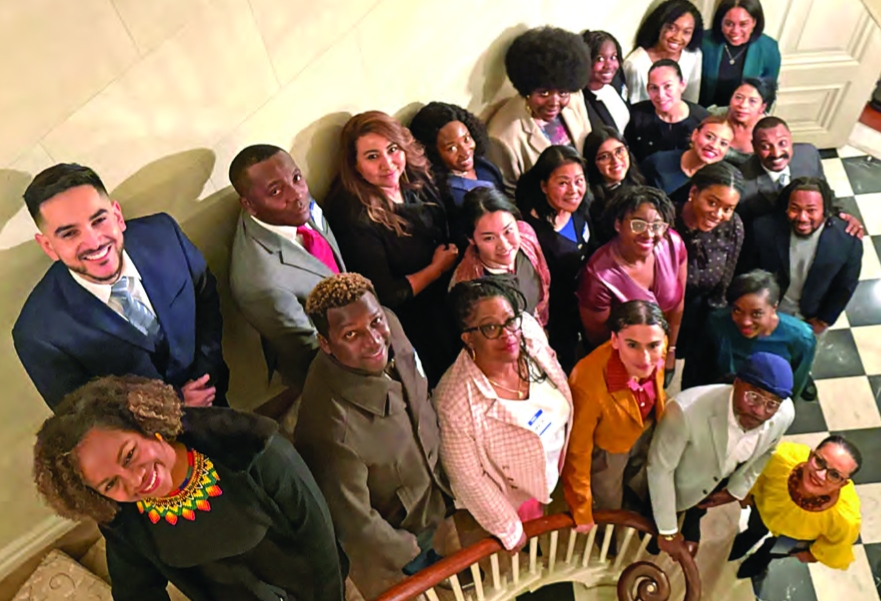
The 2025 graduates of Immigrants Lead Boston, a civic education program for adult members of the Boston immigrant community.
When Karen Mejia migrated to the United States from Somalia as a high schooler, she struggled to connect with the language and the culture. But it wasn’t long until her mother, who migrated first to set up a life for her family, sparked her desire to support others in the city’s immigrant communities.
Now, Mejia works and volunteers to support unaccompanied children. It’s work that a civic education program for adult members of the Boston immigrant community has helped her to dig deeper into and it has bolstered her engagement with the community and civic life.
“Coming into this program, knowing what I know … I wanted to bring a greater picture of that to the community,” said Mejia, senior social services coordinator with Kids in Need of Defense, who completed the program last year.
The program, called Immigrants Lead Boston, launched in 2020 and is run by the Mayor’s Office of Immigrant Advancement. Applications for its sixth cohort are open through July 18.
The courses, according to the city, are intended to support members of Boston’s immigrant community to “take more civic ownership.”
How the city has defined this has changed over the five years it’s been running, said Hawa Yusuf, the city’s Immigrants Lead Boston program manager. Initially the program was aimed at providing participants with the resources needed
to enter city jobs or participate in boards and commissions and City
Council meetings, a focus which has continued on through to today, even
as the city has added other components.
“I
think having civic ownership is understanding that what happens in your
community — you have the voice, you have the power to speak about it,”
Yusuf said. “Getting more involved in that process really helps make
changes for the better.”
And
overall — with a curriculum that includes resources about how the City
Council as well as various city departments work — it has been about
trying to help Boston’s immigrants feel like they can rely on the city
government, especially in immigrant communities from countries that may
typically have less connection with officials.
“Originally,
the goal was to build trust in government. I think that, you know, some
immigrant communities here in Boston, some are really active in
government and some aren’t,” Yusuf said. “We wanted to know why.”
She
pointed, for example, to her parents’ experience. As immigrants from
Somalia, they had little engagement with the city government, something
she attributed to perceptions around corruption in the government in
their home country.
Mejia
said that when she participated she valued being able to interact
face-to-face with city officials in a way that felt less bureaucratic,
where she was able to ask them questions and felt that they were
listening to her thoughts on the community.
“That
was really a learning experience that I got, and it shifted a lot in
the sense of how I refer clients to city programs,” Mejia said.
An
earlier version of the program included meetings with department heads
across the municipal government, where participants would have “honest
dialog with them, ask them questions,” Yusuf said, though the structure
has since shifted to condensing much of that information and expanding
emphasis on community organizing and public narratives.
For
Mejia, that civic ownership has meant attending more city meetings,
including ones led by the Mayor’s Office of Immigrant Advancement and
participating in state-level policy advocacy.
She
said that the program helped jumpstart new engagement in civic life.
Previously, a decade ago, she would participate in events or advocacy,
but over time — and a job that can be draining — she found herself
slipping away from that type of engagement.
The program, she said, kicked her back into gear and connected her with other community leaders who keep her civically engaged.
“There
is a time that I was disconnected,” Mejia said. “When I started doing
the program again, there was that fire that started in me, on being able
to be a little more active.”
Classes
in the program teach participants about how the city’s government
works, with information about how various city departments work, how the
City Council meets and operates and the structure of the city’s
government. This civic engagement is where the program has its roots,
Yusuf said.
But in
recent years, the curriculum has expanded and shifted to include a focus
not just on how to bring more immigrants into city government and city
processes, but also into local community advocacy.
That
has led to the inclusion of a portion of the program that focuses on
communicating about a community and its needs, what Yusuf called the
story of us, of self and of now —advocating based on what an
individual’s experience is, how that relates to the larger community and
the immediate call to action.
“If
you’re trying to get somebody to join your advocacy or join a community
meeting, it’s important for them to know who you are, how this relates
to them — how is this an us thing, not just a you thing — and then, what
do you need from me,” Yusuf said.
The program has also come to, in its most recent
iteration, include a grant component, where participants can propose a
project or campaign they’d like to launch in their neighborhood and
pursue city funding for the endeavor.
“The
ideal candidate is someone who is connected to a community-based
organization,” Yusuf said. “Throughout the duration of this new
iteration of the program they can think of a project or campaign that
they want to launch, and they could get funded through the community
based organization once they apply.”
The impact of the program goes beyond its 10-week
span. Mejia said that the connections she built during the Immigrants
Lead Boston course have helped her continue to stay active in the
community. Coming out of the program, she said there are now “banks of
community leaders” to fall back on and rely on for additional support.
“I
think that is the difference between me doing it all by myself and
trying to get involved — which I still do — but now I have a very good
group of leaders out there who continue this work,” she said.
Yusuf,
too, said those connections are an important outcome from the program,
which aims to recruit a broad cohort of participants.
“There’s really a diverse host of ideas and experiences,” she said. “They build a bond, and they support each other.”
In
the last cohort, she said, a group of the participants started an
effort to support the city’s Haitian community, running Know Your Rights
trainings.
Participants
in the program are eligible to receive a stipend — what MOIA officially
calls a “scholarship” to support participation. Mejia said that it was a
valuable piece to help people who care about their communities be able
to take part.
“This
program is something that you want to do because you really love the
community — and that’s what I got from the entire cohort — but we all
have lives, we all work, we all have to pay bills,” she said.
The program, Mejia said, has helped her better support and advocate for her community and the kids she works with.
“This program has been able to teach me that I can be empowered because I live here, because I belong here,” Mejia said.
The
program is gearing up to run its sixth cohort starting in August.
Applications, which can be submitted online, are due by July 18.
ON THE WEB
For more information on the program, visit boston.gov/departments/immigrant-


