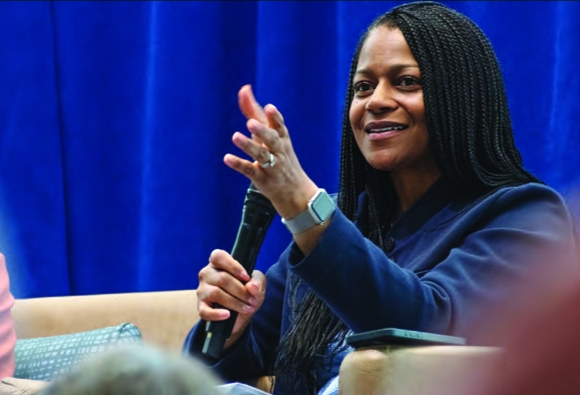
Dr. Bisola Ojikutu, Boston commissioner of public health, moderates a panel at the Health Equity Trends Summit, June 6, 2024.
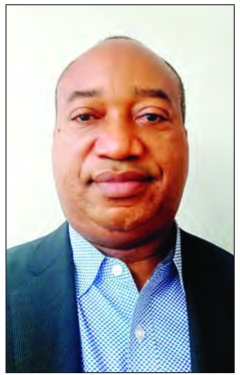
Dr. Cyril Ubiem, senior vice president of programs and services at Harvard Street Neighborhood Health Center
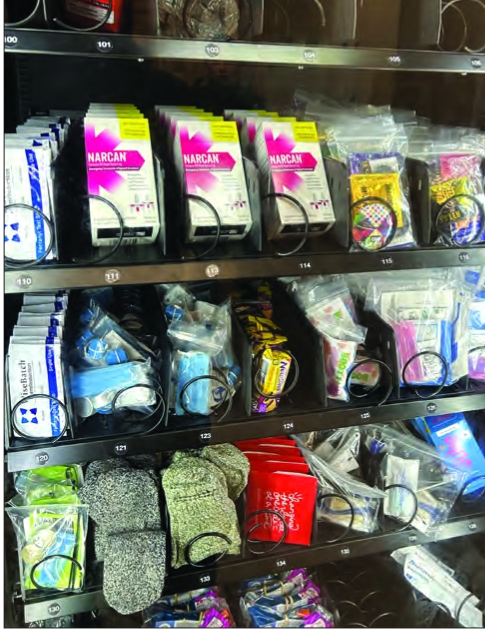
The contents of a new harm reduction vending machine are shown at the
Boston Public Health Commission’s Recovery Services office in the
Boston Medical Center Finland Building.
Opioid overdose deaths dropped sharply in 2024, according to a new analysis by the city.
According to the Boston Public Health Commission, opioid overdose deaths dropped by 38% in 2024 across the city compared to the year before, according to a new data released May 29.
Black and Latinx populations in the city, who have often been hit hardest by the opioid epidemic, saw larger decreases. Overall, Black residents experienced a 58% decrease and Latinx residents saw a 48% decrease.
Dr. Bisola Ojikutu, commissioner of public health for the city of Boston, called the decrease a “testament to work done in partnership with community-based organizations, community health centers, and residents.”
“These data reinforce our commitment to eliminating racial and ethnic disparities and to ensuring equitable access to services for people with substance use disorders,” she said in the statement.
“While we are encouraged by this data, we still have work to do. One life lost to overdose is one life too many.”
The new statistics follow a trend the
commission was tracking throughout last year. In October, the city
agency reported that from January to April 2024, opioid overdose deaths
were 33% lower than the same period the year before. And in January, the
commission released another analysis that showed that trend continuing,
with opioid overdose deaths from May to August 2024 down by 39%,
compared to that period in 2023.
Nationwide,
the United States is also seeing a broad decrease in deaths related to
opioid overdoses. In May, the Centers for Disease Control released
provisional data that found an almost 27% decrease in drug overdose
deaths across the country in 2024 compared to 2023.
The
Boston Public Health Commission’s numbers are considered preliminary —
all the death statistics for 2023 and 2024 must be checked by the state
Department of Public Health, a process that, in an interview, Ojikutu
called “complicated,” and which includes verifying things like the cause
of death and whether it was intentional or unintentional.
The
Boston Public Health Commission credited the decrease in deaths to a
host of efforts in which it has engaged in recent years, including
taking steps to support individuals struggling with substance use
disorder to access treatment, to distribute fentanyl test strips and to
increase access to naloxone, a drug that can be used to reverse the
effects of an opioid overdose. Ojikutu said the commission distributed
over 23,000 doses in 2024, focusing on neighborhoods that saw higher
drug overdose deaths in years prior.
The extent to which those initiatives are directly responsible for the decrease is a little foggy; Ojikutu
called the reasons for the decline “multifactorial.” She said the timing
of the interventions, which the commission largely started in response
to a 7% increase in opioid overdose deaths in 2022, lines up with seeing
a decrease now.
But
other factors, like a changing illegal drug supply, may also be at
play. Ojiukutu said the Boston Public Health Commission is currently
working with researchers at Brandeis University to get more information
about that shifting supply.
A 2024 report from
researchers at Brandeis found that communities across the state were
seeing decreases in amounts of fentanyl in the illegal drug supply in
Massachusetts. The synthetic drug is stronger than many other opioids
and more likely to cause an overdose.
And while the extent to
which the Boston Public Health Commission’s initiatives impacted the
decrease isn’t entirely clear, Ojikutu said she believes it had some
impact. The 2024 report from Brandeis found larger reductions in
overdose deaths in communities with harm reduction programs.
“It’s
difficult to attribute that to any one intervention, or any one
combination of interventions, however, we do believe that what we’ve
done has been impactful, and we will continue to move forward with the
work that we’re doing,” Ojikutu said.
Public health leaders in the community, too, have said they’ve seen success with efforts from the commission.
Dr.
Cyril Ubiem, senior vice president of programs and services at Harvard
Street Neighborhood Health Center, said the health center has seen
extensive engagement with harm reduction programming organized by the
Boston Public Health Commission.
The
health center has worked with the city on expanding access to treatment
services and resources, including installing a kiosk in the facility
with free naloxone and test strips. Ubiem says that when they installed
the kiosk, the amount of Narcan the health center was distributing to
the community more than doubled.
“There’s
a lot of overdose prevention in the community in Boston that’s having
effects right now,” Ubiem said. Part of that, he attributed to how the
Boston Public Health Commission works with communities. Ubiem said that
the commission “engaged people seriously.”
“I can tell the amount of footwork that’s being done out there on the streets, and it’s taking effect,” he said.
Ubiem
said he celebrated the impact the efforts have had, particularly in
communities of color. According to the health center’s 2024 annual
impact report, 88% of its patients were Black or African American and
49% reported Hispanic or Latinx ethnicity.
“That
means more individuals staying alive, to take care of their families,
to take care of themselves, to contribute to the society,” he said.
Given
the success he has seen, Ubiem said he’d like to see the work continue
at the commission, and he’d like to see Massachusetts take up the work
to expand it statewide.
Other
public health leaders also called for continued investment across all
levels of government. Julie Burns, president and CEO of RIZE
Massachusetts, a nonprofit foundation working to end the opioid
epidemic, said the organization was encouraged by the new statistics,
but would like to see ongoing support, especially as continued
cost-cutting at the federal level could impact work to address opioid
overdoses. She called that effort a “long-term vision” that requires
time, resources and collaboration.
“Given
the significant progress and positive results in addressing the
overdose crisis, now is not the time to reduce funding for the tools and
treatment that can help all those who are still at risk of losing their
lives,” Burns said.
Ojikutu said that despite the decrease in overdose deaths, “we don’t believe this is a time to celebrate.”
The
Boston Public Health Commission, she said, plans to continue the same
efforts with a goal of continuing to lower the number of overdose deaths
in the city. The commission will work on expanding its data around drug
use, including doing outreach to track use patterns among the city’s
unsheltered residents who struggle with substance abuse.
“Our
goal is to lower [the number of deaths] and to continue to see this
trend as we move forward, and we will continue to invest in these same
activities,” Ojikutu said.


