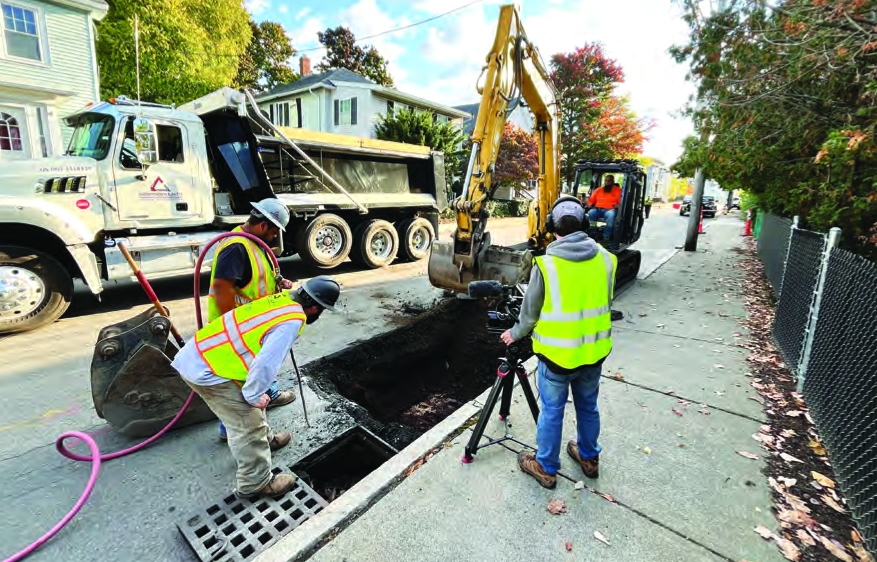
A
construction team installs an infiltration trench in Medford in 2019.
The Mystic River Watershed Association, last week, received state
funding to install 65 of the nature-based infrastructure solutions,
which filter phosphorus and other contaminants out of stormwater, in six
cities and towns across its watershed over the next two years. Mystic River Watershed Association says try an infiltration trench
When rain hits the asphalt, surface chemicals and pollutants rush straight to the nearest body of water. But a state grant is funding an effort to reduce that contamination in six municipalities across the metro Boston area.
Tapping into nearly $870,000 through a grant from the Massachusetts Department of Environmental Protection, the Mystic River Watershed Association will install 65 infiltration trenches over the next two years. The trenches function as nature-based infrastructure, removing pollutants and contaminants from rain or melting snow as it flows through storm drains and toward rivers and other waterways.
“When you pave over — like we have in our very urbanized watershed in the Mystic — you lose that connection with the soil,” said Marja Copeland, stormwater projects manager at the Mystic River Watershed Association. “So, storm water that’s hitting the ground is no longer doing that soak through; it’s running straight down into the catch basin.”
Pollutants like phosphorus usually filter directly into the soil, but in an urbanized area, surfaces like roofs, asphalt and concrete — referred to as impermeable surfaces because they don’t absorb water — collect those pollutants instead. When a storm comes, the precipitation flushes the pollutants across the impermeable surfaces and into the catch basins of storm drains.
Once in the catch basin, it doesn’t go through any cleaning process. Instead, it’s carried straight to a waterway. Infiltration trenches add an additional step to change that.
“If we don’t put these in, the existing pipes are just transmission pipes, they’re just distributing the water from the street to
the water. What these do is they intercept it, and they treat it,” said
Wayne Chouinard, town engineer in Belmont and one of the original
designers of the infiltration trenches.
The
technology behind the infiltration trenches is relatively simple, but
understanding its design requires an understanding of a normal storm
drain. There, water falls through a grate in the street and fills an
underground catch basin until the water level is high enough that it
goes through a pipe out to a nearby waterway.
Infiltration
trenches are dug as an extension of those existing drains. Stormwater,
with all the pollution that the runoff carries, flows into the storm
drain but a lower pipe carries water out first, before it can flow to a
waterway. The first wave of polluted water goes into this lower pipe
where crushed rock and the soil naturally filters out pollutants like
phosphorus. If the water level continues to rise, by the time it reaches
the pipe that flows out to a body of water, much of the pollution will
have filtered out.
This
type of design is considered green infrastructure, a broad umbrella
term which describes solutions that use natural processes to solve
problems. Green infrastructure is used in contrast to — or sometimes in
conjunction with — gray infrastructure, which includes gutters, drains,
pipes and retention basins.
Anna
Yie, green infrastructure specialist at the Neponset River Watershed
Association, said that green infrastructure solutions to stormwater
challenges can be “incredibly effective” in addressing nuisance
flooding, especially as a changing climate leads to more intense storms.
“Even
in the past couple of years, when we have those torrential sorts of
downpours, that much water that fast is really stressing the capacities
of our systems,” Yie said. “Green infrastructure can play a very
important role in helping to mitigate that.”
In
the Mystic River watershed, the trenches are being hailed as a solution
particularly for removing phosphorus from the river and its various
tributaries.
The
watershed has an “alternative Total Maximum Daily Load,” a
state-established plan under the federal Clean Water Act to restore
waterways by identifying the maximum amount of a pollutant that can
enter the water while still meeting water quality standards.
Excess phosphorus in a
waterway can impact local plant and animal life. A natural nutrient
needed by plants to grow, too much can spur the growth of invasive
species that can outcompete local flora.
And as those plants grow and die, they take up oxygen in the water that local animals need to survive.
Too
much phosphorus can also lead to the growth of cyanobacteria, algal
blooms that spread over the water and can be harmful to humans and toxic
to animals.
“When you
have higher loads of phosphorus going into the waterways, you get
essentially an encouragement of all the plant life growing within the
waterway,” Copeland said. “They do need phosphorus to grow — it’s not a
bad thing — the problem is the excess of it.”
Those
effects mean scientists call phosphorus a “limiting nutrient,” for its
ability to determine how much or little plant life can grow.
Infrastructure, like the infiltration trenches, that can reduce excess
amounts of those nutrients entering the water is key, said William
Shuster, a professor of civil and environmental engineering at Wayne
State University in Detroit, Michigan.
“Anything we can do to prevent the movement of these limiting nutrients into our waterways is very important,” he said.
Across
the state, Yie said, excess phosphorus is an issue in bodies of water,
even if not every watershed has a Total Maximum Daily Load. For example,
the Neponset River watershed has no TMDL, but its watershed association
keeps an eye on the chemical in its waterways and does work to
remediate.
The trenches are most effective at removing pollutants from the “first
flush” of stormwater, the initial wash of runoff that flows over
streets, roofs, and other impervious surfaces, taking with it the
pollutants that had built up since the last storm.
As
more water flows into the system, any contaminants it carries may go
straight to the waterway, but generally it’s that first flush, which
Copeland said is a lot like “rinsing off the road” that carries the bulk
of pollution.
Infrastructure
solutions like infiltration trenches can keep contamination from the
first flush out of waterways, while later parts of the storm, which
might still flow through to the river, will generally have less
phosphorus.
“Going
into this infiltration trench provides a kind of off-ramp for the storm
water runoff that’s carrying high concentrations of unwanted compounds
in our waterways and gives it a place to rest and settle out,” Shuster
said.
Part of the goal
in developing the design was making something scalable that could
easily be adopted by other towns. Chouinard said the trenches are easy
to maintain and cost-effective.
By
cleaning out sediment from the catch basins every year — something that
must be done anyway — the trench is kept in good working order. But the
impact from each trench can be limited, meaning that each one is a
small step that requires a larger number to really make an impact.
“You’re
only getting a certain amount of water in there,” Chouinard said. “So,
you can imagine if one trench takes out a half a pound of phosphorus a
year, and we have to remove 400 pounds, we’ve got to put 800 of these
in.”
It’s why the
Mystic River Watershed Association is gearing up to install some 65
trenches with this round of grant funding — one of the largest efforts.
The
trenches also require the right soil conditions to be effective. Soil
that is too loose will mean water moves through too quickly without
properly absorbing and filtering; soil that is too dense and clay-like
won’t absorb enough water, Copeland said.
For that reason, properly assessing where the trench will be installed is key, said Shuster.
If
there isn’t enough space, or there’s too much existing infrastructure
already in the street, then it can be tough or impossible to use one of
the trenches. Beneath roadways, in addition to the storm drains, there’s
already a network of sewers, gas pipes, waterlines and more that can
make adding new additions, like the infiltration trenches, challenging.
“Sometimes
the subsurface infrastructure that’s keeping our cities functioning,
it’s just tight under there, and we can’t dig, we can’t put something
else in,” Copeland said.
That
means that, across a watershed, the trenches must be used in
conjunction with other stormwater infrastructure solutions. Chouinard
called the trenches, “just one tool in the toolbox.”
For
the Mystic River Watershed Association, other solutions currently
include rain gardens and tree trenches — a design similar to an
infiltration trench that doesn’t need to be constructed in the street
and that also adds the co-benefits of a tree greening the community.
Copeland
said the watershed association also is working to construct or restore
wetland ecosystems, but those are bigger solutions that require more
space and resources.
In
the middle of cities and towns, however, like the terrain that makes up
much of the Mystic River watershed, a more distributed approach might
be more successful.
Copeland
said that the Mystic River Watershed Association views that smaller,
more distributed approach for green infrastructure as the most effective
way to get the phosphorus reductions needed under the Total Maximum
Daily Load.
“Our
watershed, it’s dense; it’s very urban,” Copeland said. “Some of these
bigger green infrastructure projects require a lot of space that we
don’t have, or sidewalks might be too narrow, things like that. If we
can get smaller solutions, then that might be the best way to tackle the
problem.”


