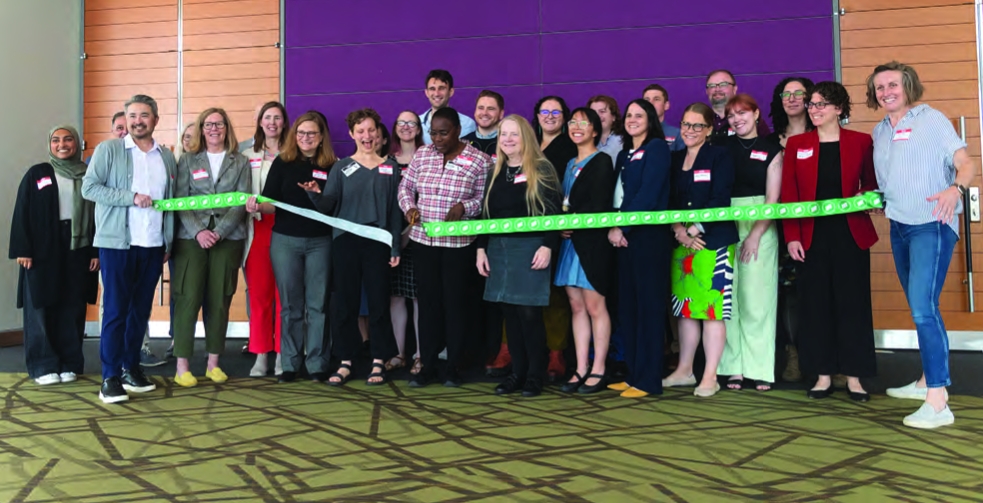
Members
of the 2024/25 Green Ribbon Commission’s Collaborative Climate Action
Planning Cohort cut a ribbon to celebrate the completion of their
program at an event at the Boston Convention and Exhibition Center, May
28. The nine nonprofit organizations completed a nine-month process to
create climate action plans for their respective organizations aimed at
addressing emissions mitigation, climate resilience and environmental
justice. 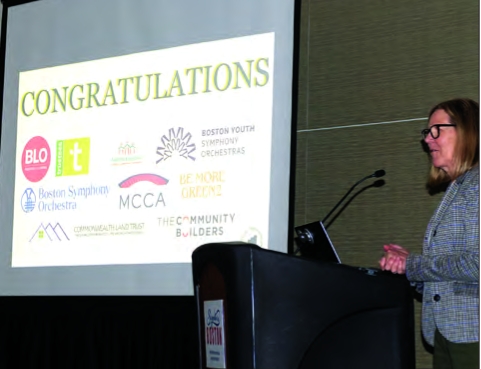
Amy Longsworth,
executive director of the Green Ribbon Commission, congratulates members
of its Collaborative Climate Action Planning Cohort.
As colleges and universities across the Boston area celebrated the completion of degrees for their students, a cohort of local organizations celebrated a different kind of graduation — all in the name of climate justice.
At a celebration, May 28, a group of nine organizations with focuses spanning from cultural to affordable housing to operating the state’s convention centers gathered to mark the end of a nine-month program developing organizational climate action plans.
The cohort was the fourth to complete a collaborative climate action planning program organized by the Green Ribbon Commission, a coalition of local businesses and leaders focused on accelerating green efforts across the city.
Amy Longsworth, executive director of the Green Ribbon Commission, said she was excited to see the level of engagement from cohort members.
“It’s very heartening to realize that they’re not just doing it because they have to,” Longsworth said. “They’re doing it because they want to and because they know it’s the right thing because they can see the writing on the wall.”
Over the course of the program, representatives from each organization developed plans to help their respective groups reduce their emissions and prepare for the impacts of climate change.
The program was first launched, in part, with the then-pending implementation of the Building Emissions Reduction and Disclosure Ordinance, or BERDO. That 2021 legislation from the Boston City Council set requirements for large buildings — those over 20,000 square feet, or residential buildings with at least 15 units — to report their carbon emissions and establish a plan to reduce those emissions with benchmarks until they reach net-zero emissions by 2050.
Noah Frigault, director of special initiatives at the Commonwealth Land Trust, one of the members of the latest cohort, called the changes “integral to the long-term success of our organizations.”
The
program is aimed at tailoring efforts to each specific organization.
Jennifer Haugh — vice president of planning and customer engagement at
Greener U, which provided technical expertise and guidance to cohort
members — said the biggest challenge for a lot of the nonprofits,
especially those with work not directly tied to the environment, is
linking the plan to its existing goals. The best climate action plans,
she said, were the ones that understood and worked in harmony with each
organization’s mission.
“For
some organizations, that mission of the organization might be music or
culture, and it’s harder to make those day-to-day activities that are
associated with their mission connect to the broader topic of climate
change,” Haugh said.
“The
most successful climate action planning processes are going to be the
ones that really zero in on that message and connect it with what they
do.”
The program takes
a broad approach. Longsworth touted its comprehensive nature, which
guides participants with three objectives: to reduce and mitigate
emissions, to increase resilience, and to work toward climate justice.
Dallase
Scott, founder and principal at climate-consultancy firm Trust, who ran
the program, compared the course’s three pillars to steps taken to
reduce harm if a car crashes into a wall.
Mitigation
efforts, things that reduce the amount of greenhouse gas emissions
released, are like trying to slow the car, while steps to increase
resilience and prepare for the impacts of
climate change are like adding sandbags in front of the wall or making
sure there are airbags. Climate justice work includes thinking about who
is driving the car and who has historically had access to seatbelts and
first responders in the aftermath.
For
Longsworth, the resilience and mitigation efforts go hand in hand, but
she acknowledges that the benefits of reducing emissions right now won’t
pan out for a long time.
“That’s
not going to happen for a century, so we need to focus on both of them
at once, right now,” Longsworth said. “And we need to do it in a way
that’s equitable.”
Scott
called out “innovation at the expense of others” — moments like the
city’s history with urban renewal and building freeways to speed travel
but cutting through neighborhoods of color in the process.
“We can absolutely do that again if we’re not
intentional around it, so that’s where the climate justice piece is,”
Scott said. “We need to transition to a new energy system; we need to
transition away from fossil fuels, but not at the expense of others who
have historically been marginalized time and time again.”
For
members of the cohort, that comprehensive approach played out in
increased communication with the communities they work with.
Frigault
said that, as part of the climate justice pillar, he had conversations
with residents that the Commonwealth Land Trust serves to see how the
climate action plan changes would impact them and what their opinion
was.
“It was great that they were supportive and letting me do that,” he said.
During
the graduation event, Frigault presented the Commonwealth Land Trust’s
action plan and said that engagement with residents also led to a
greater understanding of their priorities.
Members
of that community, he said, weren’t especially invested in
conversations around the environmental impacts of mitigation and
resilience efforts but were more engaged when they understood how more
efficient energy operations would save money and make more funding
available for other work the organization does.
The
cohort was also designed to support learning between the member
organizations, something that Longsworth said was bolstered by the
variety of organizations in the cohort.
The most recent group included organizations like the Boston Symphony Orchestra and Boston Youth
Symphony Orchestras, the Allston Brighton Community Development
Corporation, Trustees of Reservations and the Massachusetts Convention
Center Authority.
“We
came up with this idea of putting them all into one group and letting
them learn from each other as they went, and it really has worked,”
Longsworth said.
It’s a
design that slots in with the program’s broader aims to teach its
participants not just about what steps might help reduce emissions and
prepare for the impacts of climate change but also about how to
communicate what those efforts are and why they’re worth taking up.
Frigault
said he found the collaborative nature of the program helpful as he
tried to grapple with pending deadlines under BERDO and the looming
impacts of a changing climate.
“There’s
this huge urgency to get all this stuff done, and it’s very complicated
and time-consuming,” he said. “We’re all nonprofits where this is not
necessarily part of our mission. So being able to see how the other
folks were in their journey was really helpful.”
The
Green Ribbon Commission’s program, however, may be poised to shift. It
had its roots in helping Boston organizations — especially large
cultural ones — prepare for the kind of operational shifts that would be
necessary under BERDO.
But
now that BERDO has officially kicked into gear this year, with the
first standards for emissions going into place, many of the city’s
cultural institutions have already gone through the program. Its first
cohort, in 2022, included some of the city’s largest institutions,
including the Museum of Fine Arts, the Museum of Science, and the
Huntington Theater Company.
That
more urgent focus on BERDO compliance is leading to increased interest
in programs aimed at training organizations and building owners in the
more nitty-gritty engineering of how to reduce their emissions,
Longsworth said.
Scott said she welcomed those other programs that fill gaps that the Green Ribbon Commission’s program doesn’t get to.
“We only have so much time together, and we’re only going to go so deep with BERDO,” Scott said.
The
changing landscape also means the Green Ribbon Commission’s program is
taking a pause to adjust. Normally, the next cohort would begin in
September, but at the event, Longsworth announced it wouldn’t begin
until January to give more time to recruit and build the group.
The
Green Ribbon Commission’s program will continue to focus on
establishing the broader goals — and training organizations how to
communicate why they’re worth it — internally. Once organizations have
their climate action plans, they can tap the technical experts needed to
take the steps that will lead to specific emissions reductions required
under BERDO.
“Everyone
actually just got to the starting line,” Scott said. “The strategic
plan is supposed to make doing the work easier for you, but … you’re not
done.”
Although the program’s next steps are still coming together, Longsworth is celebrating the work they’ve done so far.
“It
may have been a thing that was perfect for its time and now it’s over,
or it may be that we morph it a little bit and we update it and get a
lot more interest,” she said. “The future is unwritten.”


