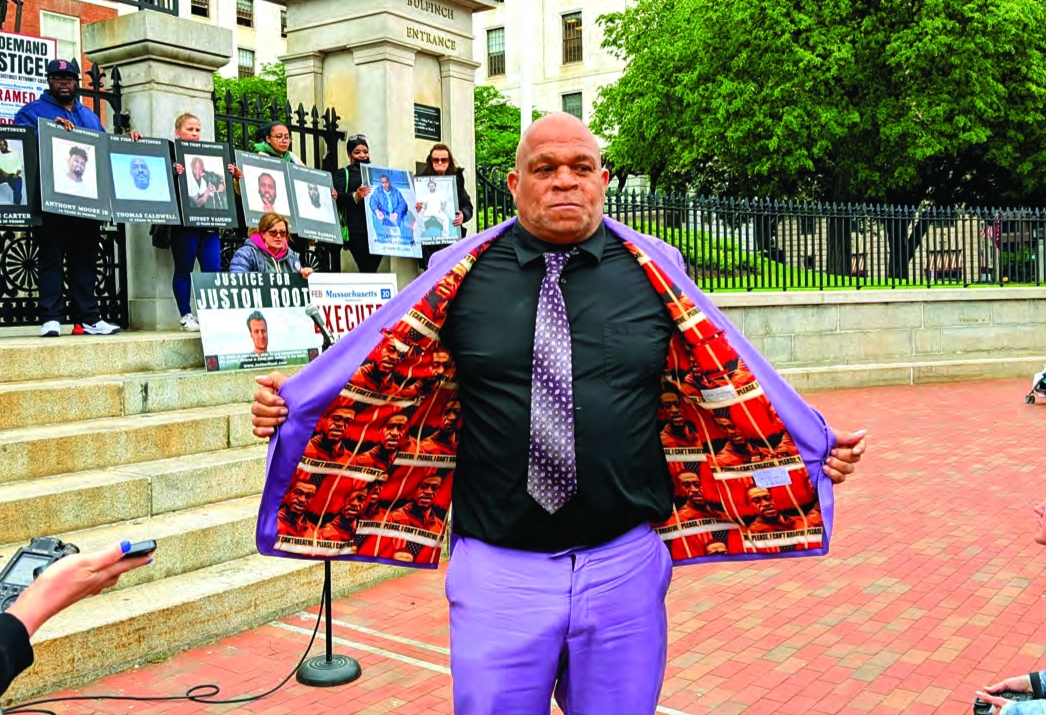
Selwyn Jones shows jacket lining with photos of his nephew, George Floyd.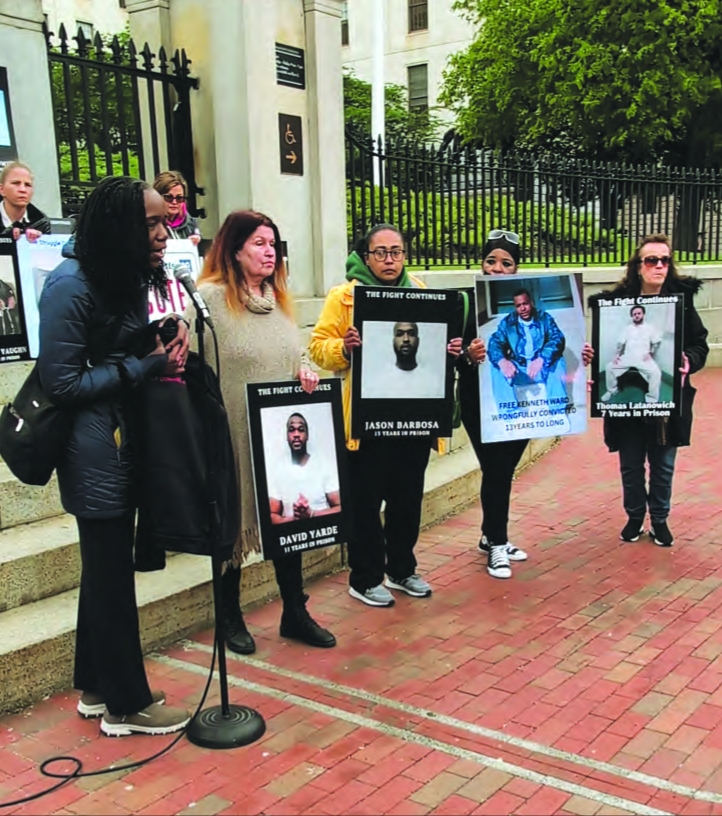
Members of the Coalition of Judiciary Accountability hold posters of their loved ones.
On May 21, Selwyn Jones appeared at a Massachusetts State House press conference and rally to mark the fifth anniversary of the May 25, 2020 murder of his nephew, George Floyd. He hasn’t stopped fighting for justice since that dark day. Floyd’s death also spurred the Black Lives Matter movement’s massive international rallies for justice that led to the convictions of former Minneapolis police officers Derek Chauvin, Tou Thao, Thomas Lane and J. Alexander Kueng.
Jones was joined by cosponsors Lynn Currier of the South Shore-based Skweda Solutions and the families of 16 wrongfully convicted men from Massachusetts who make up part of the Coalition of Judiciary Accountability, which asks for an independent entity, not County DAs, to examine their cases and set up an independent commission on wrongful convictions in Massachusetts.
Since his nephew’s death, Jones has co-founded the Justice 929 organization, a nonprofit charity — named for the gruesome number of minutes and seconds that Chauvin’s knee was on Floyd’s neck, back and shoulder that Minneapolis evening — that promotes law reform and civil rights, locates missing persons, works with youth, counters gun violence, and assists those who have been wrongfully convicted. Jones has also helped develop the forthcoming MYTH app, which can record police interactions and transmit panic alerts to emergency contacts.
“There’s been some changes, but it’s not enough,” Jones told the Banner prior to the event. “Every year, innocent people are dying at the hands of police. People are losing their loved ones. It hasn’t stopped. We need to do better.”
We do. Reports that week detailed the ongoing
debate on the design of George Floyd Square at the intersection of 38th
and Chicago. That very day, the DOJ nixed police reform settlements,
called consent decrees, that were agreed upon with Minneapolis and
Louisville following the deaths of Floyd and Breonna Taylor. Minneapolis
Mayor Jacob Frey issued a statement that in his city the police reforms
would continue, despite the DOJ’s motion.
The
State House program was coordinated by Currier, a youth advocate,
anti-racism activist and founder of Haitkaah Social Justice Project and
The Boston Arts Project who holds a psychology degree from Adelphi
University and an MFA in Film Production from Boston University.
Speakers
included Carla Sheffield from the Better Opportunities support
organization and her daughters, Zyariah Sheffield and Nikia Ramsey, who
spoke about their son and brother Burrell Ramsey-White, 26, who was shot
and killed by Boston police in the South End on August 21, 2012.
“People
tried to tarnish his name to reduce him to something he wasn’t. They
didn’t know him, not like we did,” Nikia Ramsey said. “Our story is not
isolated — it is a reflection of a national crisis.”
She cited the grim stats:
“According
to Mapping Police Violence, in 2024 alone, police killed 1,247 people
in the United States. That’s roughly three people every day, with Black
and brown people nearly three times more likely to be killed by the
police than white people.” Massachusetts, she said, wasn’t exempt. “We
must stop pretending that systemic racism ends at our borders. The
trauma lives here.”
“It’s
a mystery to me that we can say we’re in the land of the free, the home
of the brave, and yet we have to suffer this year after year, long
after Medgar Evans,” said Wayne Dozier, grandfather of Dan Roy Henry
Jr., known as DJ Henry, who was shot and killed by police in
Pleasantville, New York, 15 years ago. “If you look across the street at
that relief there (the Robert Gould Shaw and Massachusetts 54th
Regiment Memorial), you see Black soldiers fighting in the Civil War.
From the Civil War to the Vietnam War to other wars, Black men have
stood for this country — to come back and see our children killed.”
Jen
Root Bannon, whose brother Juston Root was shot 46 times in February
2020 while he was suffering a mental episode, spoke of the frustration
of losing their civil suit due to qualified immunity. “Because they
investigated themselves,” she said. “It all started at Brigham and
Women’s Hospital, and it escalated every step of the way. It didn’t need
to happen, and it shouldn’t have happened.”
Another
speaker was Leonna Abraham Brandao of Randolph, whose New Vision
Organization, Inc. is an advocate for Massachusetts incarcerated
firsttime offenders serving Life and Life without Parole. “We have an
epidemic in this country of mental illnesses and addiction,” said
Brandao. “They’re using the prisons to house these people. We have a
high rate of suicide.”
Hank
Houghton of West Brookfield gave emotional remarks about his 44 years
in prison, during which his entire family died, and his 12-year-old
daughter was killed by a drunk driver, before DNA testing cleared him of
a wrongful rape charge three years ago. A Vietnam veteran, he was
already under stress.
“There
was a sentiment against returning soldiers,” Houghton told this
reporter after the rally. “We were told before we left Vietnam not to
wear our uniforms home.” And he had plenty to say about the so-called
DOC. “It isn’t the Department of Corrections, but when the staff sees
you trying to self-correct and better yourself, they oppose it,” he
said. “They want to see you come back because we are their guaranteed
paycheck.”
In prison,
Houghton cofounded Vietnam Veterans in Prison in Walpole, and after his
release on Dec. 31, 2021, he began volunteering with the Open Sky
Community Compass Center in Worcester, Project Youth at MCI Norfolk, and
has spoken at UMass Chan Medical School about drug and alcohol abuse,
the criminal system, prison life and his post-prison life, which has
also involved volunteering at the Recovery Center of HOPE in Ware and a
criminal justice organization in Springfield.
He is a member of the Parole Review for All, which aims to eliminate all life sentences in Massachusetts.
Also
holding up a poster and speaking was Jonathan Tetherly of Chicopee, a
retired UCC Minister, author and social justice advocate whose latest
book, “What’s Going On In There? A Jail Chaplain’s Story,” details his
30 years as a chaplain at the Hampden County Jail in Ludlow. Tetherly
and Houghton are members of First Congregational United Church of Christ
in Chicopee. The national body of the UCC has been active in social
causes, including support for abortion rights, the United Farm Workers
and the Wilmington Ten.
Jabir
Pope, who spent 38 wrongful years in prison and was the subject of an
Emmy-winning Boston Globe story, said the damage to his life and that of
his
family was irreparable. But while imprisoned, he resurrected a singing
group called the OGs, for Original Gentlemen, that he had begun years
before with longtime best friend and co-defendant Albert Brown, as well
as Robert Rose, who was incarcerated with them for 20 years. At the
State House, the three men then sang their song “Freedom,” as the TV
cameras moved up. Pope said the song was about the things that might
enslave a person — be they drugs, alcohol, anything that holds one back
from being their best.
Twenty-year
inmate Devon McNeil told the crowd about finding a father figure he
never had while imprisoned. “Today, five years home, I’m the founder of
Not on My Watch Mentoring Incorporated,” he said, “and I mentor about 20
youth in the inner city.” He recently signed a lease on a 2,000 square
foot building at 314 Bowdoin and Quincy Street that now houses his
nonprofit.
“I was what they call an impact player in my neighborhood,” said McNeil.
“Now
I’m making an impact in my community, in a positive way.” He’s written
two books: “The Streets Lied and We Believed,” and “From Negative to
Positive in My Own Words.”
“I
woke one day, and the world was in chaos because somebody decided that
they would take my nephew’s life,” Jones said. “However you want to look
at it, it was wrong. The people that are standing behind me that have
been incarcerated for 25, 30, 40 years have also been wronged. How do we
fix this? We fix this by fighting. You know, without a fight, you can’t
win a war,” he said. “Why wouldn’t I come to Boston?” he asked, with an
aside that it was colder in Boston than in South Dakota, where he
lives. “I came here to support all the brothers on these posters. And
how many George Floyds are there?”
During
the Boston rally, schoolchildren cheered and waved from a passing bus,
as did a city public works driver from his van. Clearly, justice is both
in process and on the minds of Americans of all ages. And Jones may
have had a big part in advancing this transformation, but no one knows
more than he that there’s far too much yet to be done. And so, he was
soon off to his next stop, Minneapolis.
Susie
Davidson has contributed to HuffPost, The Houston Chronicle, Wicked
Local and The Jewish Advocate, among other publications. She is the
author of “I Refused to Die: Stories of Boston-area Holocaust Survivors
and Liberating Soldiers”and is completing “Tracking the Times: A Century
of Protest Music.”


