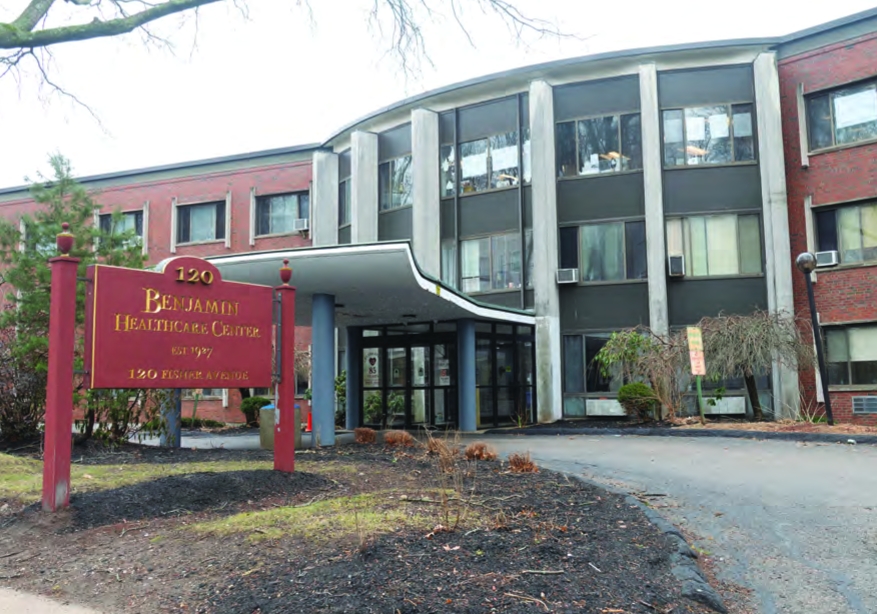
The
Edgar P. Benjamin Healthcare Center on Mission Hill, shown March 6. Now
in its 13th month of receivership, community members of the Edgar
Benjamin face a list of questions about the facility’s future and, for
now, few answers.
When the Suffolk Superior Court ruled to install a receivership at the Edgar P. Benjamin Healthcare Center in April 2024, following a closure plan and allegations of financial mismanagement, it was a moment of celebration for a community eager to keep the almost century-old nursing home open and running.
Now, 13 months later, optimism is lagging as the Mission Hill facility stares down millions-of-dollars operating deficit by the end of the year and pending buyout that could be a last-ditch to avoid closure of the facility that has, for its almost 100 years of operations, predominantly served Boston’s communities of color.
“I think it’s a really tough spot,” said Rep. Sam Montaño, whose House district includes the Edgar Benjamin. “It’s not quite as promising we hoped to be at this point.”
The facility has long served as a local option for community members to send family members where they can remain close and can easily be visited.
Mary Ann Nelson, a long-time Mission Hill resident, said that she has known many neighbors who would walk to visit family members at the facility. She said one friend of hers, who lives down the street from the facility, has long thought of the Edgar Benjamin as a place to go if he needs to access long-term care.
For Nelson and other community members, the Edgar Benjamin is a quiet community asset, even if it’s not a frequently discussed resource.
So, talk about a sale makes her feel disappointed, she said.
Joseph Feaster, the court-appointed receiver, first announced the possibility of a buyout in a report filed with the court March 24. On April 23, he held a half-day meeting at the facility, hosting potential buyers.
According
to a document Feaster filed with the court, the groups who attended
included local, regional and national longterm care facilities operators
and investor groups, including one made up, at least in part, by staff
at the Edgar Benjamin. The document also said the prospective buyers
also included real estate development firms.
Previously,
Feaster had said that, in pursuing a buyout — a choice he deemed
necessary unless the facility receives a major infusion of cash — he
would have certain requirements, including continuing operations as a
nursing home and keeping the name of “Edgar P. Benjamin.”
“There’s additional land there.
A
developer may come in and say, ‘Look, we’re going to have this
long-term care facility; we’re going to have condos; we’re going to have
some other type of use,” Feaster said.
Proposals that would tear down the facility to only build condos or apartments will be rejected, Feaster said.
Community
members have said that they are concerned with seeing the facility
continue operations to serve Boston’s Black and brown elderly residents.
And they don’t want to see it become an expensive housing development,
said Mary Ann Nelson, a longtime Mission Hill resident.
Those
concerns are especially centered around how new housing might attract —
or be geared toward — short-term residents in a neighborhood that has
been saturated with students. According to the city of Boston, as of
2017, more than 90% of units on Mission Hill were renter-occupied.
“We’ve
lost stability, we’ve lost families, we’ve lost long-term residents,”
said Richard Giordano, who lives down the street from the Edgar
Benjamin. “I mean, we’re already overcrowded with students.”
In
an interview following a status conference on the receivership, May 15,
Feaster said he’s open to proposals that include other uses in addition
to the continued operation of a nursing facility, which those
developers might present.
Additional
uses on the available space — according to the city of Boston, the
current facility takes up about 79,000 of the lot’s etimated 97,200
square feet — could provide an alternative revenue stream for a facility
that has, to date, been struggling financially, Feaster said.
Community members said they’d like to see the facility consider other medical uses, too, to try to keep operations running.
Both
Nelson and Giordano said they could envision some of the unused space
at the facility used for assisted living operations — something they
said could be useful to help more Mission Hill residents age in their
community.
Currently,
one wing of the building, with space for 31 beds, is out of use, and the
facility’s third floor is rented out to the Roxbury Prep Charter
School. But the school will be moving out of the building later this
year into a new campus.
Previously,
the center’s leadership had discussed the possibility of opening a
dialysis treatment center. State Sen. Liz Miranda scored an amendment in
last year’s nearly $4 billion economic development bond bill that could
direct $1 million to the dialysis center effort.
“That
only happens if the state goes out and does the bonding and puts the
money into it — the governor has that authority,” Giordano said. “But,
heck, I think that would be an appropriate and good use.”
But
Vincent Mor, a professor of health services policy and practice at
Brown University, said he had doubts about how effective setting up
dialysis treatments would be as a new revenue stream, given the
challenges of building relationships with the proper medical providers
and cultivating the skilled staff needed to get and keep it running. He
called it a “difficult management problem.”
“You’ll
end up having made the investment, and there won’t be anybody to
sustain it,” Mor said. “Again, it comes down to needing really good
management.”
In the courtroom, much is hanging on the prospect of a buyout.
Responding
to questions from Justice Christopher Belezos, who presided over the
May 15 status conference, lawyers for both the receivership and the
commonwealth said that if no buyer comes out of the current process —
Feaster set the due date for bids on June 5 — then the facility may have
to move to transfer its residents out and ultimately close.
At
the May 15 status conference, Oren Sellstrom, an attorney with the
Lawyers for Civil Rights who represents the guardians of Edgar Benjamin
residents who filed a lawsuit for the receivership in March 2024, said
that at present, he does not support a closure if no buyer is found at
the June 5 deadline.
“We
would not be prepared to agree, at this point, that if there is no
willing buyer as of June 5 that it should proceed to a closure,” he
said. “That may, in fact, have to happen, but at this point we don’t
have details about how the property has been marketed, who has proposed
and whether there is a possibility of continuing on into another sale.”
The
attorneys for the receivership said that closure may have to be the
next step if there are no eligible bids. Feaster said he wanted to
amplify Sellstrom’s stance.
“I’ve
heard all this discussion about closure,” Feaster said during the
status conference. “This never was contemplated by me, as the receiver,
but more importantly, there’s no indication that the operation doesn’t
have the ability to continue on, in terms of operation, until such time
there is an ownership sale.”
But
Belezos pushed back, citing financial statements filed by the receiver
in April that projected monthly operating losses ranging from about
$360,000 to nearly $470,000.
“That creates a level of urgency that captures everyone’s attention,” Belezos said.
Feaster
has expressed some skepticism about the financial documentation, which
was prepared by center administrator Delicia Mark, with whom he has been
butting heads. In his fifth report, filed with the court May 14,
Feaster said that the facility performed better than expected in March,
with total monthly revenue clocking in at over $799,000 and total
expenses at a little more than $713,000.
Community connection
But outside of the courtroom, some suggest that a buyout might not be the cure-all that the various parties are hoping for.
If
a large, outside company purchases the facility, reduced community
ownership and investment might impact the facility and its operations,
Mor said.
“If it’s only McDonald’s and Burger King and Wendy’s and there’s no
local place, there’s nobody who cares about that neighborhood or cares
about that place,” Mor said. “You could have an outside nursing home
come in and take it over and try to go upscale, or what have you, but I
think it’s going to be tough.”
That
community connection is an important feature of the Edgar Benjamin,
said Hank Cohen, a political organizer with 1199 SEIU, the union that
represents much of the facility’s staff.
“It’s
so important to feel at home, when you’re being cared for, especially
in these stages of your life,” Cohen said. “And you’d be hard pressed to
find another home in Massachusetts that has a more diverse population,
both in terms of the folks being cared for, but also the staff that are
working there, which is invaluable to this community.”
Outside
takeover can also have its drawbacks — concerns that are especially on
the mind of a city recently impacted by the bankruptcy of Steward Health
Care. Mor pointed to that impact, which stemmed from when the
for-profit company came into the state and purchased a number of
struggling hospitals.
Last
year, when Steward declared bankruptcy, the proceedings led to the sale
and transfer of five of its hospital campuses across the state, which
reportedly led to confusion for the communities served by them.
Two
of Steward’s former hospitals — Carney Hospital in Dorchester and
Nashoba Valley Medical Center in Ayer — closed when no qualified bids
were identified in the bankruptcy court.
And
some of the challenges that Carney Hospital faced in the sales process
are similarly true for the Edgar Benjamin, Mor said. The location is
unlikely to attract private payers, as of June, Mark said Medicaid paid
for 90% of residents at the Edgar Benjamin, which might make the
facility less appealing to potential buyers.
But
Feaster said he sees the situation at the Edgar Benjamin as different
from the one faced by Carney Hospital. For example, the land is owned by
the facility, unlike in the situation of Carney and the other Steward
hospitals, where the company had sold off the physical campuses and
leased them for use.
And
some of the challenges facing the Edgar Benjamin are true for nursing
homes generally, as facilities of this sort struggle across the board.
“It’s
not a place where people want to go, so they’re waiting as long as
possible until they’re really sick and been to the hospital multiple
times and kicked out of the hospital multiple times before they’re
actually ending up in a nursing home,” Mor said.
That makes the occupancy rates lower, and means it’s hard to find staff, even as the Medicaid rate is not going up, he said.
Across
the state, many are facing difficulties with lingering impacts from the
COVID-19 pandemic and staffing shortages, Cohen said.
“The
larger story, just about nursing homes, is not just ours but many
across the state are feeling the crunch right now,” he said.
That leaves fewer options for residents in the city.
“We’re
running out of options in the city of Boston for folks to get support
with family members who need that extra support,” Montaño said.
The drawn-out receivership has raised concerns for community members and elected officials.
Montaño
said some of the details that have come up in court, like the high
salary of Dianne Wilkerson, executive assistant to the receiver, have
raised flags.
In
an April 16 status conference, during sworn testimony, Wilkerson said
as an employee of the Edgar Benjamin she is paid $82 an hour.
“I think that there’s probably some bloat on staff,” Montaño said.
Feaster
defended the $82 per hour salary that Wilkerson earns, and said that he
thought it was justified, given the sums of money she had brought in
through attempts to recoup some of the facility’s funds. He also
compared it to the salary of Mark, the facility’s administrator, who he
said makes $200,000 a year — making for an hourly rate of about $96 per
hour.
As the court process goes
on, for the first time, the question of Feaster’s continuation as
receiver has been raised — if half-heartedly.
In
a statement filed the day before the May 15 status conference, the
attorney general’s office said that at the end of June, when the
receivership is set to end, it would not support an extension without a
plan in place for a transfer of ownership or a plan to transfer out
residents and shutter the facility.
It
ended its statement by suggesting that “if the court were inclined to
replace the receiver” the state could recommend an alternative receiver
with experience successfully managing long-term care receiverships.
Feaster has previously served as a receiver for a health care facility,
but that role was for Roxbury Comprehensive Community Health Center,
which he guided through its closure.
But it wasn’t a position that Mary Freeley, assistant attorney general, doubled down on in the courtroom.
When
asked by Belezos, she said that the commonwealth was content to see
Feaster continue in his role through the end of June, and said the state
is open to seeing the receivership stay as is, with a plan for sale or
closure.
And there may
be something of a time crunch to proceed. At the start of May, the
attorney general’s office filed the Superior Court’s
December decision to require the state to advance MassHealth payments
for accounting and legal fees, as well as receivership costs.
Belezos
had, in March, pulled back some of that requirement — he ordered the
commonwealth to continue advancing the receivership fees, but said they
only had to pay the accounting and legal fees from the initial order
through March 19.
But
the commonwealth has maintained that under the law that allows for
receivership, all those funds should be pulled from the facility’s
finances, not from the state.
Ahead
of the May 15 conference, the commonwealth made a payment for those
funding areas — Feaster said the amount was less than was owed under the
court’s order, while Freeley said that the commonwealth had tried to
coordinate with Feaster on how much was owed and never received a
response — but the timeline on the state’s appeal could mean reduced
funds for an already cashstrapped facility.
“Let
me just be clear, the appeals court could come down in 30 days and say,
‘You know what? The Superior Court overstepped and no money for the
receiver,” Belezos said at the status conference. “No more money for
accounting, no money for legal, no more money at all. We all have to be
prepared for that possibility.”
But
for some in the Edgar Benjamin’s community, there are triumphs in the
center’s continued operations, even with the pending sale and
dragged-out court process.
Cohen,
who started work with the facility around the same time the fight to
keep it open began in February 2024, said, “Every day we’ve been able to
keep this home open to me … has been just such a triumph, every person
we’ve been able to maintain care for,” he said.
He
said he sees that level of success, even in the fight to keep it open
and how guardians of Edgar Benjamin residents sued for the receivership,
what he called a “great story of community organizing.”
The whole process has been hampered, he said, by distractions.
“I
wish the focus had been more on how we turn this home around,” he said,
But he said he sees the level of continued care as a success.
And
if a closure does come, following the end of June, he said he expects
that the process will be more orderly, and residents will be more cared
for, unlike the initially proposed closure, which was slated to occur in
July 2024 and prompted the community fight to keep it open. He said he
thinks that closure would have been an “unmitigated disaster.”
But community members aren’t sold on the idea of closure.
“It
should be staying as a nursing home,” Giordano said. “I don’t
understand why anybody at the courts, or the receiver think it couldn’t
function properly with a different operator running the place.”


