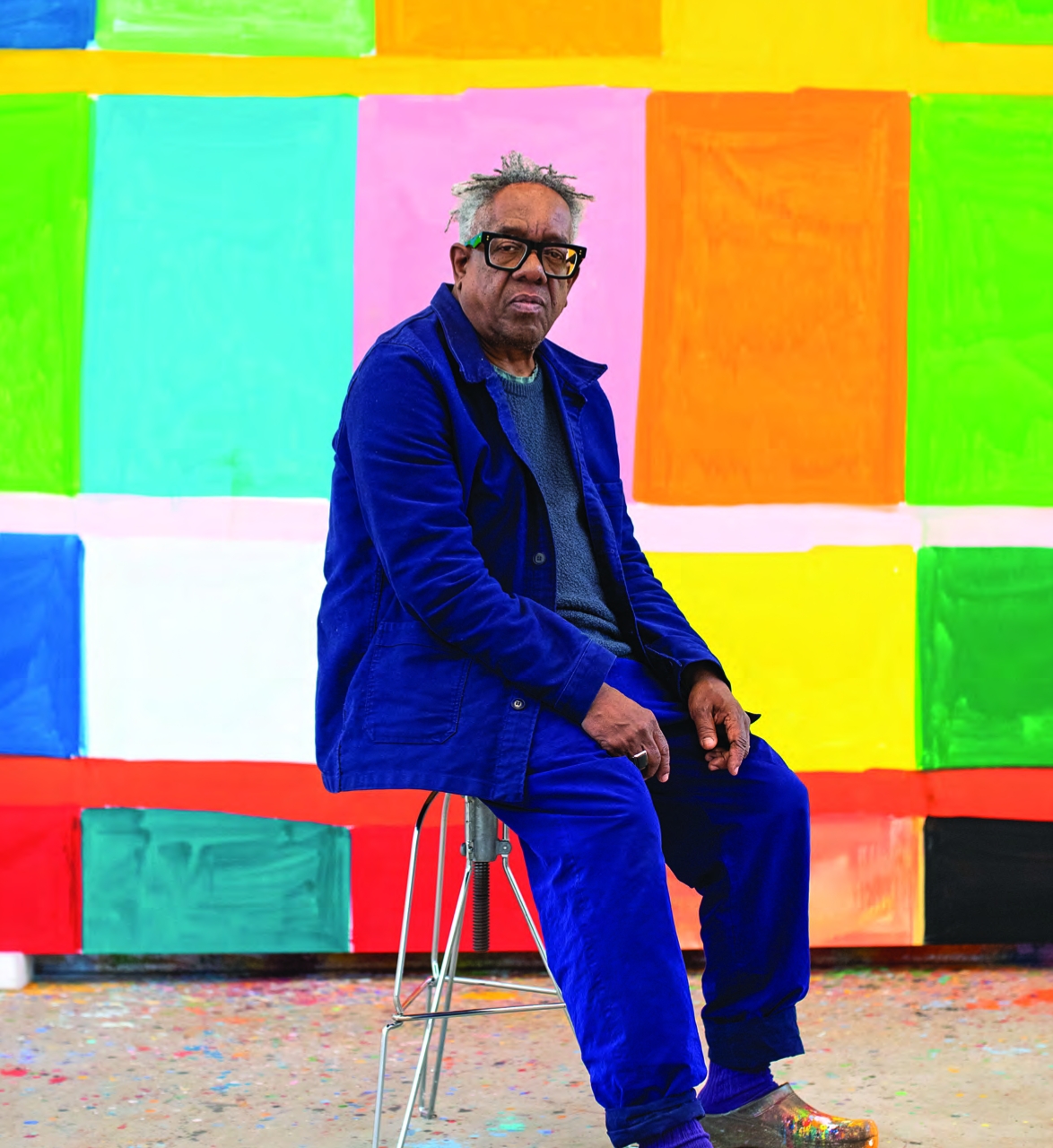
Stanley Whitney 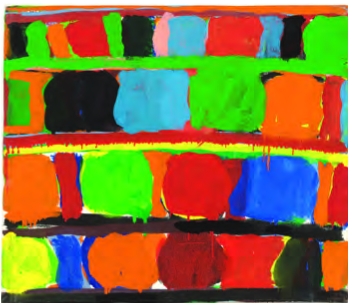
“Untitled,” 1997. Oil on linen. Private Collection. Artwork © Stanley Whitney.
ICA mounts first Stanley Whitney retrospective
Painter Stanley Whitney found freedom in restriction. In his first retrospective exhibition “Stanley Whitney:
How High the Moon” at the ICA Boston, viewers can see how the artist found his signature structure of colored blocks and the way he has explored that structure for decades.
The exhibition features more than 100 works spanning five decades, beginning with his early, more representational sketches and paintings and moving up to recent works. A selection of his sketchbooks is also on view, offering insight into his process and politics.
Color is paramount for Whitney. All his paintings are different ways of seeing and experiencing color. In the early days he played around with figurative work and different abstractions, which are shown in the first few galleries of the exhibition. But by 2002 he had a found a geometric system of blocks that suited his purpose, and he still paints in that style to this day.
“Like the 1940 song, penned by Nancy Hamilton and Morgan Lewis, that inspired the exhibition’s title, ‘Stanley Whitney: How High the Moon’ conveys feelings of enchantment through the artist’s consistent yet wholly expansive paintings,” said Ruth Erickson, the ICA’s Barbara Lee Chief Curator and director of curatorial affairs. “Whitney’s abstractions create a space for viewers to focus on their wide-ranging responses to color, rather than a specific subject.”
Whitney’s
work was influenced by the fabric of the world he lived in. Music,
especially jazz, was always playing in his house growing up and his
experiences in New York City during the 60s and 70s had a profound
impact in terms of experiencing live music and poetry and seeing
abstract works made by contemporaries. Whitney says he always listens to
music while he works, and some paintings are named after performers or
songs.
“I grew up in
Philadelphia and in the Black community music was everything,” said
Whitney. “I went to jazz clubs; I listened to music a lot. I was just
trying to make my own recipe for what painting is.”
That recipe comes in the form of four rows of colored blocks. The rows are often divided by thick horizontal lines.
The colors of the blocks
and the size of the rows vary per painting, but the rigid format allows
Whitney, and the viewers, to focus solely on the colors. Rather than
becoming restrictive, this pattern allows for a deep inspection of the
basics of construction: color, shape, scale and brushstrokes.
“Stanley
Whitney: How High the Moon” is on view at the ICA Boston through
September 1. Admission to the ICA is free every Thursday evening after
5p.m.
Whitney was
prolific from a young age, filling hundreds of sketchbook pages and
painting every day. But his work is only now getting the recognition
that many of his contemporaries received years ago.
“Like
many African American artists, attention to his work came late,” said
Cathleen Chaffee, Charles Balbach Chief Curator at the Buffalo AKG Art
Museum where the exhibition was organized. “He was always showing. He’s
always really been exhibiting, but he still supported himself full time
through teaching up until just a handful of years ago.”
In
many ways this parallels the experience of Roxbury native artist John
Wilson, who worked as a teacher at Boston University for several
decades. The largest exhibition of his work ever shown is currently on
view at the Museum of Fine Arts, Boston. Though Wilson and Whitney made
very different kinds of work, they are both important Black artists,
masters of their craft, who are finally getting their flowers.
LEARN MORE AT ICABOSTON.ORG