The
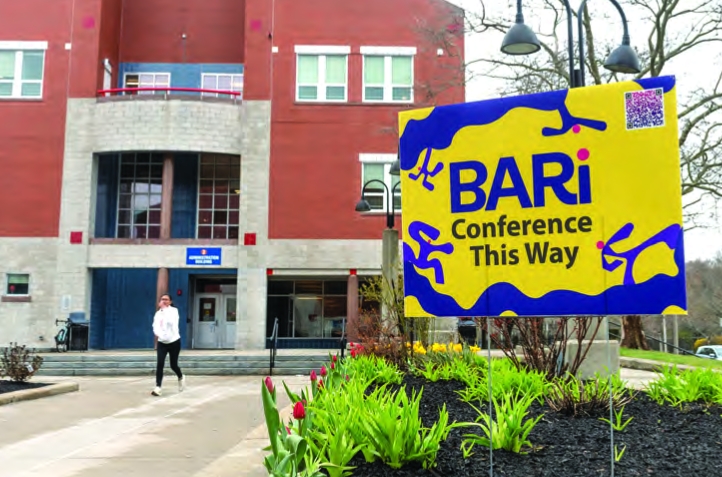
Northeastern University-based Boston Area Research Initiative held its
annual conference at Roxbury Community College, April 11. The conference
featured local efforts in civic research — academic study based on the
goals of partnership with community and impact in those communities.As Daniel O’Brien, director of the Boston Area Research Initiative, welcomed guests and speakers to the group’s 2025 conference, the initiative’s acronym “BARI” was emblazoned behind him.
On that screen, the little “i” was dancing.
In his remarks, O’Brien encouraged attendees to be like that wiggling, squirming “i” and to find joy in the day.
It was an appeal that marked a strange moment for a regularly out-of-theordinary conference.
BARI, which is housed at Northeastern University, focuses on “civic research,” an approach to data collection and study that centers on partnership with the communities involved and emphasizes the creation of products that have an impact on those same communities.
At BARI, much of that work tackles issues related to topics around equity — things like poor air quality which often impacts disadvantaged neighborhoods at a heightened rate, social and economic mobility, housing access and preservation and environmental justice — many things that O’Brien said have been in the crosshairs of the administration of President Donald Trump.
The Trump administration, in recent weeks, has started to look toward higher education institutions to pressure them away from perspectives and teachings that don’t align with its priorities.
So,
as he opened the annual “Insight-to-Impact Summit,” held at Roxbury
Community College April 11, O’Brien had another request for attendees:
“I think we can use today to advance the work not just in spite of the context but because of the context,” he said.
At
the heart of the event, which was hosted in collaboration with RCC’s
Center for Economic and Social Justice, was the idea of increasing
collaboration and bringing in more voices to academic work.
That
perspective, organizers said, can better support the communities that
researchers work with or, in less civic-focused research, draw from.
“You
have to understand the people behind the numbers and then you have to
empower them to make decisions,” said Anna Johannes, a retired
Paralympian and inclusive marketing and design consultant, at the
keynote panel during which she spoke.
Breaking
out of that ivory tower is at the heart of the vision of the civic
research BARI focuses on, said Kim Lucas, associate director of civic
research at the initiative and professor of public policy and economic
justice at Northeastern University.
“Projects
don’t get done with just one group of people doing them; change doesn’t
get made with just one group working on it,” she said. “It takes all
types of coalition. It also takes all types of expertise to be able to
get something off the ground and done.”
The
tools and approaches from academic research and data collection can be
useful additions to getting those projects off the ground, Lucas said.
Using
the “really powerful tool” of research to target a particular issue or
understand a particular concept can more effectively put it to use,
O’Brien said.
“It can
surface all sorts of facts and relationships that you might not see and
understand otherwise,” he said. “But in the purpose of what? Research is
never fully inert.”
It can also lead to better information about how topics actually play out.
While
presenting previous research on the intersection of backyard chickens
and the avian flu, Boston University researcher Jessica Leibler gave the
example that different communities keep chickens for different reasons.
What might be a pet and a source of eggs in one household might be a
source of meat and a reflection of cultural practices in a different
one.
However,
recognizing that they have different motivations can support a
conversation about minimizing risk rather than shutting chicken
ownership down entirely. Greater partnership between residents and
researchers can break patterns of academics engaging with communities in
what Leibler called a
“oneway stream of negativity” and can help research like hers better
serve communities who rely on chickens to provide a good food source
through eggs or as a traditional carry-over from their home country.
“Part of the challenge is realizing there’s no onesize-fits-all as it comes to messaging,” she said.
That message was well received by community organizations present at the conference.
In
response to comments from Leibler and others who spoke during the
session, Rene Mardones, director of community organizing at the Dudley
Street Neighborhood Initiative, described how the day before he had
spoken with a different group of researchers about housing issues. When
he asked them if they were doing any work with legislation around the
topic, they said it wasn’t their job.
The engagement from researchers at the BARI conference, he said, excited him.
And the broader question of bringing in laypeople impacted by research is something often on his mind.
When
he attends conversations like the one at the BARI conference, he is
often left with the question of, “Ok, how are we going to involve our
communities?” said Mardones, who served during the session as a
“provocateur,” a role designed by conference organizers to challenge
speakers to generate more conversation on the topic.
And, Northeastern Professor Ted Landsmark said recent changes in the political landscape make the work all the more important.
“What
we did before — and by ‘before,’ I mean as little as two weeks ago — is
no more,” he said during the keynote panel, on which he sat.
What’s
left, he suggested, is a moment for a shift toward more humility, more
self-care, and more relationship-building among institutions.
“This
is the moment for us to be strong, in terms of the values that we bring
forward, in terms of the ethics that we speak from,” Landsmark said.
At
the conference, the latitude of that work on display was broad, ranging
from big and aspirational to the nitty gritty of everyday life.
In
one session, speakers tackled breakthrough solutions to climate change
and its impacts, like the state’s 2022 textile disposal ban, which
prohibited throwing clothes and other old textiles in the landfill.
Another looked at the goals and efforts around community stability and
anti-displacement.
Yet,
down the hall, Leibler and other researchers were talking about how to
keep backyard chickens safe from avian flu and how to address Boston’s
rat problem. Later a different group of scholars and speakers dove into
the complexities of zoning.
That
wide range is characteristic of an approach to study that is designed
to keep research from sitting on the shelf without being useful to
anyone, Lucas said.
Housing
it all under the one roof of a conference like BARI’s is more
reflective of how people interact with issues, compared to the silos
that tend to exist in institutions like universities and municipal
governments, she said.
“I’m
not saying that it’s problematic; it helps people concentrate on an
area. You can go deep — get a bunch of transportation people in one
place, and they all go hard on transportation. That’s great. We need
that,” Lucas said. “But that’s not how people experience the world.
That’s not how we experience the city.”
For
an approach to study that has that wide range, O’Brien said it falls to
BARI and its conference to make sure all those topics are discussed.
“It’s
our job, if we’re going to host the civic research community of Greater
Boston, to host all those conversations,” he said in an interview.
“Hopefully, the research on each of those topics that touch the lives of
the people who live around here can be approached in that way.”
At the end of the day, O’Brien said he felt like his call for joy and for productive conversations was heard.
“I
think people took me up on my offer, if you will,” he said. “It felt
like folks enjoyed themselves all day and had really aspirational
conversations about ‘what can we do right now?’ That was what I was
hoping.”