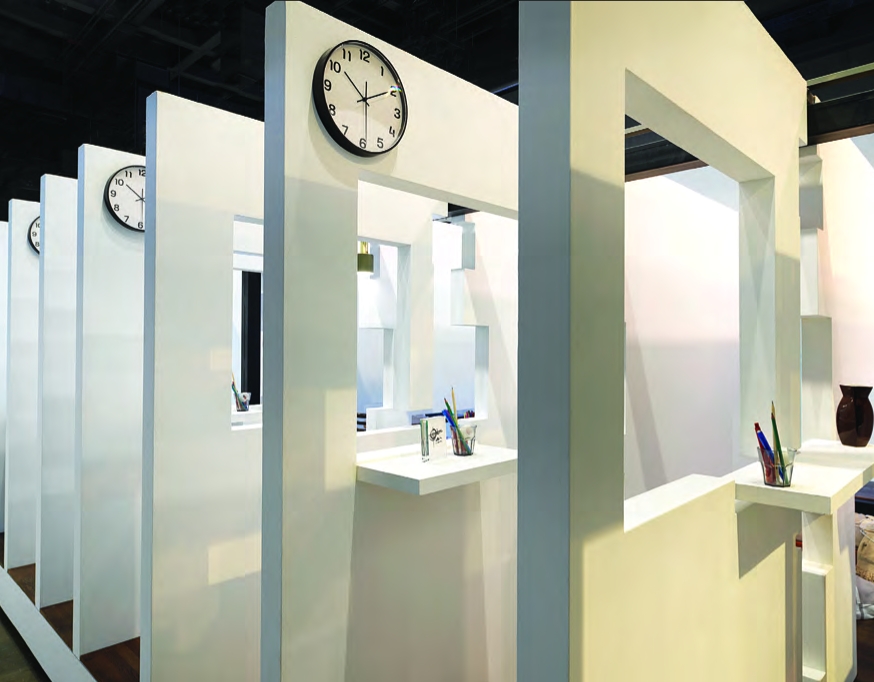
Detail of Virgo, 2022, from Pedro Gómez-Egaña: The Great Learning at the List Visual Arts Center.
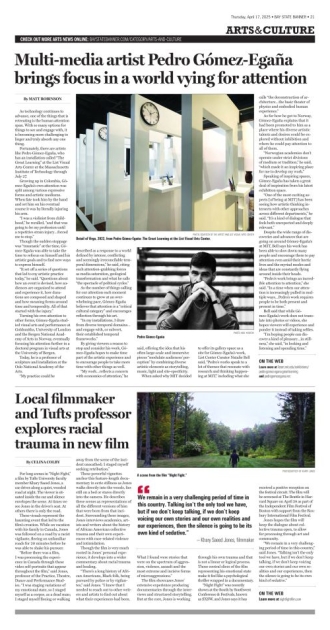
Pedro Gómez-Egaña
As technology continues to advance, one of the things that is retreating is the human attention span. With so many options for things to see and engage with, it is becoming more challenging to linger and truly absorb any one thing.
Fortunately, there are artists like Pedro Gómez-Egaña, who has an installation called “The Great Learning” at the List Visual Arts Center at the Massachusetts Institute of Technology through July 27.
Growing up in Colombia, Gómez-Egaña’s own attention was split among various expressive forms and artistic mediums. When fate took him by the hand and set him on his eventual course it was by literally injuring his arm.
“I was a violinist from childhood,” he recalled, “and that was going to be my profession until a repetitive strain injury…forced me to stop.”
Though the sudden stoppage was “traumatic” at the time, Gómez-Egaña was able to take the time to refocus on himself and his artistic goals and to find new ways to express himself.
“It set off a series of questions that led to my artistic practice today,” he said. “Questions about how an event is devised, how audiences are organized to attend and experience it, how durations are composed and shaped and how meaning forms around time and temporality. All of that started with the injury.”
Turning his own attention to other forms, Gómez-Egaña studied visual arts and performance at Goldsmiths, University of London and the Bergen National Academy of Arts in Norway, eventually focusing his attention further in a doctoral program in visual arts at the University of Bergen.
Today, he is a professor of sculpture and installation at the Oslo National Academy of the Arts.
“My practice could be described as a response to a
world defined by intense, conflicting and seemingly irreconcilable
temporal dimensions,” he said, citing such attention-grabbing forces as
media saturation, geological transformation and what he calls “the
spectacle of political cycles.”
As
the number of things calling for our attention each moment continues to
grow at an overwhelming pace, Gómez-Egaña believes that attention is a
“critical cultural category” and encourages reflection through his art.
“In my installations, I draw from diverse temporal domains… and engage with, or subvert, their established temporal frameworks.”
By
giving viewers a reason to stop and consider his work, Gómez-Egaña
hopes to make time part of the artistic experience and to encourage
people to take more time with other things as well.
“My work…reflects a concern with economies of attention,” he said, offering the idea
that his often large-scale and immersive pieces “modulate audiences’
perception” by combining diverse artistic elements as storytelling,
music, light and site-specificity.
When
asked why MIT decided to offer its gallery space as a site for
Gómez-Egaña’s work, List Center Curator Natalie Bell said, “Pedro’s
works speak to a lot of themes that resonate with research and thinking
happening at MIT,” including what she calls “the deconstruction of
architecture…the basic theater of physics and embodied human
experience.”
As
for how he got to Norway, Gómez-Egaña explains that it had been
promoted to him as a place where his diverse artistic talents and
desires could be explored without inhibition and where he could pay
attention to all of them.
“Norwegian
academies don’t operate under strict divisions of medium or tradition,”
he said, “which made it an inspiring place for me to develop my work.”
Speaking of inspiring spaces, Gómez-Egaña has taken a great deal of inspiration from his latest exhibition space.
“One
of the most exciting aspects [of being at MIT] has been seeing how
artistic thinking intersects with other approaches across different
departments,” he said. “It’s a kind of dialogue that feels both
unexpected and deeply relevant.”
Despite
the wide range of discoveries and advances that are going on around
Gómez-Egaña’s at MIT, Bell says his work has been able to slow down many
people and encourage them to pay attention even amid their hectic lives
and the myriad modes and ideas that are constantly flying around inside
their heads.
“Pedro’s
work brings an incredible attention to attention,” she said. “In a time
when our attention is increasingly pulled in multiple ways…Pedro’s work
requires people to be both present and present in time.”
Bell
said that while Gómez-Egaña’s work does not translate into photos or
videos, she hopes viewers will experience and ponder it instead of
taking selfies.
“I’m hoping people can discover a kind of pleasure…in stillness,” she said, “in looking and listening and spending time.”
ON THE WEB
Learn more at listart.mit.edu/exhibitions/pedro-gomez-egana-great-learning and pedrogomezegana.net