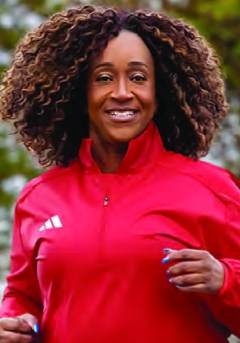
Tanisha Tate runs in preparation for the Boston Marathon.
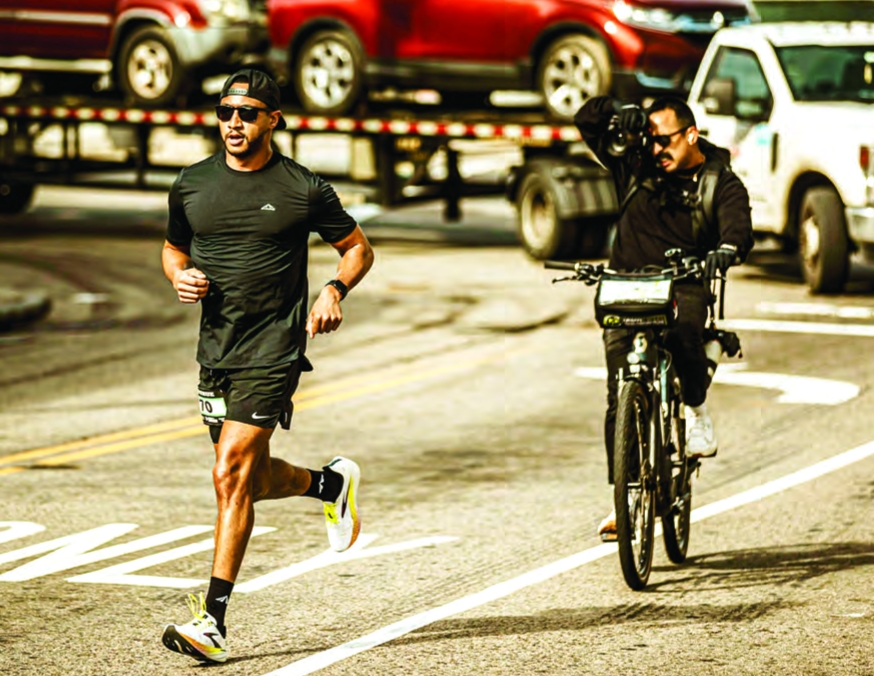
Reynolds
Graves, who runs a public affairs, lobbying and political consulting
firm, shown on a run. Graves is running the Boston Marathon, with the
money raised for his race set to be donated to the Lenny Zakim Fund.It was a hard move when Tanisha Tate moved back to Boston to care for her parents who were facing health issues.
Tate, a Dorchester resident, struggled with anxiety and depression. Within six months, she gained over 100 pounds.
Staff at the Codman Square Health Center wrote her a prescription for exercise — part of the center’s partnership-based effort to address a wider variety of health factors — and connected her to Healthworks Community Fitness, a nonprofit gym in then health center’s Wellness Center.
Two years later, with support from the staff of the gym, she had lost the weight and improved her health.
“It totally changed my life,” she said. “I was able to get off all the anti-depressants and anxiety medicine. I lost 100 pounds. … I just felt like it was great.”
In honor of that support, Tate, who now works as the community outreach and engagement director at Healthworks Community Fitness, is running the Boston Marathon this year as one of the race’s many charity runners, with the $12,000 she’s aiming to raise, set to be donated to the gym.
“When the executive director said they had bibs for the marathon, I thought, I would love to raise money for it and to participate, to be an inspiration for other women that, ‘you could do it,’” Tate said of her effort, which has been included in a Bank of America billboard campaign featuring charity runners in the event.
Since
the marathon’s charity program launched in 1989, charity runners have
been a significant part of the race’s base. Last year, charity runners
made up almost 10% of the racers, logging $45.7 million for their
respective organizations.
This year, Healthworks Community Fitness is one of 174 organizations that will be supported by runner-collected donations.
Reynolds
Graves, another charity runner in this year’s race, is racing to
support the Lenny Zakim Fund, which funds efforts related to social,
economic and racial justice. Graves said he’s proud to be supporting the
fund’s efforts in bridge-building and making community connections.
“I think that so many communities these days need allyship.
Whether
it’s the Black community or LGBTQ community or other marginalized
groups, or certain religious groups, everyone needs allyship. That’s the
only way any of this stuff that’s going on today that’s detrimental and
harmful to these communities is going to stop,” said Graves, who runs a
local public affairs, lobbying and political consulting firm.
He is aiming to raise $10,000 for the fund.
The
race is an opportunity to use his platform, “in this case, 26.2 miles
from Hopkinton to Boylston Street, to raise funds and to secure funds
for causes that really impact people’s lives positively or change
people’s lives throughout the Boston metro area,” he said.
For both Tate and Graves,
the race is also a chance to show people from communities of color that
running is a sport they can tackle.
“I
think that is kind of where my activism with running starts, it is
trying to bring this sport to others who probably would have never
thought about participating in the sport of distance running,” he said.
Growing
up, running wasn’t on his radar. Instead, he participated on the swim
team and the golf team. It wasn’t until the mid-2010s, when his friend
Sid Baptiste started Pioneers Run Crew, a local running group aimed at
bringing the sport to a more diverse array of runners, that he got into
distance running.
“It’s
a beautiful thing to see people of color, Black people from Roxbury,
Dorchester, Mattapan, meeting up at Franklin Park, or meeting up on
Mass. Ave. or in the South End to go for runs,” he said.
Since
taking up running, he’s already run the Boston Marathon once, alongside
three other marathons, including 26.True, a local, unsanctioned
marathon organized by Pioneer Run Crew, that traces its just over 26
miles largely through the city of Boston (organizers draw a contrast
with the official Boston Marathon, which, despite its name, only runs
within the city’s limits for about two miles).
And Tate said she’s proud to run the race representing runners — especially women — of color.
“With
our community, especially Black women, we have so much on our plate
personally,” she said. For Tate, participating in the race is a chance
“to show that running could be part of your routine and also part of
your therapy.”
That
same effort is also part of her life for the rest of the year. Tate is a
certified running coach for the Dorchester chapter of 261 Fearless, a
woman-focused running group.
The
race is a return to long-distance running for her — previously she
lived in New York City, where she ran three half-marathons and a spate
of 5k and 10k races, as well as qualified for the New York City Marathon
twice (neither time she was actually able to run the race due to other
outside factors).
She
said she’s run a handful of 5k races, but this will be her first
long-distance race since returning home to Boston. But the Boston
Marathon has long been a goal for her.
“That’s why I was like, ‘Oh my gosh. I’ve always wanted to,’” she said. “That’s my dream to run the Boston Marathon.”


