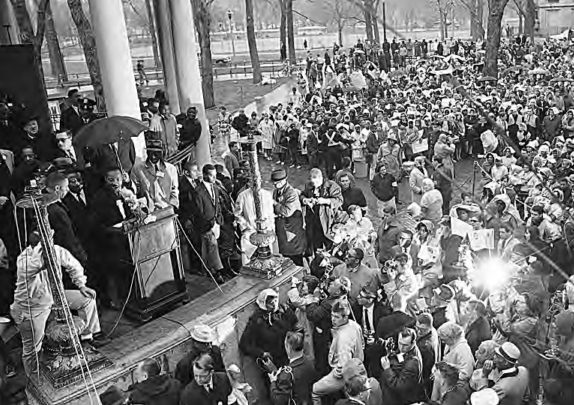
Martin Luther King Jr. speaks on Boston Common, April 1965. 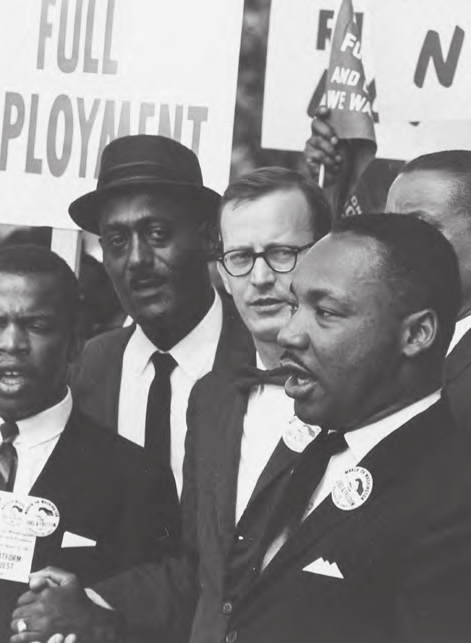
Martin
Luther King Jr. speaks at the 1963 March on Washington for Jobs and
Freedom. During the weekend of April 26, a handful of events across
Boston will celebrate the 60th anniversary of a 1965 King rally on
Boston Common.
In April 1965, Rev. Martin Luther King Jr. led a march from Carter Playground on the edge of Roxbury to Boston Common. It was a rally that called for action on civil rights and segregation in schools.
Now, 60 years later, groups across the city are planning events to commemorate King’s 1965 Freedom Rally, even as organizers say that looking back over half a century, they see uncomfortable similarities in today’s political landscape.
“At this moment in time, where the issues of housing, poverty, racial equity and education are on the national stage being erased and removed, those four issues — as they were with the [1965] march, feel more important now than ever before,” said Imari Paris Jeffries, president and CEO of Embrace Boston.
Paris Jeffries’ Embrace Boston will host a commemorative rally April 26, calling back to King’s 1965 march.
And commemorating the march is an important way to remember the role that Black religious leaders like King had in pushing for civil rights, said Rev. Willie Bodrick II, pastor at Twelfth Baptist Church.
The
church will be hosting events throughout the weekend of April 26 —
including prayer and worship services and a book reading — to honor
King’s march.
The
commemorative events are “long overdue,” said Arthur T. Gerald, reverend
emeritus at Twelfth Baptist Church, who marched in the 1965 Freedom
Rally.
The events come as part of a couple of different broader historical commemorations.
At
Twelfth Baptist Church, the weekend full of celebrations is included in
the church’s celebration of its 185th anniversary, which they are
focusing around the theme of “Built to Last” — a message that Bodrick
said he sees reflected in King’s work and march.
“We
have been deeply committed to the work of spreading love, light, life
and liberation, and continuing to show the commitment of this great
institution in the life of this city, but also in the life of this
country. We think it’s important that we continue to tell our stories.
We continue to stand upon the premise that we shall not be moved and
that we are built to last,” he said. “This story is an American story”
The
church has its own history with King, as well as his 1965 march. While a
student at Boston University, King attended Twelfth Baptist, where he
sometimes taught and preached.
For
Willia Cooper, a member of Twelfth Baptist, celebrating and remembering
that history is important, as is making sure it gets passed on to the
church’s younger members.
“We
have a strong relationship with Reverend King and his family, and it
keeps that memory alive,” said Cooper, who is helping organize the 185th
anniversary celebrations, specifically with the events around the 1965
Freedom Rally.
And
Embrace’s planned rally is part of a series of events being organized by
Everyone250, a campaign that is aiming to bring in a broader and more
diverse selection of perspectives as the city plans to celebrate the
250th anniversary of the United States next year.
In
that work, Everyone250 is highlighting socalled “founding stories” from
across the two-and-a-half centuries of the country’s history,
celebrating not only Revolutionary War events but other moments since
that have shaped the United States.
The
1965 Freedom March is one of those “founding stories,” Paris Jeffries
said, pointing to the legacy of organizers like King and others who
pushed for civil rights both at the march and since.
And,
he said, it commemorates the “founding story” of the King family.
Martin Luther King Jr. and his wife, Coretta Scott King, met while
attending universities in Boston — him at Boston University, her at the
New England Conservatory — making a celebration like the one
commemorating the Freedom March, as well as monuments like the Embrace
on Boston Common unique for the city, Paris Jeffries said.
“This is the only city where their origin story began,” he said.
The
commemorations come as the presidential administration of Donald Trump
takes steps to limit initiatives around diversity, equity, and
inclusion, measures that some see as a move back toward the 1960s when
King was active.
Cooper,
from Twelfth Baptist, said the current political landscape brings back
“very dark memories” — having grown up in Virginia. She said when she
marched for civil rights, it was in front of the Ku Klux Klan.
And
efforts from the Trump administration have included measures pulling
back from the teaching of Black history. Last week, the National Park
Service removed a photo of Harriet Tubman and some content about slavery
from its webpage on the Underground Railroad.
The
Pentagon had previously deleted pages related to Jackie Robinson’s
military career and the Navajo Code Talker’s role in World War II.
After public outcry, the various web pages were restored.
Those
actions come as Trump has taken aim at the Smithsonian Institution. A
presidential action from March directed Vice President J.D. Vance, among
other administration officials, to remove “improper ideologies” from
the Smithsonian and National Zoo.
Those
efforts make the commemoration events — as well as the dedication of
the Charles Street entrance to the Boston Common, where King and others
entered the park during the rally 60 years ago, as “1965 Freedom Rally
Square” — especially important, said Paris Jeffries.
“We’re
in a little bit of a culture war of this erasure of Black history,” he
said. “To be able to create permanency — permanent objects and permanent
things that become part of our public memory — is part of the affirming
cultural moves that Everyone250 and Embrace are designed and organized
around.”
But
organizers also say that the same landscape makes these commemorations,
including another rally, an important moment to push back on what they
see as the same fights King faced in 1965.
“It’s
very much so apropos that we are continuing to step up and to march and
to speak up to make sure that that the fight that was started 60 years
ago — and even before then — continues to make sure
that folks can really, truly live out what they desire: to be in a
healthy community and a whole community and living a world that gives
them equal rights and access and opportunity,” Bodrick said.
Much of what King fought for has yet to come to fruition, Gerald said.
“We would sing ‘We Shall Overcome’ but we still have not overcome,” he said.
Cooper,
who met King herself as a teenager in Virginia, said the events are an
important chance to remind community members of the history and “keep
[King’s] memory alive” as well as to speak out for civil rights.
“I’m prepared to stand up for justice and equality again and again and again,” she said.
Embrace
Boston will host a rally on Boston Common at the Parkman Bandstand from
12 p.m. to 2:30 p.m. on April 26. Before the rally, the city of Boston
and the Everyone250 coalition will dedicate the Charles Street entrance
to The Boston Common as “1965 Freedom Rally Square” in a ceremony at 11
a.m., April 26.
The
Twelfth Baptist Church will host a virtual prayer service on Zoom at
from 7 p.m. to 8 p.m., Friday April 25; a children’s book presentation
by Glynette Scott, who attended the 1965 march, at Hester Hall, 160
Warren St., from 10 a.m. to 12 p.m., Saturday, April 26; “Legacy in
Action,” a conversation with Martin Luther King III and Susannah Heschel
at the Twelfth Baptist Sanctuary, 160 Warren St., from 4:30 p.m. to
6:00 p.m., April 26; and a special worship service, Twelfth Baptist
Church Sanctuary, 160 Warren St., from 10:45 a.m. to 1 p.m., April 27.


