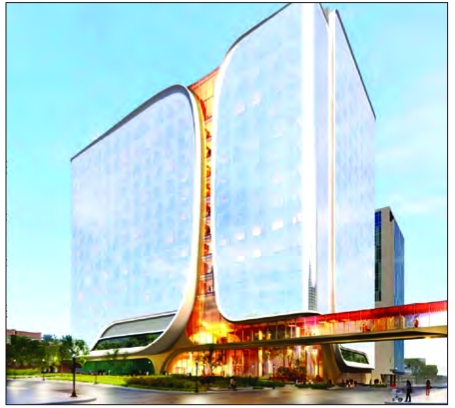
A
rendering shows a proposed design for the pending inpatient hospital to
be built by Dana-Farber Cancer Institute in Longwood Medical Area. The
300-bed hospital, which would be the only freestanding cancer hospital
in New England received state approval from the Massachusetts Public
Health Council last month. Approval from the state for Dana-Farber Cancer Institute to build a freestanding hospital in Longwood Medical Area means progress for the cancer institute’s plan, as well as potential expansion of efforts to increase equitable access to care, supporters said.
The proposal for the 300- bed hospital was approved in a unanimous vote by the Massachusetts Public Health Council in its meeting March 20.
“You can propose anything, but you have to talk with the state and show them that there’s a need to build a new facility and how it will serve the community,” said Dr. William Hahn, executive vice president and chief operating and transformation officer at Dana-Farber. “I think we worked with the state over the last year-and-a-half to answer their questions and it was really gratifying to see that they — the Department of Public Health — agreed with us that there’s a need for this cancer hospital.”
The proposal for the hospital was first announced in September 2023.
Dana-Farber is the only comprehensive cancer center in Massachusetts — a level of designation from the National Cancer Institute that indicates it has the widest range of qualified research programs — and one of three in New England.
Its standalone hospital, once built, will be the only freestanding cancer hospital in New England. Hahn said the next nearest is Memorial Sloan Kettering Cancer Center in New York.
The approval from the Public Health Council, officially called a determination of need, indicates that the state found that the proposed hospital will help the state
meet health goals like promoting public health, making resources
equitably available, and promoting competition in the health care
industry.
Clearing
that hurdle means that Dana-Farber can start the next steps of planning
and construction, though they still need to move through additional
approval steps.
Currently,
Dana-Farber is working with the city of Boston to approve the design
and with the state’s Health Policy Commission, which is doing an
analysis of the impact the hospital and Dana-Farber’s proposed
collaboration with Beth Israel Deaconess Medical Center, which provides
medical support for patients on non-cancer issues, will have on health
care costs in the Commonwealth.
The hospital is expected to improve access and quality of care for cancer patients in the state and the region.
“There
are a few other freestanding cancer centers around the country that
have built cancer hospitals,” Hahn said. “What we’ve learned is that the
outcomes for patients are better. They do better with treatment; they
have longer survival; and we know that patients and families, their
experience in the hospital is better.”
Those
supports, Hahn said, are especially important in the state with the
shuttering of hospitals like Dorchester’s Carney Hospital as the
long-embattled Steward Health Care system declared bankruptcy and sold
its hospitals in the state.
“There’s
the commitment on our part to do this, and the starting point and
foundation that we’ve done with Whittier Street and other clinics, but
it’s, I think, a particularly important time for us to do that, given
the challenges we have in the state,” he said.
And
Hahn said he expects those improvements in care to also support more
equitable access to screening and care. Already, the hospital has
partnerships with health centers and clinics, and it runs its Patient
Navigator Program, which connects patients with professionals who can
answer questions and arrange for tests and appointments to smooth out
processes and make cancer care more accessible.
“Because
we will decide and manage the hospital, our ability to link up with the
ongoing collaborations … will allow us to synchronize those efforts for
those patients who need inpatient hospitalization and make it easier
for them to get to the hospital and not feel like there are logistical
things that stand in the way of allowing patients to get to the
hospital,” Hahn said.
The approval processes with the state also require agreements around Dana-Farber supporting new
funding toward community access efforts, a process Hahn said the cancer
institute will begin working on fleshing out soon.
More
equitable access to cancer screening and care has been in the sights of
groups focused on improving cancer outcomes from Boston’s communities
of color, which tend to be hit hardest by cancer mortality.
According
to a 2023 report from the Boston Public Health Commission, Black men
were just over 1.4 times as likely to die from invasive cancers than the
city population at large. Black women were just under 1.4 times as
likely.
Among certain
types of cancer, those rates grew. Black women were about 1.7 times as
likely as the city at large — and just over twice as likely as the
city’s white population — to die of breast cancer. Black men were over
twice as likely as the city population overall and almost 2.5 times as
likely as their white counterparts to die from prostate cancer.
When,
in July, the city’s Public Health Commission announced its Live Long
and Well agenda — an effort to close life-expectancy gaps citywide — it
said it planned to target preventable cancers as one of the leading
causes of premature death, alongside heart disease, diabetes and opioid
overdoses.
Already, Dana-Farber runs a partnership with Whittier Street Health
Center
in Roxbury. In 2002, the health center and the cancer institute began
to partner through Dana-Farber’s mobile mammography van. In 2013,
shortly after the construction of the health center’s new Tremont Street
facility, the center opened its mammography suite in partnership with
Dana-Farber. The suite is operated by a team from the cancer institute.
Efforts between the health center and Dana-Farber also include work around tobacco cessation and support for other types of cancers. Dana-Farber
oncologists have visited Whittier Street Health Center to work with and
teach primary care providers at the center.
Frederica
Williams, president and CEO at Whittier Street Health Center, said the
partnership has been an important step in improving trust with the
communities Whittier Street serves.
Before the mammography van brought services to Whittier Street, Williams said, the community didn’t feel Dana-Farber was a welcoming place.
“When
our patients know we have a trusted partner in Dana-Farber Cancer
Institute, who’s there consistently, and the relationships start in a
primary care setting … people are much more willing to engage and
connect,” Williams said. “I see this new hospital as their continued
commitment to reducing the barriers to high-quality cancer care for our
historically underserved patients and communities.”
Williams has served on the Dana-Farber board of trustees for about 20 years.
The
construction of the new hospital will, she hopes, continue to foster
and expand that partnership, efforts that she said will be made possible
by building a hospital from the ground up with a focus on equity and
simply through the expansion of capacity.
And
that expanded capacity may also allow Dana-Farber to extend its
partnership to other health centers and clinics, Hahn said. Already, the
cancer institute’s mammography van serves about 15 other health centers
and clinics across the Greater Boston region.
Already,
Dana-Farber is working to expand its work with local health providers. A
new initiative between Dana Faber and Neighbor- Health — which, last
year, opened its own mammography suite in its South End clinic — will
bring cancer care specialists and services directly to Neighbor-Health
patients, a step that the health center in a statement said will
hopefully improve access to cancer care, enhance coordination, and
reduce time to diagnosis and treatment.
Programs
like that, which supporters said they hope will be made possible by the
expansion, are expected to be a boon to Boston residents hit hardest by
cancer rates.
“Big is not always better, but I can tell you that this ‘big’ is going to be an asset to our community,” Williams said.


