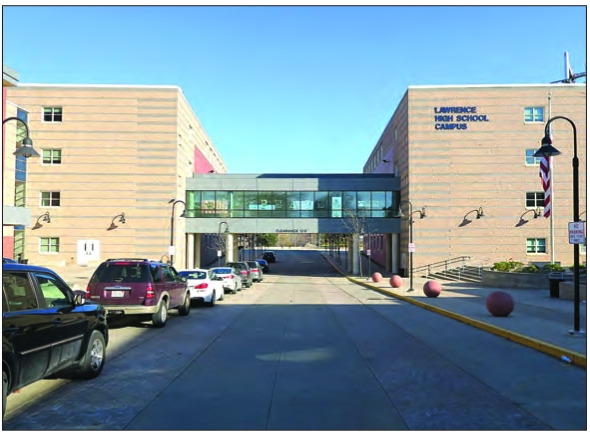
Lawrence High School Massachusetts voters decided to toss the highest hurdle between high schoolers and their diplomas: MCAS-measured proficiency.
For those leaps and bounds ahead, little changes. This matters most where graduation rates lag.
The state is considering new regulations to qualify graduates. Grades of D-may suffice. Four-day credit recovery programs or classes in other countries may substitute for semesters of learning.
The public is asked to comment through an online form. The deadline to submit public comment is April 4, 2025 at 5:00 pm. The Board is expected to vote on the proposed amendments at its regular monthly meeting scheduled for May 20, 2025.
Among the municipal school districts with the lowest graduation rates are large gateway cities and small ruralities. Racially, and concerning English language learners, their demographics differ. Their similarities include concentrated poverty, dropout rates and frequent transfers.
Epitomizing this group are two school systems in state receivership: Lawrence and Southbridge. Both are pursuing turnaround strategies measured, in part, by the dropout rate.
Easier graduations, combined with post-pandemic test score recovery, will count for ending state control. If the academic and financial fundamentals go unaddressed, Massachusetts may find itself responsible for its least fortunate again soon.
Southbridge, like Webster, Greenfield, North Brookfield and North Adams, is west of Worcester longitudinally. After Chelsea, Lawrence, Lowell, Brockton and Fall River are home to many English learners.
In
Southbridge 80.6% of students are low income. Those kids experience one
of the state’s highest churn rates: 22.8% of the student population
transfers in or -out mid-year annually.
Therefore,
early-grade gains hardly predict high school outcomes. Southbridge’s
last progress report documents academic growth demonstrated in
elementary and middle schools.
At
the high school, the number of A’s awarded is increasing and failing
grades are decreasing. The district has also invested in a graduation
coach, after-school tutoring and credit recovery courses. Over a school
break, students can “earn back course credits missing due to course
failure or chronic absenteeism, to promote on-time graduation.”
Southbridge
has addressed many of the challenges identified in its last district
review, which took place in 2015 — the same year state receivership
commenced.
A core
criticism was low expectations. Reviewers found “low evidence of rigor
and high expectations in observed lessons at the middle/high school.”
Unequivocally, Southbridge students told the state to “raise academic standards.”
Without
the MCAS standard, MassCore is Southbridge’s requirement. “MassCore
outlines a recommended minimum program of high school study while
maintaining flexibility for districts to set additional graduation
requirements,” an FAQ reads.
In
the latest data, Southbridge’s dropout rate has risen since its
receivership started. Students who transfer during high school dropout
at a higher rate than those who attended all four years.
In
Lawrence, a key dropout rate is less than a quarter of the number in
2011, pre-receivership. Participation in credit recovery acceleration
academies grew from “1,000 students per vacation week in 2013 to 2,500
in 2015.” They continue post-pandemic.
However,
some of the highest-risk students are educated outside the district. A
partnership with the Phoenix Foundation to “re-engage disconnected and
underperforming students” morphed into a charter school in 2019. In
2023, 54% of Phoenix Academy, Lawrence’s four-year cohort, dropped out —
the highest rate of its existence.
In
Massachusetts, graduation and dropout rates are calculated for four-
and five-year cohorts. They are also reported for the cohort, and as an
adjusted metric for only those who attended throughout high school. The
differences between adjusted and regular data reveal transient students’
outcomes.
In 2023, a quarter of Lawrence Public School’s four-year cohort transferred in during high
school. That population of late arrivals dropped out at a slightly
higher rate, about 28%, than in 2011. Back then, that rate was 26%.
LPS’s adjusted dropout rate was 5.7% in 2023.
The
Turnaround Plan for Lawrence involves a “comprehensive redesign” of
Lawrence High School. Its “backbone” created “a more structured learning
environment in the 9th and 10th grades, while gradually releasing
responsibility to 11th and 12th graders to be independent,
self-motivated learners.”
The
Lawrence Education Alliance discussed LHS’s graduation requirements
post-MCAS in March. “The bulk of our students who transfer come from
outside the country, mostly the Dominican Republic,” said an LHS
administrator.
LHS
contacts “departments of education within the Dominican Republic to see
what is covered” in the math courses on student transcripts. “We have
found that it does align with the algebra and geometry standards in the
state of Massachusetts,” she told the receivership’s overseers.
At
the meeting, Jonathan Guzman, an elected member of the city school
committee poised to retake control post-receivership, testified that
diplomas denied due to MCAS were an “injustice.”
For
“up to a thousand [students] as far back as 2003,” he said, “applying
current local competency standards retroactively is unfair. We owe it to
them to revisit their cases.”
In March, Fall River’s
school committee voted to approve a proposal regarding students
previously denied diplomas due to the MCAS graduation requirement.
Assistant Superintendent Brian Raposa termed it a “look back or
retroactive competency determination up through 2024.”
“Essentially
we could do a transcript review,” he said, so having completed the
equivalents of core classes could qualify people for diplomas.
At
the state level, Ed Lambert of the Massachusetts Business Alliance for
Education called for a stronger regulatory definition of “demonstrating
mastery” before the Board of Elementary and Secondary Education in
February.
A former
mayor of Fall River said, “We recommend you establish a minimum grade of
C for CD-required coursework and consider a minimum GPA for all
coursework as showing mastery worthy of graduation.”
“Completing
the coursework, just earning full credit,” Rob Curtin, a state
education official, told the board, “doesn’t necessarily demonstrate
mastery.” The regulations he proposed “outlined things like a final
assessment in the course, or a capstone portfolio, or an equivalent
measure.”
Inevitably,
DESE’s next commissioner will inherit this school landscape. The last
two men to lead the department, Jeff Riley and Russell Johnston, were
once receivers of the Lawrence and Southbridge Public Schools,
respectively.


