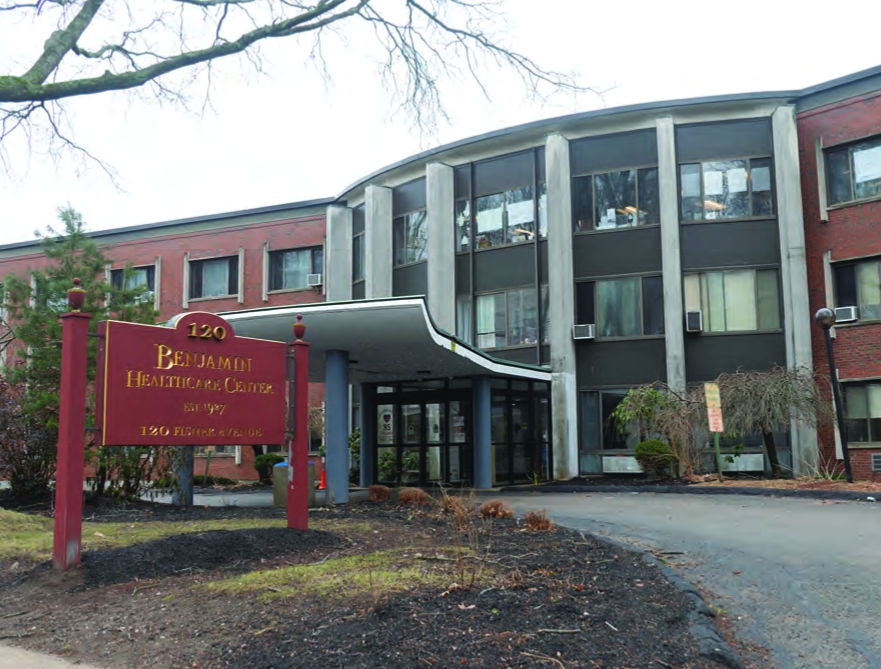
The
Edgar P. Benjamin Healthcare Center on Mission Hill is shown March 6.
Leadership from the nursing home and staff from the Massachusetts
Attorney General’s Office went to Massachusetts Suffolk Superior Court
March 19 over a state request to not have to pay for costs of the
receivership, as directed by a court order in December.
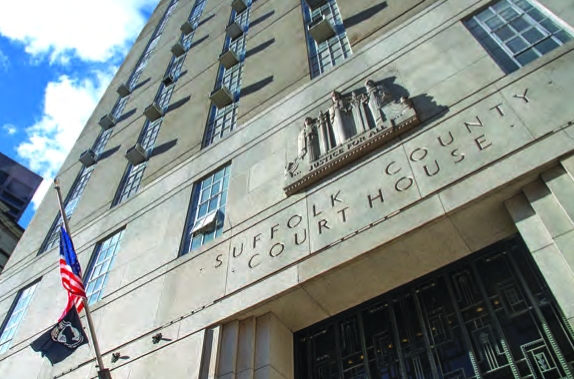
The Suffolk County Superior Court in downtown Boston is shown Dec. 19.
The Commonwealth of Massachusetts is looking to limit the financial support it provides to the Edgar P. Benjamin Healthcare Center
Through a request filed with the Suffolk Superior Court, the judicial body that oversees the court-appointed receivership that ousted the center’s former administrator last April, the Massachusetts Attorney General’s Office requested that the state’s Mass- Health office not be required to advance funds to pay for receivership costs at the center.
The move comes in contrast to a court order in December, where Justice Anthony Campo ruled at the request of receiver Joseph Feaster that, to keep the Edgar Benjamin on a path to stability, the state should continue providing advances from MassHealth to the facility. Those funds, Feaster proposed, should pay for the cost of paying for his work as the receiver, as well as supporting the facility’s accounting work and legal efforts to recoup funds allegedly stolen and embezzled by the center’s former administrator.
In its request, the state argued that under the state law used to establish the receivership, the Commonwealth cannot be made to pay for the cost of the receivership.
Its argument is based on the state statutes governing the establishment of a receivership, which say that a receiver should rely on the facility’s revenue to pay for his or her costs. The law says that the receiver should fund any operating expenses, as well as compensation for the receiver, through the revenue.
Feaster, as well as an attorney for the family members of residents at the Edgar Benjamin who first sued for the receivership, argued in documents filed with the court that the funds are necessary for the continued progress of the facility. Feaster recently said the center is at a “pivotal point” as it seeks to get the necessary funds to become financially stable. The court, they argued based on a previous Supreme Judicial Court decision, can reach beyond the powers the receivership law provides to the court to get to the overriding purpose of the act.
The debate over the state’s financial responsibility for the receivership is not a new one. Since October, the state has been pushing
for greater financial clarity from Feaster regarding the receivership,
as well as reduced reliance on MassHealth advances to fund actions taken
as receivers.
It has
been a sticking point for Feaster, who in the December proceedings
described the state’s efforts to limit the funding that it would provide
as a measure of reduced support for the Edgar Benjamin, as the facility
aims for longterm financial viability.
He
argued then — in a call he repeated at the March 19 hearing — that he
felt the state was exercising much stronger oversight over him than over
Tony Francis, the former administrator who was pushed out by the
receivership.
But
Justice Christopher Belezos, who presided over the hearing March 19,
opted to hold off on hearing the substance of the argument from the
attorney general’s office or the responses from the petitioners who
initially requested the receivership or from Feaster. That decision was
made based on two documents anonymously delivered to the court,
addressed to Belezos and to Campo, March 18.
Belezos
said the first document was a letter from Delicia Mark, who was hired
as the center’s administrator last May, addressed to him. The second
letter was labeled “an amicus brief submitted by the concerned staff of
the Edgar P. Benjamin Healthcare Center regarding current receivership.”
“Both
of these letters raise concerns about the management, and the second
one — more specifically — issues of alleged financial mismanagement and
misappropriation of funds,” Belezos said. “Obviously those are some
important issues we have to deal with.”
The
management issues outlined in the documents were not of immediate
concern, Belezos said, though he acknowledged the way management is
being handled could filter down to the residents, but the documents
raised “significant allegations” around the use of center funds to
pay for things like travel to Washington, D.C., for hotel rooms in
Virginia Beach, and a conference in San Francisco.
Belezos asked for those allegations to be addressed “pretty quickly.”
Following
the hearing, Feaster, as well as Dianne Wilkerson, declined to comment
on the allegations in the document. Feaster said he had just been made
aware of the documents in court and needed time to review them.
In
the amicus brief, Wilkerson, a former state senator who has served as
Feaster’s executive assistant following involvement in the community-led
fight to keep
the Edgar Benjamin open, faced allegations of nepotism, hiring family
members for jobs at the facility. Feaster said Wilkerson has no
authority to hire people to roles at the Edgar Benjamin.
In
postponing the larger conversation, Belezos told Edgar Benjamin
leadership to pause any further payments related to the forensic
accounting — which Feaster said is ongoing — as well as to the lawsuit
filed by the center against Francis, the center’s former administrator
who was forced out through the receivership, until after the next
hearing, scheduled for April 3.
That
civil complaint, filed in early March, alleged Francis stole and
embezzled more than $3 million from the facility over the 10 years he
served as its administrator.
What assets remain recoverable is an ongoing question, one that Belezos asked during the hearing.
“Have we made any determination on whether there’s any of this money left, or is it all just gone?” Belezos said.
Timothy
Fraser, an attorney at Dain Torpy, where Feaster also works, who is
representing the Edgar Benjamin in the proceedings said that the
attorneys working on the suit against Francis believe he has remaining
assets, including a condominium locally and abroad, as well as cars,
bicycles and other things he purchased with the funds and is still in
possession of.
The
suit alleges that Francis used center funds to make a host of personal
purchases, including designer clothes, jewelry, and a specially designed
racing bike.
The
state’s request to modify the previous ruling came weeks before Feaster
and the facility are set to go before the court again to present on the
status of the Edgar Benjamin Healthcare Center and its receivership. At
that hearing, scheduled for April 2, Feaster is slated to present on the
potential paths forward for the facility, including his sense of the
facility’s long-term viability.


